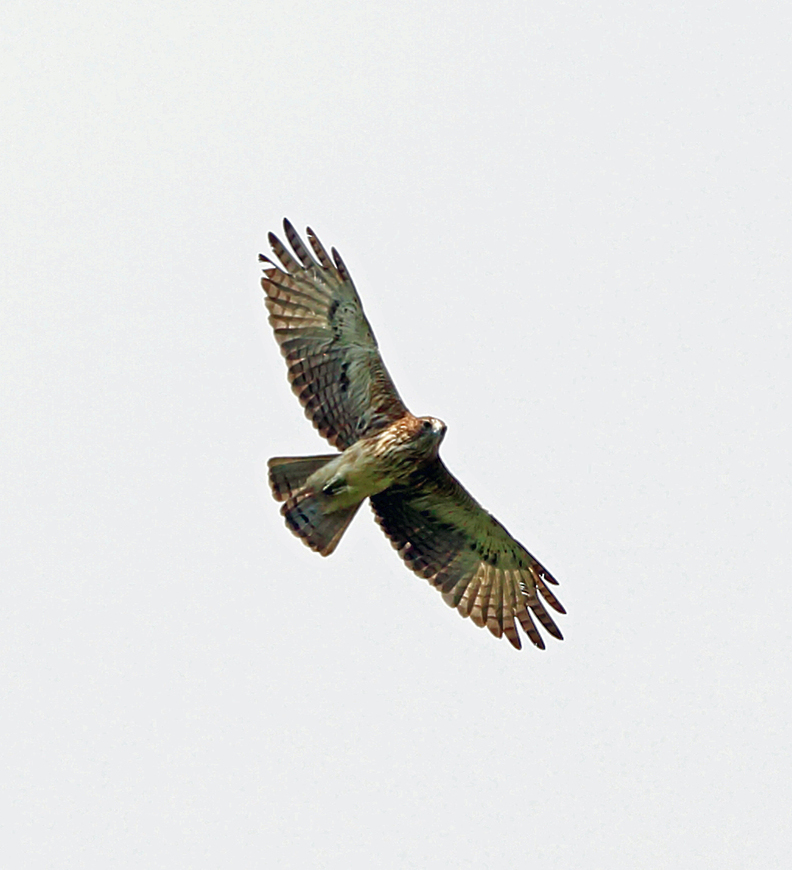
| Appearance | - The Little Eagle occurs in both light and dark colour forms. English Wikipedia
- The light colour form has a dark brown back and wings, black streaks on the head and neck, and a sandy to pale underbody. English Wikipedia
- The dark colour form generally has a darker brown or rich rufous head and underbody. English Wikipedia
- Females are larger and typically darker than males. English Wikipedia
- Juveniles tend to be more strongly rufous and have less contrasting plumage patterns than adults. English Wikipedia
- The Little Eagle has fully feathered legs and a square-cut, barred tail. English Wikipedia
- The species has a black-streaked head with a slight crest and a pale shoulder band on its upperwings. environment.nsw.gov.au
| |
|---|
| Size | | |
|---|
| Habitat | - The Little Eagle inhabits open woodland, grassland and arid regions, generally avoiding dense forest. English Wikipedia
- The species is associated with hillsides containing a mixture of wooded and open areas. English Wikipedia
- Its preferred habitats include riparian woodlands, forest margins and wooded farmland. English Wikipedia
- The Little Eagle occupies open eucalypt forest, woodland and open woodland where prey is abundant. environment.nsw.gov.au
- The species also uses sheoak, acacia and riparian woodlands in interior New South Wales. environment.nsw.gov.au
| - The species inhabits subtropical and tropical moist lowland forests. English Wikipedia
- The species also inhabits subtropical and tropical moist montane forests. English Wikipedia
- The species primarily occupies lowland forests and forest edges. English Wikipedia
- The species nests in closed forest but has also been observed in open habitats and at forest edges. English Wikipedia
- The species occurs in open forest, woodland, scrub and savanna, as well as above rainforest. datazone.birdlife.org
- The species has been recorded from sea level to 1,950 m elevation. datazone.birdlife.org
|
|---|
| Diet | - The Little Eagle eats birds, mammals and reptiles, occasionally supplementing its diet with large insects. English Wikipedia
- Rabbits became the Little Eagle's main dietary item following their introduction to Australia. English Wikipedia
- The Little Eagle's diet in northern Australia contains a high proportion of birds. English Wikipedia
- Lizards constitute most of the Little Eagle's diet in arid regions. English Wikipedia
- Juvenile rabbits constitute a high proportion of the Little Eagle's diet in southern Australia. English Wikipedia
- In the Australian Capital Territory, the Little Eagle eats mostly rabbits and, to a lesser extent, rosellas, magpie-larks and starlings. English Wikipedia
- The Little Eagle occasionally consumes carrion. environment.nsw.gov.au
| - The species attacks other birds, including brown cuckoo-doves and mountain fruit-doves. English Wikipedia
|
|---|
| Behaviour | - The Little Eagle searches for prey by soaring at altitudes of up to 500 m or by using elevated exposed perches. English Wikipedia
- The species captures prey by swooping onto animals on the ground and by hunting in trees and shrubs. English Wikipedia
- Little Eagles defend their nesting territories against intruders. English Wikipedia
- The species advertises its nesting territories through soaring and undulating flight displays, conspicuous perching and calling. English Wikipedia
- Individual Little Eagles may be partially migratory, dispersive or permanently resident. English Wikipedia
- Little Eagles tend to leave when humans first intrude. English Wikipedia
| - The species soars and dives onto prey in forest canopies. English Wikipedia
- The species makes very swift dives when attacking prey. English Wikipedia
- The species typically flies low over the canopy while scanning for prey before diving at other birds. English Wikipedia
- The species has a flight call described as a series of two short notes followed by a longer high-pitched note. English Wikipedia
- The species has also been observed producing a weaker single-tone squeal. English Wikipedia
|
|---|
| Reproduction | - Little Eagles may use different nests in successive breeding years, including nests originally built by other birds. English Wikipedia
- Each pair produces one or two eggs per breeding season, usually in late August or early September. English Wikipedia
- The incubation period lasts approximately 37 days. English Wikipedia
- Young Little Eagles fledge approximately eight weeks after hatching. English Wikipedia
- Little Eagles reach breeding maturity at two to three years of age. English Wikipedia
- The species builds large stick nests in winter and lays eggs in early spring. environment.nsw.gov.au
- Young Little Eagles fledge in early summer. environment.nsw.gov.au
| No checked fact yet |
|---|
| Lifespan | | No checked fact yet |
|---|
| Distribution | - The Little Eagle is endemic to Australia. English Wikipedia
- The species occurs across most of mainland Australia but is absent from the most densely forested parts of the Great Dividing Range. environment.nsw.gov.au
- The Little Eagle occurs as a single population throughout New South Wales. environment.nsw.gov.au
| |
|---|
| Conservation | - The Little Eagle was listed as vulnerable in New South Wales under the Threatened Species Conservation Act 1995. English Wikipedia
- The Little Eagle is classified as Least Concern on the IUCN Red List. English Wikipedia
- The Little Eagle's reporting rate declined by 39% in New South Wales and 14% nationally between the first and second national bird atlases. environment.nsw.gov.au
- Clearing and degradation of foraging and breeding habitats are considered the main threats to the Little Eagle. environment.nsw.gov.au
| No checked fact yet |
|---|
| Similar species | - The Whistling Kite is similar in appearance to the Little Eagle but has a longer, rounded and unbarred tail, lacks black head markings and has weaker bare legs. environment.nsw.gov.au
- The Square-tailed Kite is more slender than the Little Eagle and has a pale face, small bill and feet, short bare legs and longer, boldly banded wingtips. environment.nsw.gov.au
| No checked fact yet |
|---|