Species · Birds
Pygmy Eagle Hieraaetus weiskei
The scientific name of the Pygmy Eagle is Hieraaetus weiskei. It is a species of bird in the family Accipitridae (hawks), order Accipitriformes. The name dates from 1900.
- Scientific name
- Hieraaetus weiskei (Reichenow, 1900)
- Common name
- Pygmy Eagle
- Genus
- Hieraaetus
- Family
- Accipitridae (Hawks)
- Order
- Accipitriformes
- Class
- Aves
- Red List category
- LC Least Concern
- Recorded in
- 3 countries
- Name status
- accepted in the Catalogue of Life
Overview
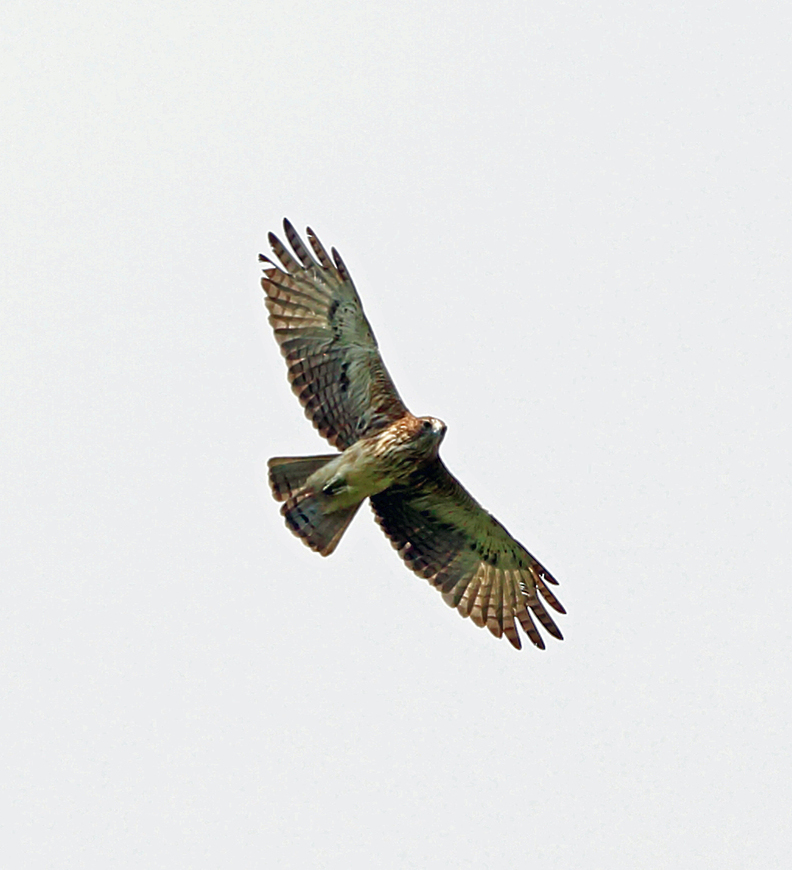
The Pygmy Eagle occurs in New Guinea and has also been observed on Buru and in the northern Moluccas. It occurs in light and dark plumage morphs and measures 38–48 cm in body length.
Written 26 November 2026 from the sources listed below. Each statement was checked against the passage it cites; statements that could not be supported were removed.
Appearance
The Pygmy Eagle has darker and more pronounced streaks on its nape, crown and underparts than the little eagle. It occurs in both light and dark plumage morphs, and the dark morph resembles the dark morph of the little eagle.[1][2][3]
Its feet are grey or dull yellow.[4]
Habitat
The Pygmy Eagle inhabits subtropical and tropical moist lowland forests and moist montane forests. It primarily occupies lowland forests and forest edges.[5][6][7]
It nests in closed forest but has also been observed in open habitats and at forest edges. It occurs in open forest, woodland, scrub and savanna, as well as above rainforest.[8][9]
The species has been recorded from sea level to 1,950 m elevation.[10]
Diet
The Pygmy Eagle attacks other birds, including brown cuckoo-doves and mountain fruit-doves.[11]
Behaviour
The Pygmy Eagle typically flies low over the canopy while scanning for prey, then dives onto prey in forest canopies. Its attacks involve very swift dives.[12][13][14]
Its flight call consists of two short notes followed by a longer high-pitched note. It has also been observed producing a weaker single-tone squeal.[15][16]
Classification of the Pygmy Eagle
| Kingdom | Animalia |
|---|---|
| Phylum | Chordata |
| Subphylum | Vertebrata |
| Infraphylum | Gnathostomata |
| Parvphylum | Osteichthyes |
| Megaclass | Tetrapoda |
| Class | Aves (Bird) |
| Order | Accipitriformes (Hawks) |
| Family | Accipitridae (Hawks) |
| Genus | Hieraaetus (Hawk-eagles) |
| Species | Hieraaetus weiskei (Reichenow, 1900) |
Where the Pygmy Eagle is found
Checklists and occurrence records place Hieraaetus weiskei in 3 countries across Asia and Oceania. GBIF holds 775 georeferenced records of it.
Countries
Regions and cities with the most records
- Central Province, Papua New Guinea 109
- Western Province, Papua New Guinea 69
- Papua, Indonesia 46
- Western Highlands Province, Papua New Guinea 38
- Maluku, Indonesia 35
- Enga Province, Papua New Guinea 24
- Morobe Province, Papua New Guinea 23
- Mount Hagen, Papua New Guinea 17
- Hela Province, Papua New Guinea 16
- Chimbu Province, Papua New Guinea 15
- Abepura, Indonesia 13
- Sentani, Indonesia 12
- Madang Province, Papua New Guinea 11
- Sofifi, Indonesia 9
- Sorong, Indonesia 8
- Oro Province, Papua New Guinea 7
- Bulolo, Papua New Guinea 5
- East Sepik Province, Papua New Guinea 5
- Eastern Highlands Province, Papua New Guinea 4
- Gulf Province, Papua New Guinea 4
- Madang, Papua New Guinea 4
- Ternate, Indonesia 4
- Fakfak, Indonesia 3
- Lae, Papua New Guinea 3
- Wamena, Indonesia 3
Range as the checklists state it
Southern Asia
Australia
A number beside a place is its count of GBIF occurrence records. A place without a number comes from a checklist alone. Records show where a species has been observed or collected, which can include escapes and vagrants.
Common names
English
- Pygmy Eagle
- New Guinea Hawk-Eagle
Names in 24 other languages
- Catalan
- àguila de Weiske
- Chinese
- 侏隼雕, 新幾內亞小鵰
- Croatian
- papuanski orao
- Czech
- orel novoguinejský
- Danish
- Ny Guinea-dværgørn
- Dutch
- Papoeadwergarend
- Esperanto
- pigmea aglo
- Finnish
- uudenguineanpikkukotka
- French
- Aigle de Weiske
- German
- Neuguinea-Habichtsadler, Papuazwergadler
- Japanese
- コビトクマタカ
- Korean
- 피그미수리
- Lithuanian
- Naujosios Gvinėjos sakalinis erelis
- Norwegian
- pygméørn
- Norwegian Bokmål
- pygmeørn
- Polish
- orzełek nowogwinejski
- Portuguese
- águia-anã
- Russian
- Новогвинейский орёл-карлик
- Serbian
- Pigmejski orao
- Slovak
- orol novoguinejský
- Spanish
- Aguililla Papúa, Águila papú, Águila papúa
- Swedish
- pygméörn
- Turkish
- Yeni Gine Küçük Kartalı
- Ukrainian
- орел-карлик новогвінейський
Synonyms
3 other scientific names have been used for this species and are now treated as synonyms of Hieraaetus weiskei.
- Aquila morphnoides weiskei Reichenow, A, 1900
- Eutolmaetus weiskei Reichenow, 1900
- Hieraaetus morphnoides weiskei Reichenow, A, 1900
Related species
-
 Booted EagleHieraaetus pennatus
-
 Little EagleHieraaetus morphnoides
-
 Wahlberg's EagleHieraaetus wahlbergi
-
 Ayres's Hawk-eagleHieraaetus ayresii
-
 Bald EagleHaliaeetus leucocephalus
-
 Golden EagleAquila chrysaetos
-
 Haast's EagleHarpagornis moorei
-
 Harpy EagleHarpia harpyja
Compare
Questions and answers
What is the scientific name of the Pygmy Eagle?
The scientific name of the Pygmy Eagle is Hieraaetus weiskei. Written with its author, the full name is Hieraaetus weiskei (Reichenow, 1900).
Which family does the Pygmy Eagle belong to?
Hieraaetus weiskei belongs to the family Accipitridae, in the order Accipitriformes and the class Aves.
Where is the Pygmy Eagle found?
Checklists and occurrence records place Hieraaetus weiskei in 3 countries: Indonesia, Papua New Guinea and Australia.
What is the conservation status of the Pygmy Eagle?
The IUCN Red List category recorded for Hieraaetus weiskei is Least Concern (LC).
What other names does the Pygmy Eagle have?
Hieraaetus weiskei is also known in English as New Guinea Hawk-Eagle.
What do eagles eat in a rainforest?
The Pygmy Eagle attacks other birds, including brown cuckoo-doves and mountain fruit-doves.[11]
What is the smallest eagle species?
The Pygmy Eagle is among the smallest known eagles worldwide.[17]
Sources
Passages the profile rests on
- The species has darker and more pronounced streaks on its nape, crown and underparts than the little eagle. Source passage: “The pygmy eagle has darker more pronounced streaks on the nape, crown and ventral.” — English Wikipedia
- The species occurs in both light and dark plumage morphs. Source passage: “The plumage of the pygmy eagle can vary depending on the morph, light or dark.” — English Wikipedia
- The dark plumage morph resembles the dark morph of the little eagle. Source passage: “The dark morph is very similar to the dark morph of the little eagle” — English Wikipedia
- The feet are grey or dull yellow. Source passage: “The feet of the eagle are described as grey or dull yellow.” — English Wikipedia
- The species inhabits subtropical and tropical moist lowland forests. Source passage: “Its natural habitats are primarily subtropical or tropical moist lowland forest” — English Wikipedia
- The species also inhabits subtropical and tropical moist montane forests. Source passage: “and subtropical or tropical moist montane forest.” — English Wikipedia
- The species primarily occupies lowland forests and forest edges. Source passage: “The pygmy eagle primarily resides in lowland forests and forest edges in New Guinea.” — English Wikipedia
- The species nests in closed forest but has also been observed in open habitats and at forest edges. Source passage: “They enjoy nesting in closed forestry but have also been seen in open habitat and forest edges.” — English Wikipedia
- The species occurs in open forest, woodland, scrub and savanna, as well as above rainforest. Source passage: “The species occurs in open forest, woodland, scrub and savanna, and over rainforest” — datazone.birdlife.org
- The species has been recorded from sea level to 1,950 m elevation. Source passage: “from sea-level to 1950 m (Thiollay 1994).” — datazone.birdlife.org
- The species attacks other birds, including brown cuckoo-doves and mountain fruit-doves. Source passage: “attacks other avians such as the brown cuckoo-dove and mountain fruit-dove.” — English Wikipedia
- The species soars and dives onto prey in forest canopies. Source passage: “Pygmy eagles have been seen soaring and diving on prey in forest canopies.” — English Wikipedia
- The species makes very swift dives when attacking prey. Source passage: “The raptor is capable of very swift dives” — English Wikipedia
- The species typically flies low over the canopy while scanning for prey before diving at other birds. Source passage: “Usually, the raptor low soars over the canopy scanning for prey and then dives on other birds in the canopy.” — English Wikipedia
- The species has a flight call described as a series of two short notes followed by a longer high-pitched note. Source passage: “The voice of the pygmy eagle has been described as a "sip sip yeeee" during flights.” — English Wikipedia
- The species has also been observed producing a weaker single-tone squeal. Source passage: “The bird has also been observed giving a weaker single tone squeal.” — English Wikipedia
- The species is among the smallest known eagles worldwide. Source passage: “The pygmy eagle is one of the world's smallest-known species of eagle” — English Wikipedia
Data
- Catalogue of Life, 2026-10-16 XR cc by
- Global Biodiversity Information Facility CC BY 4.0
- Wikidata CC0
- GeoNames CC BY 4.0
- Wikimedia Commons per image; credit shown with each image
- Within the Catalogue of Life, this name comes from The Integrated Taxonomic Information System cc0
This species in other databases
Page built on 28 November 2026. See how the catalog is made and all sources and licences.
Cite this page
ScientificNames.org. (2026). Hieraaetus weiskei (Pygmy Eagle). Retrieved November 28, 2026, from https://scientificnames.org/species/hieraaetus-weiskei
“Hieraaetus weiskei (Pygmy Eagle).” ScientificNames.org, 2026, scientificnames.org/species/hieraaetus-weiskei. Accessed 28 Nov. 2026.
ScientificNames.org. “Hieraaetus weiskei (Pygmy Eagle).” Accessed November 28, 2026. https://scientificnames.org/species/hieraaetus-weiskei.
@misc{scientificnames_hieraaetus_weiskei_pygmy_eagle,
  author = {{ScientificNames.org}},
  title = {Hieraaetus weiskei (Pygmy Eagle)},
  year = {2026},
  url = {https://scientificnames.org/species/hieraaetus-weiskei},
  note = {Accessed 2026-11-28}
}