Comparison

Little Flying Squid vs Humboldt Squid

Little Flying Squid (Todarodes pusillus) and Humboldt Squid (Dosidicus gigas) both belong to the family Ommastrephidae (flying squids) and part ways below it.

Little Flying Squid

Todarodes pusillus
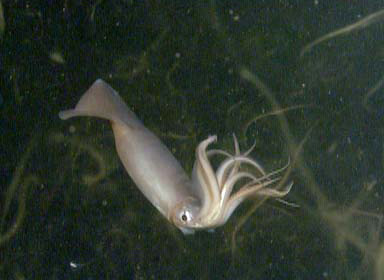
Humboldt Squid

Humboldt Squid

Dosidicus gigas

Image courtesy of NOAA/MBARI 2006, Public domain, via Wikimedia Commons

Side by side

Little Flying SquidHumboldt Squid
Scientific nameTodarodes pusillus Dunning, 1988Dosidicus gigas (A. d'Orbigny, 1835)
English nameLittle Flying SquidHumboldt Squid
GroupMolluscsMolluscs
ClassCephalopoda CephalopodCephalopoda Cephalopod
OrderOegopsidaOegopsida
FamilyOmmastrephidae Flying SquidsOmmastrephidae Flying Squids
GenusTodarodesDosidicus
Named in19881835
Red List categoryNot recordedData Deficient
Environmentmarinemarine
Countries on record1 country5 countries
GBIF occurrence records17 records89,997 records

Rows where the two agree are shown in grey.

Where each is found

Only Little Flying Squid (1)

Only Humboldt Squid (5)

From Catalogue of Life checklists and GBIF occurrence records. A country missing from a list means no record is held, which is not proof of absence.

Checked facts

Little Flying SquidHumboldt Squid
Appearance
  • The species has a cylindrical, muscular body that narrows toward a short, pointed tail. English Wikipedia
  • Its fins measure approximately 25–31% of its mantle length. English Wikipedia
  • The second and third arms on each side are longer than the first and fourth arms. English Wikipedia
  • The species can rapidly change its body coloration using chromatophores. English Wikipedia
  • The species can produce rapid red-and-white flashes across its entire body. English Wikipedia
Size
Habitat
  • The species occurs in continental shelf and upper continental slope regions of northern Australia. English Wikipedia
  • Recorded specimens have been collected at depths ranging from 78 to 357 m. English Wikipedia
  • The species has been recorded in waters where temperatures at 50 m depth exceed 23 °C. English Wikipedia
  • Surface water temperatures in its recorded habitat can reach 29 °C during summer. English Wikipedia
  • The species inhabits ocean depths ranging from approximately 200 to 700 metres. English Wikipedia
  • The species occupies depths exceeding 250 metres during the day and approaches the surface at night. animaldiversity.org
  • The species can tolerate low dissolved oxygen concentrations in deep water by reducing its oxygen consumption. animaldiversity.org
  • The species can inhabit hypoxic and anoxic ocean waters. pmc.ncbi.nlm.nih.gov
DietNo checked fact yet
  • The species feeds primarily on small fish, crustaceans, other cephalopods, and copepods. English Wikipedia
  • Juveniles consume copepods and pelagic shrimp before shifting toward fish and other cephalopods as they grow. animaldiversity.org
  • The species consumes very little anchovy off Peru despite the large biomass of this fish in the region. pmc.ncbi.nlm.nih.gov
  • The species sometimes consumes other individuals of its own species. English Wikipedia
Behaviour
  • The species is suggested to form schools based on a trawl catch containing up to 54 individuals. English Wikipedia
  • The species can travel in shoals containing as many as 1,200 individuals. English Wikipedia
  • The species can swim at speeds of up to 24 kilometres per hour. English Wikipedia
  • The species undertakes daily vertical migrations between deeper daytime waters and shallower nighttime waters. animaldiversity.org
  • The species can travel horizontally for up to 100 kilometres over three to four days. animaldiversity.org
  • The species has been observed participating in cooperative hunting. English Wikipedia
  • The species can use visual signals to interact with other individuals. animaldiversity.org
Reproduction
  • Females exceeding 60 mm mantle length have been recorded as sexually mature. English Wikipedia
  • Mature females exceeding 60 mm mantle length have eggs in their oviducts. English Wikipedia
  • All recorded males exceeding 50 mm mantle length have mature spermatophores. English Wikipedia
  • Females produce floating egg masses enclosed in a gelatinous protective layer. animaldiversity.org
  • A single egg mass can contain approximately 5,000 to 4.1 million eggs. English Wikipedia
  • Large females can produce egg masses measuring three to four metres in diameter. English Wikipedia
  • Embryonic development lasts approximately six to nine days before hatching. animaldiversity.org
  • Spawning is believed to occur throughout the year, with peaks between October and January in the Southern Hemisphere. animaldiversity.org
  • Females may produce between three and twenty egg masses during their reproductive cycle. animaldiversity.org
Distribution
  • The species occurs in waters around northern Australia. English Wikipedia
  • Its Australian distribution extends from the Timor Sea along the eastern coast to waters off Brisbane. English Wikipedia
  • Its recorded range extends northward from the Timor Sea through the Indonesian archipelago to Mindanao in the southern Philippines. English Wikipedia
ConservationNo checked fact yet
  • The Gulf of California fishery collapse associated with warming waters in 2015 had not recovered at the time described in the source. English Wikipedia
UsesNo checked fact yet
  • The species is commercially harvested for markets in Europe, Russia, China, Japan, Southeast Asia, and the Americas. English Wikipedia
  • The species is consumed in Chile in dishes including chupes and paila marina. English Wikipedia
  • The species is used to prepare ceviche in Peru. English Wikipedia
Other
  • The species was previously considered a subspecies of the Japanese flying squid. English Wikipedia
  • Further morphological and molecular analyses are required to clarify its relationship with the Japanese flying squid. English Wikipedia
  • Specimens from Hong Kong, Taiwan and the Philippines have been described as intermediate in some characteristics between the nominate form and this species. English Wikipedia
  • The species' relatively small size and rapid sexual maturation may be associated with living at higher temperatures than its related temperate form. English Wikipedia
  • The species is the most important squid worldwide in commercial fisheries. English Wikipedia

In brief

Little Flying Squid

Todarodes pusillus occurs in waters around northern Australia, extending from the Timor Sea through the Indonesian archipelago to Mindanao in the southern Philippines. Full profile

Humboldt Squid

Dosidicus gigas occurs in the eastern Pacific Ocean from northern California to southern Chile and inhabits ocean depths ranging from approximately 200 to 700 metres. It is distinguished by its ability to rapidly change its body coloration and produce red-and-white flashes across its entire body. Full profile

Compare something else

Page built on 29 November 2026 from the data on the two species pages, where every source is listed.

Cite this page

ScientificNames.org. (2026). Little Flying Squid vs Humboldt Squid. Retrieved November 29, 2026, from https://scientificnames.org/compare/little-flying-squid-vs-humboldt-squid