Comparison

Long-billed Murrelet vs Razorbill

Long-billed Murrelet (Brachyramphus perdix) and Razorbill (Alca torda) both belong to the family Alcidae (auk) and part ways below it. Both are recorded in 4 countries.
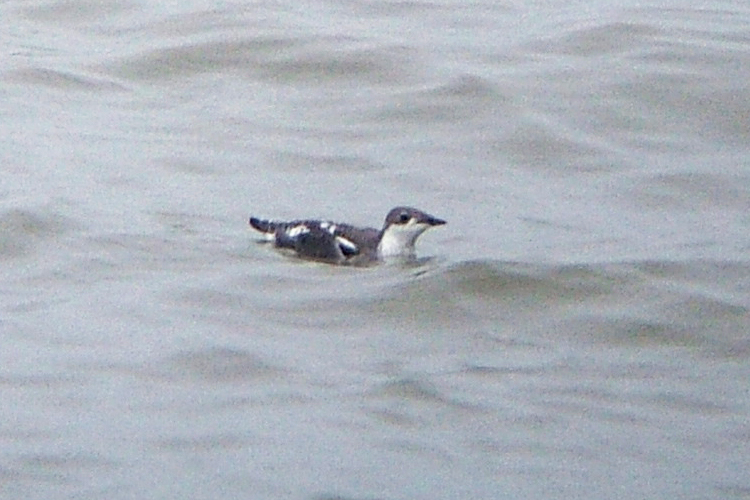
Long-billed Murrelet

Long-billed Murrelet

Brachyramphus perdix

MPF, CC BY 2.5, via Wikimedia Commons

Razorbill

Razorbill

Alca torda

neekoh.fi, CC BY 2.0, via Wikimedia Commons

Side by side

Long-billed MurreletRazorbill
Scientific nameBrachyramphus perdix (Pallas, 1811)Alca torda Linnaeus, 1758
English nameLong-billed MurreletRazorbill
GroupBirdsBirds
ClassAves BirdAves Bird
OrderCharadriiformes AuksCharadriiformes Auks
FamilyAlcidae AukAlcidae Auk
GenusBrachyramphus Marbled MurreletsAlca Razorbills
Named in18111758
Red List categoryNear ThreatenedLeast Concern
Environmentmarine, terrestrialmarine, terrestrial
Countries on record7 countries34 countries
GBIF occurrence records770 records718,234 records

Rows where the two agree are shown in grey.

Where each is found

Both recorded in 4 countries

Only Long-billed Murrelet (3)

Only Razorbill (30)

From Catalogue of Life checklists and GBIF occurrence records. A country missing from a list means no record is held, which is not proof of absence.

Checked facts

Long-billed MurreletRazorbill
Appearance
  • The Long-billed Murrelet has a chunky body and a slender black bill. English Wikipedia
  • The species has pointed wings and seasonal variations in its plumage. English Wikipedia
  • In non-breeding plumage, the bird is typically white underneath, with a black crown, nape, wings and back. English Wikipedia
  • During the breeding season, its plumage is predominantly brown, with pale feather edges creating a scaly appearance. English Wikipedia
  • The central underparts of breeding birds are white. English Wikipedia
  • The species has a white eye ring. English Wikipedia
  • Breeding individuals have a pale throat that is absent in the Marbled Murrelet. English Wikipedia
  • Its breeding plumage has weaker scaling than that of the Marbled Murrelet. English Wikipedia
  • In winter plumage, the species lacks the white collar found on the Marbled Murrelet. English Wikipedia
  • The Razorbill has predominantly black upperparts and a white underside. English Wikipedia
  • During the breeding season, the Razorbill has a black head, neck, back and feet, with a white belly. English Wikipedia
  • During the breeding season, a thin white line extends from the Razorbill's eyes to the end of its bill. English Wikipedia
  • Outside the breeding season, the Razorbill develops white coloration on its throat and the facial area behind the eye. English Wikipedia
  • The Razorbill has a black, deep, laterally compressed bill with a blunt tip. English Wikipedia
  • The Razorbill's bill has several vertical grooves near its curved tip. English Wikipedia
  • The Razorbill has a comparatively long tail, with the central tail feathers slightly longer during incubation. English Wikipedia
  • The feet of the Razorbill do not extend beyond its tail during flight. English Wikipedia
Size
  • The Long-billed Murrelet is approximately 20% heavier than the Marbled Murrelet. English Wikipedia
Habitat
  • The Razorbill inhabits subarctic and boreal waters of the Atlantic. English Wikipedia
  • Razorbills breed on islands, rocky shores and coastal cliffs in the northern Atlantic. English Wikipedia
  • Razorbills commonly enter large estuaries with relatively low salinity to feed. English Wikipedia
  • Razorbills thrive in waters with surface temperatures below 15 °C. English Wikipedia
  • Razorbills nest in crevices among coastal cliffs and boulders. English Wikipedia
Diet
  • The Razorbill feeds primarily on schooling fish living in mid-water. English Wikipedia
  • The Razorbill's documented fish prey include capelin, sandeels, juvenile cod, sprats and herring. English Wikipedia
  • The Razorbill also consumes crustaceans and polychaetes. English Wikipedia
Behaviour
  • The Razorbill is capable of both flying and diving. English Wikipedia
  • The Razorbill has a predominantly aquatic lifestyle and visits land primarily for breeding. English Wikipedia
  • Razorbills use semi-folded wings and streamlined bodies to propel themselves underwater. English Wikipedia
  • Most Razorbill feeding activity occurs at approximately 25 m depth, although individuals can dive to 120 m. English Wikipedia
  • Razorbills spend approximately 44% of their time foraging at sea. English Wikipedia
  • Razorbills may travel more than 100 km offshore to forage during egg incubation. English Wikipedia
Reproduction
  • The female lays a single egg on a thick branch or in a hollow covered with lichen or moss. English Wikipedia
  • The Long-billed Murrelet incubates its egg for approximately one month. English Wikipedia
  • The chick is fed for approximately 40 days before fledging. English Wikipedia
  • After fledging, the chick flies to the sea without an accompanying adult. English Wikipedia
  • The Razorbill is monogamous and maintains the same partner throughout life. English Wikipedia
  • Razorbills generally begin breeding between three and five years of age. English Wikipedia
  • Female Razorbills usually lay one egg annually between late April and May. English Wikipedia
  • Razorbill eggs are ovoid-pyramidal and range in coloration from creamy white to pale brown with dark brown blotches. English Wikipedia
  • Both parents incubate the Razorbill egg for approximately 35 days. English Wikipedia
  • Razorbill chicks leave their nest approximately 17–23 days after hatching. English Wikipedia
Distribution
  • The species breeds in Japan, across the Sea of Okhotsk region, and on the Kamchatka Peninsula in Russia. datazone.birdlife.org
  • Most individuals winter in seas around northern Japan. English Wikipedia
Conservation
  • The Long-billed Murrelet is considered globally threatened. English Wikipedia
  • The species has declined across its range over recent decades. English Wikipedia
  • Logging-related loss of old-growth forest is identified as the greatest threat to the species. English Wikipedia
  • The species can also be lost through entanglement in fishing gear. English Wikipedia
  • Oil development on the Okhotsk and Bering Sea shelves is identified as a potential threat. English Wikipedia
  • The Razorbill population is classified by the IUCN as fluctuating. English Wikipedia
  • The global Razorbill population declined between 2015 and 2021. English Wikipedia
  • The estimated global population of mature Razorbills ranges from 838,000 to 1,600,000 individuals. English Wikipedia
  • Major threats to the Razorbill include destruction of breeding sites, oil spills and deterioration of food quality. English Wikipedia
  • Commercial fishing threatens Razorbills through accidental entanglement in fishing nets. English Wikipedia
  • Overfishing threatens Razorbills by reducing the availability of their prey. English Wikipedia
  • The Razorbill received protection in the United States under the Migratory Bird Treaty Act in 1918. English Wikipedia
UsesNo checked fact yet
  • Razorbills were historically harvested for their eggs, meat and feathers. English Wikipedia
Similar species
  • The Long-billed Murrelet closely resembles the Marbled Murrelet. English Wikipedia
  • The Long-billed Murrelet was classified as a subspecies of the Marbled Murrelet until 1998. English Wikipedia
No checked fact yet

In brief

Long-billed Murrelet

The Long-billed Murrelet breeds in Japan, across the Sea of Okhotsk region and on the Kamchatka Peninsula in Russia, and most individuals winter in seas around northern Japan. It closely resembles the Marbled Murrelet but has a pale throat in breeding plumage, which is absent in the Marbled Murrelet. Full profile

Razorbill

Alca torda is distributed throughout the North Atlantic and inhabits subarctic and boreal waters of the Atlantic. It has predominantly black upperparts, a white underside and a deep, laterally compressed bill with a blunt tip. Full profile

Compare something else

Page built on 29 November 2026 from the data on the two species pages, where every source is listed.

Cite this page

ScientificNames.org. (2026). Long-billed Murrelet vs Razorbill. Retrieved November 29, 2026, from https://scientificnames.org/compare/long-billed-murrelet-vs-razorbill