Comparison

Long-wattled Umbrellabird vs White Bellbird

Long-wattled Umbrellabird (Cephalopterus penduliger) and White Bellbird (Procnias albus) both belong to the family Cotingidae (contingas) and part ways below it.
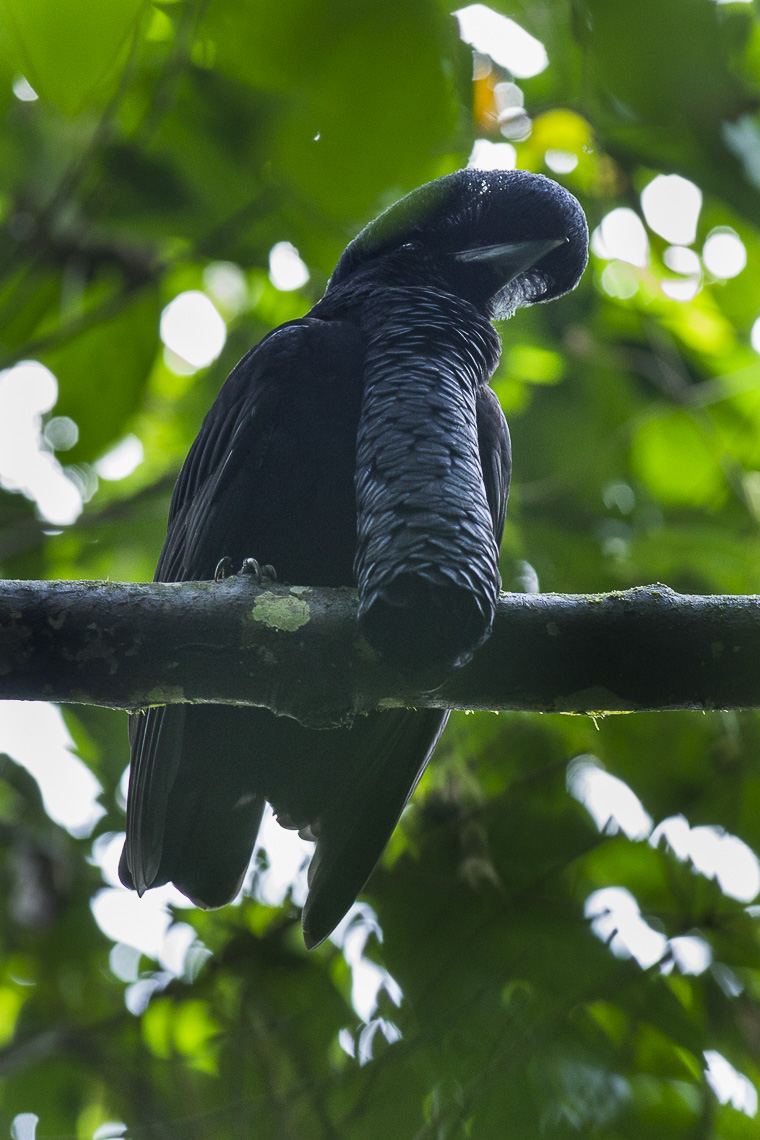
Long-wattled Umbrellabird

Long-wattled Umbrellabird

Cephalopterus penduliger

Francesco Veronesi from Italy, CC BY-SA 2.0, via Wikimedia Commons

White Bellbird

White Bellbird

Procnias albus

Hector Bottai from São Paulo, Brasil, CC BY-SA 2.0, via Wikimedia Commons

Side by side

Long-wattled UmbrellabirdWhite Bellbird
Scientific nameCephalopterus penduliger P. L. Sclater, 1859Procnias albus (Hermann, 1783)
English nameLong-wattled UmbrellabirdWhite Bellbird
GroupBirdsBirds
ClassAves BirdAves Bird
OrderPasseriformes PasserinePasseriformes Passerine
FamilyCotingidae ContingasCotingidae Contingas
GenusCephalopterus UmbrellabirdProcnias Neotropical Bellbird
Named in18591783
Red List categoryVulnerableLeast Concern
Countries on record2 countries5 countries
GBIF occurrence records3,989 records1,655 records

Rows where the two agree are shown in grey.

Where each is found

Only Long-wattled Umbrellabird (2)

Only White Bellbird (5)

From Catalogue of Life checklists and GBIF occurrence records. A country missing from a list means no record is held, which is not proof of absence.

Checked facts

Long-wattled UmbrellabirdWhite Bellbird
Appearance
  • Adult males of the nominate subspecies have entirely white plumage and a single black wattle extending from the base of the upper mandible. English Wikipedia
  • Adult females have olive-green heads and upperparts, olive-green wings and tails, and yellow underparts with olive streaks. English Wikipedia
  • Females lack the wattle present in adult males. English Wikipedia
  • Both sexes have blackish irises, black bills with pale cutting edges, and dark gray legs and feet. English Wikipedia
  • Immature birds resemble females in appearance. English Wikipedia
  • The subspecies Procnias albus wallacei has a slightly gray-tinged throat. English Wikipedia
  • The subspecies Procnias albus wallacei has a longer and thinner bill than the nominate subspecies. English Wikipedia
Size
Habitat
  • The species inhabits humid to wet premontane and cloud forests. English Wikipedia
  • The species inhabits humid montane forests at elevations of 1,500–1,800 m above sea level. English Wikipedia
  • The white bellbird inhabits humid forests, primarily in lowland areas. English Wikipedia
  • In Venezuela, the species also inhabits the slopes of tepuis. English Wikipedia
  • In Venezuela, the species occurs at elevations between 450 and 1,100 m. English Wikipedia
  • In Brazil, the species occurs from near sea level to approximately 1,250 m elevation. English Wikipedia
Diet
  • The white bellbird apparently feeds exclusively on fruit. English Wikipedia
  • The white bellbird swallows fruit whole and subsequently regurgitates the seeds. English Wikipedia
Behaviour
  • The species can control the length of its throat wattle. English Wikipedia
  • The throat wattle can be retracted during flight. English Wikipedia
  • The species uses lek mating, with males gathering in shared display areas visited by solitary females. English Wikipedia
  • Females select males displaying prominent secondary traits, including aggression and territorial behaviour. English Wikipedia
  • The white bellbird sometimes plucks fruit while perched but more frequently catches it during flights launched from a perch. English Wikipedia
  • The white bellbird appears to be partially migratory. English Wikipedia
  • The nominate subspecies makes some elevational movements between breeding and non-breeding seasons. English Wikipedia
  • The species occasionally wanders beyond its core geographical range. English Wikipedia
  • The white bellbird is believed to be the world's loudest bird, with calls reaching 125 dB(A) at an equivalent distance of one metre. English Wikipedia
  • The species has two principal vocalizations, including a loud call resembling two sharp blows on a cracked bell. English Wikipedia
  • The white bellbird also produces a musical, droning vocalization. English Wikipedia
  • Male white bellbirds perform displays from treetops. English Wikipedia
  • During calling displays, males hold a horizontal posture and inflate their wattles. English Wikipedia
Reproduction
  • The breeding season of the white bellbird appears to extend from February through June. English Wikipedia
  • The nesting behaviour of the white bellbird has not been clearly established. English Wikipedia
  • One source reports that the species builds a sparse nest on open branches. English Wikipedia
  • The reported clutch size is one or two eggs. English Wikipedia
Distribution
  • The white bellbird occurs in Brazil, French Guiana, Guyana, Suriname, and Venezuela, and has been recorded as a vagrant in Trinidad. English Wikipedia
Conservation
  • The species is classified as vulnerable by the IUCN. English Wikipedia
  • The estimated population in 2023 was 7,500–15,000 mature individuals. English Wikipedia
  • Habitat destruction through deforestation is identified as a pressure on the species. English Wikipedia
  • The species is particularly susceptible to trapping because its lek mating areas are easy to locate. English Wikipedia
  • The species occurs in several protected areas. English Wikipedia
  • Consolidating existing scattered reserves is identified as potentially beneficial to the species. English Wikipedia
  • Managing forest composition and undertaking reforestation are identified as important conservation approaches. English Wikipedia
  • The white bellbird is classified as Least Concern by the IUCN. English Wikipedia
  • The population size of the white bellbird is unknown and is believed to be decreasing. English Wikipedia
  • No immediate threats to the white bellbird have been identified. English Wikipedia
  • The species is considered uncommon and thinly distributed overall, although it can be locally common when singing. English Wikipedia
Similar speciesNo checked fact yet
Name origin
  • The specific epithet penduliger derives from the Latin word pendulus, meaning hanging, and refers to the bird's wattle. English Wikipedia
No checked fact yet
Other

In brief

Long-wattled Umbrellabird

Cephalopterus penduliger inhabits humid to wet premontane and cloud forests, as well as humid montane forests at elevations of 1,500–1,800 m above sea level. Males are distinguished by a prominent feathered throat wattle that can be retracted during flight. Full profile

White Bellbird

The White Bellbird (Procnias albus) is a bird in the family Cotingidae, order Passeriformes, class Aves. It occurs in Brazil, French Guiana, Guyana, Suriname, and Venezuela, and has been recorded as a vagrant in Trinidad. Adult males of the nominate subspecies have entirely white plumage and a single black wattle extending from the base of the upper mandible. Full profile

Compare something else

Page built on 28 November 2026 from the data on the two species pages, where every source is listed.

Cite this page

ScientificNames.org. (2026). Long-wattled Umbrellabird vs White Bellbird. Retrieved November 28, 2026, from https://scientificnames.org/compare/long-wattled-umbrellabird-vs-white-bellbird