Species · Birds
White Bellbird Procnias albus
The scientific name of the White Bellbird is Procnias albus. It is a species of bird in the family Cotingidae (contingas), order Passeriformes. The name dates from 1783.
- Scientific name
- Procnias albus (Hermann, 1783)
- Common name
- White Bellbird
- Genus
- Procnias
- Family
- Cotingidae (Contingas)
- Order
- Passeriformes
- Class
- Aves
- Red List category
- LC Least Concern
- Recorded in
- 5 countries
- Name status
- accepted in the Catalogue of Life

Overview
The White Bellbird (Procnias albus) is a bird in the family Cotingidae, order Passeriformes, class Aves. It occurs in Brazil, French Guiana, Guyana, Suriname, and Venezuela, and has been recorded as a vagrant in Trinidad. Adult males of the nominate subspecies have entirely white plumage and a single black wattle extending from the base of the upper mandible.
Written 26 November 2026 from the sources listed below. Each statement was checked against the passage it cites; statements that could not be supported were removed.
Appearance
Adult males of the nominate subspecies have entirely white plumage and a single black wattle extending from the base of the upper mandible. Adult females have olive-green heads, upperparts, wings, and tails, with yellow underparts marked by olive streaks.[1][2]
Females lack the wattle present in adult males. Immature birds resemble females in appearance.[3][4]
Both sexes have blackish irises, black bills with pale cutting edges, and dark gray legs and feet. The subspecies Procnias albus wallacei has a slightly gray-tinged throat and a longer, thinner bill than the nominate subspecies.[5][6][7]
The White Bellbird measures approximately 27–29 cm in length. Adult males weigh approximately 210–222 g.[8][9]
Habitat
The White Bellbird inhabits humid forests, primarily in lowland areas. In Venezuela, it also inhabits the slopes of tepuis and occurs at elevations between 450 and 1,100 m.[10][11][12]
In Brazil, the species occurs from near sea level to approximately 1,250 m elevation.[13]
Diet
The White Bellbird apparently feeds exclusively on fruit. It swallows fruit whole and subsequently regurgitates the seeds.[14][15]
It sometimes plucks fruit while perched but more frequently catches it during flights launched from a perch.[16]
Behaviour
The White Bellbird appears to be partially migratory. The nominate subspecies makes some elevational movements between breeding and non-breeding seasons, and the species occasionally wanders beyond its core geographical range.[17][18][19]
The White Bellbird is believed to be the world's loudest bird, with calls reaching 125 dB(A) at an equivalent distance of one metre. One of its two principal vocalizations resembles two sharp blows on a cracked bell.[20][21]
The species also produces a musical, droning vocalization. Male White Bellbirds perform displays from treetops, holding a horizontal posture and inflating their wattles during calling displays.[22][23][24]
Reproduction and life cycle
The breeding season of the White Bellbird appears to extend from February through June. Its nesting behaviour has not been clearly established.[25][26]
One source reports that the species builds a sparse nest on open branches. The reported clutch size is one or two eggs.[27][28]
Conservation
The White Bellbird is classified as Least Concern by the IUCN. Its population size is unknown and is believed to be decreasing.[29][30]
No immediate threats to the species have been identified. It is considered uncommon and thinly distributed overall, although it can be locally common when singing.[31][32]
Similar species
Female White Bellbirds resemble female bearded bellbirds. The White Bellbird and the three-wattled bellbird are sister species.[33][34]
Classification of the White Bellbird
| Kingdom | Animalia |
|---|---|
| Phylum | Chordata |
| Subphylum | Vertebrata |
| Infraphylum | Gnathostomata |
| Parvphylum | Osteichthyes |
| Megaclass | Tetrapoda |
| Class | Aves (Bird) |
| Order | Passeriformes (Passerine) |
| Family | Cotingidae (Contingas) |
| Genus | Procnias (Neotropical Bellbird) |
| Species | Procnias albus (Hermann, 1783) |
Where the White Bellbird is found
Checklists and occurrence records place Procnias albus in 5 countries across South America. GBIF holds 1,655 georeferenced records of it.
Countries
Regions and cities with the most records
- Bolívar, Venezuela 672
- Pará, Brazil 359
- Potaro-Siparuni, Guyana 103
- Roraima, Brazil 100
- Upper Takutu-Upper Essequibo, Guyana 84
- Parauapebas, Brazil 64
- Sipaliwini District, Suriname 54
- Brokopondo District, Suriname 30
- Cuyuni-Mazaruni, Guyana 15
- Santa Elena de Uairén, Venezuela 15
- Pacaraima, Brazil 12
- Barima-Waini, Guyana 6
- Amazonas, Venezuela 4
- Delta Amacuro, Venezuela 3
- Kourou, French Guiana 3
- Rémire-Montjoly, French Guiana 3
- Upper Demerara-Berbice, Guyana 3
Range as the checklists state it
South America
A number beside a place is its count of GBIF occurrence records. A place without a number comes from a checklist alone. Records show where a species has been observed or collected, which can include escapes and vagrants.
Common names
English
- White Bellbird
Names in 28 other languages
- Arabic
- طائر الجرس الأبيض
- Catalan
- campaner blanc
- Chinese
- 白鐘雀, 白钟伞鸟
- Croatian
- brkata kotinga
- Czech
- zvonovec bílý
- Danish
- Hvid Klokkefugl
- Dutch
- Witte Klokvogel
- Esperanto
- blanka sonorilkotingo
- Estonian
- valge-kellalind
- Finnish
- valkoseppäkotinga
- French
- Araponga blanc
- Galician
- Campaneiro branco
- German
- Einlappenkotinga, Weißglöckner, Zapfenglöckner
- Hungarian
- csombókos harangozómadár
- Indonesian
- Burung lonceng
- Italian
- Campanaro bianco
- Japanese
- スズドリ
- Lithuanian
- baltasis varpininkas
- Norwegian
- pendelklokkefugl
- Polish
- dzwonnik biały
- Portuguese
- Araponga-da-amazônia, araponga-da-amazónia, ave-sino-branca
- Russian
- Одноусый звонарь
- Serbian
- Bela zvonarka
- Slovak
- zvonec cencúľový
- Spanish
- Campanero blanco
- Swedish
- vit klockkotinga
- Turkish
- Ak Çankuşu
- Ukrainian
- арапонга біла
Synonyms
5 other scientific names have been used for this species and are now treated as synonyms of Procnias albus.
- Ampelis alba Hermann, 1783
- Procnias alba (Hermann, 1783)
- Procnias alba BirdLife International (2004)
- Procnias alba Sibley & Monroe (1990, 1993)
- Procnias alba Stotz et al. (1996)
Subspecies and varieties
- Procnias albus albus subspecies
- Procnias albus wallacei subspecies
Related species
-
 Bare-throated BellbirdProcnias nudicollis
-
 Three-wattled BellbirdProcnias tricarunculatus
-
 Bearded BellbirdProcnias averano
-
 CapuchinbirdPerissocephalus tricolor
-
 Andean Cock-of-the-rockRupicola peruvianus
-
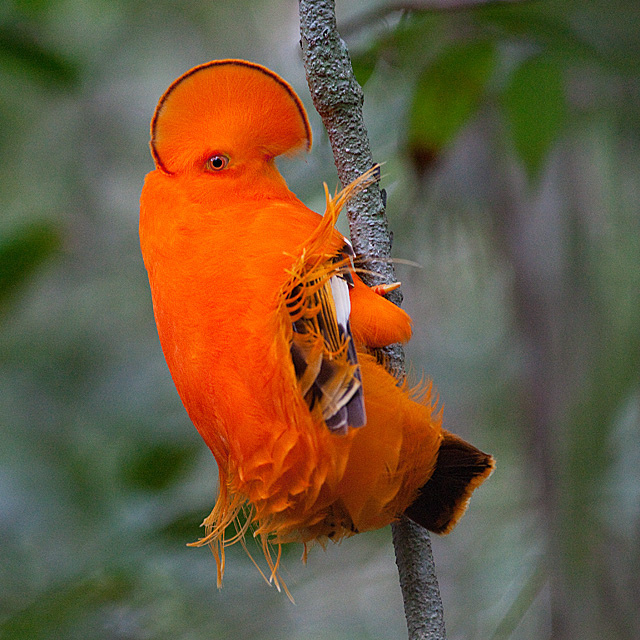 Guianan Cock-of-the-rockRupicola rupicola
-
 Screaming PihaLipaugus vociferans
-
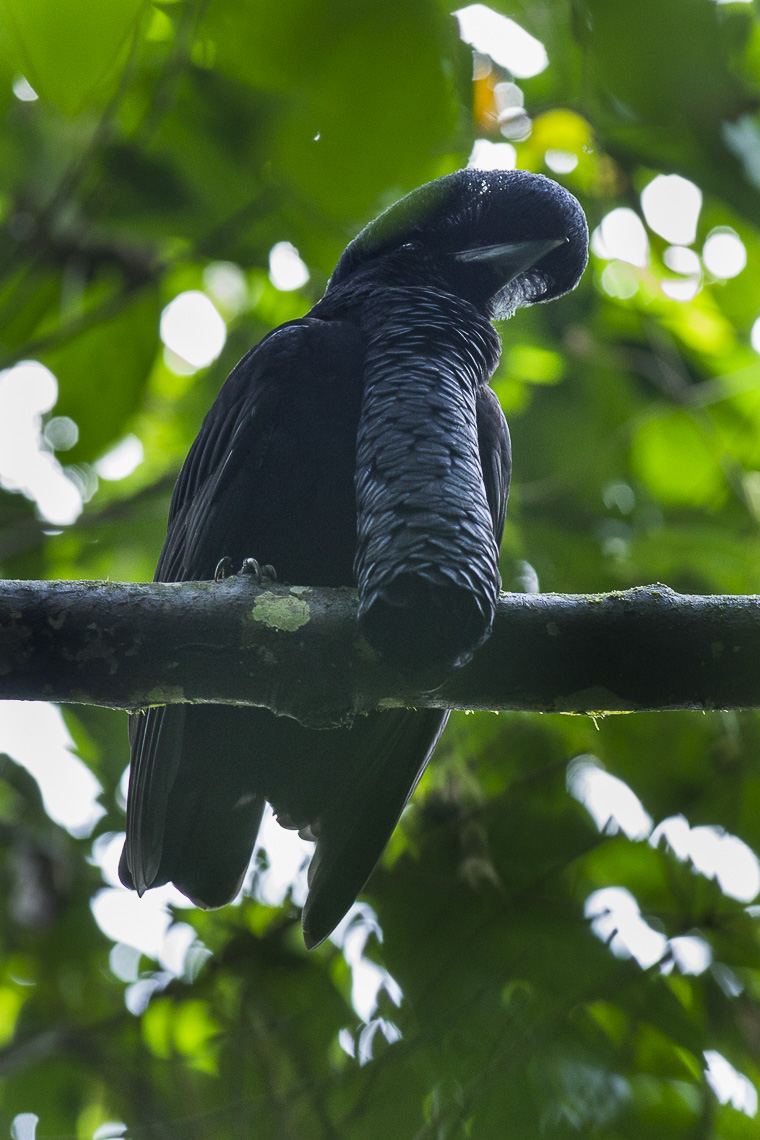 Long-wattled UmbrellabirdCephalopterus penduliger
Compare
Questions and answers
What is the scientific name of the White Bellbird?
The scientific name of the White Bellbird is Procnias albus. Written with its author, the full name is Procnias albus (Hermann, 1783).
Which family does the White Bellbird belong to?
Procnias albus belongs to the family Cotingidae, in the order Passeriformes and the class Aves.
Where is the White Bellbird found?
Checklists and occurrence records place Procnias albus in 5 countries: Venezuela, Brazil, Guyana, French Guiana and Suriname.
What is the conservation status of the White Bellbird?
The IUCN Red List category recorded for Procnias albus is Least Concern (LC).
Are white bellbirds rare?
The White Bellbird is considered uncommon and thinly distributed overall, although it can be locally common when singing. It is classified as Least Concern by the IUCN.[29][32]
What is the dangly thing on a white bellbird?
It is a black wattle extending from the base of the upper mandible. Adult males of the nominate subspecies have this wattle, while females lack it.[1][3]
Where is the white bell bird native to?
The White Bellbird occurs in Brazil, French Guiana, Guyana, Suriname, and Venezuela. It has also been recorded as a vagrant in Trinidad.[35]
Why are they called bellbirds?
One of their two principal vocalizations is a loud call resembling two sharp blows on a cracked bell.[21]
What do white bellbirds eat?
The White Bellbird apparently feeds exclusively on fruit. It swallows fruit whole and subsequently regurgitates the seeds.[14][15]
Where do white bellbirds live?
They inhabit humid forests, primarily in lowland areas. In Venezuela, they also inhabit the slopes of tepuis.[10][11]
Is the white bellbird the loudest bird?
The White Bellbird is believed to be the world's loudest bird, with calls reaching 125 dB(A) at an equivalent distance of one metre.[20]
Sources
Passages the profile rests on
- Adult males of the nominate subspecies have entirely white plumage and a single black wattle extending from the base of the upper mandible. Source passage: “Adult males of the nominate subspecies have entirely white plumage. They have a single black wattle with a few white feathers that drapes from the base of the maxilla.” — English Wikipedia
- Adult females have olive-green heads and upperparts, olive-green wings and tails, and yellow underparts with olive streaks. Source passage: “Adult females have an olive-green head and upperparts. Their wings and tail are also olive-green with somewhat duskier primaries and their coverts. Their underparts are yellow with olive streaks.” — English Wikipedia
- Females lack the wattle present in adult males. Source passage: “Females do not have a wattle.” — English Wikipedia
- Immature birds resemble females in appearance. Source passage: “Immature birds resemble females” — English Wikipedia
- Both sexes have blackish irises, black bills with pale cutting edges, and dark gray legs and feet. Source passage: “Both sexes have a blackish iris, a black bill with pale cutting edges, and dark gray legs and feet.” — English Wikipedia
- The subspecies Procnias albus wallacei has a slightly gray-tinged throat. Source passage: “its throat has a slight gray tinge.” — English Wikipedia
- The subspecies Procnias albus wallacei has a longer and thinner bill than the nominate subspecies. Source passage: “Subspecies P. a. wallacei has a longer and thinner bill than the nominate” — English Wikipedia
- The white bellbird measures approximately 27–29 cm in length. Source passage: “The white bellbird is about 27 to 29 cm (11 to 11 in) long” — English Wikipedia
- Adult males weigh approximately 210–222 g. Source passage: “males weigh 210 to 222 g (7.4 to 7.8 oz).” — English Wikipedia
- The white bellbird inhabits humid forests, primarily in lowland areas. Source passage: “The white bellbird inhabits humid forest, mostly in the lowlands” — English Wikipedia
- In Venezuela, the species also inhabits the slopes of tepuis. Source passage: “but also on the slopes of tepuis in Venezuela.” — English Wikipedia
- In Venezuela, the species occurs at elevations between 450 and 1,100 m. Source passage: “In elevation it ranges between 450 and 1,100 m (1,500 and 3,600 ft) in Venezuela” — English Wikipedia
- In Brazil, the species occurs from near sea level to approximately 1,250 m elevation. Source passage: “from near sea level to 1,250 m (4,100 ft) in Brazil.” — English Wikipedia
- The white bellbird apparently feeds exclusively on fruit. Source passage: “The white bellbird apparently feeds only on fruit.” — English Wikipedia
- The white bellbird swallows fruit whole and subsequently regurgitates the seeds. Source passage: “The fruit is swallowed whole and seeds are regurgitated.” — English Wikipedia
- The white bellbird sometimes plucks fruit while perched but more frequently catches it during flights launched from a perch. Source passage: “It sometimes plucks it while perched but more often during a sally from a perch.” — English Wikipedia
- The white bellbird appears to be partially migratory. Source passage: “The white bellbird appears to be partially migratory though details are poorly defined.” — English Wikipedia
- The nominate subspecies makes some elevational movements between breeding and non-breeding seasons. Source passage: “The nominate subspecies makes some elevational movements between the breeding and non-breeding seasons.” — English Wikipedia
- The species occasionally wanders beyond its core geographical range. Source passage: “The species also wanders, with isolated records outside its core range.” — English Wikipedia
- The white bellbird is believed to be the world's loudest bird, with calls reaching 125 dB(A) at an equivalent distance of one metre. Source passage: “The white bellbird is believed to be the world's loudest bird, with calls of up to 125 dB(A) (at equivalent 1m distance).” — English Wikipedia
- The species has two principal vocalizations, including a loud call resembling two sharp blows on a cracked bell. Source passage: “One is "a loud kong-kay like two sharp blows on a cracked bell, given with the head held immobile".” — English Wikipedia
- The white bellbird also produces a musical, droning vocalization. Source passage: “The species' second call is "a more musical, droning duaaaaaaaaa...deeeeeee, almost hypnotic".” — English Wikipedia
- Male white bellbirds perform displays from treetops. Source passage: “Male white bellbirds display from treetops.” — English Wikipedia
- During calling displays, males hold a horizontal posture and inflate their wattles. Source passage: “They call with a horizontal posture, with the wattle inflated” — English Wikipedia
- The breeding season of the white bellbird appears to extend from February through June. Source passage: “Its breeding season appears to span from February to June.” — English Wikipedia
- The nesting behaviour of the white bellbird has not been clearly established. Source passage: “The nesting behavior of the white bellbird is not well defined.” — English Wikipedia
- One source reports that the species builds a sparse nest on open branches. Source passage: “One source states that a sparse nest is built on open branches” — English Wikipedia
- The reported clutch size is one or two eggs. Source passage: “the clutch is one or two eggs.” — English Wikipedia
- The white bellbird is classified as Least Concern by the IUCN. Source passage: “The IUCN has assessed the white bellbird as being of least concern.” — English Wikipedia
- The population size of the white bellbird is unknown and is believed to be decreasing. Source passage: “Its population size is not known and is believed to be decreasing.” — English Wikipedia
- No immediate threats to the white bellbird have been identified. Source passage: “No immediate threats have been identified.” — English Wikipedia
- The species is considered uncommon and thinly distributed overall, although it can be locally common when singing. Source passage: “It is overall "uncommon, thinly distributed and difficult to observe, although conspicuous and very locally common when singing.” — English Wikipedia
- Female white bellbirds resemble female bearded bellbirds. Source passage: “Females resemble female bearded bellbirds (P. averano).” — English Wikipedia
- The white bellbird and the three-wattled bellbird are sister species. Source passage: “it and the three-wattled bellbird (P. tricarunculatus) are sister species.” — English Wikipedia
- The white bellbird occurs in Brazil, French Guiana, Guyana, Suriname, and Venezuela, and has been recorded as a vagrant in Trinidad. Source passage: “It is found in Brazil, French Guiana, Guyana, Suriname, Venezuela, and as a vagrant to Trinidad.” — English Wikipedia
Data
- Catalogue of Life, 2026-10-16 XR cc by
- Global Biodiversity Information Facility CC BY 4.0
- Wikidata CC0
- GeoNames CC BY 4.0
- Wikimedia Commons per image; credit shown with each image
- Within the Catalogue of Life, this name comes from The Integrated Taxonomic Information System cc0
References
- David, Normand, & and Michel Gosselin. (2002). The grammatical gender of avian genera. Bulletin of the British Ornithologists’ Club, Vol. 122, No. 4.
- Gill, Frank, & and Minturn Wright. (2006). Birds of the World: Recommended English Names.
This species in other databases
Page built on 29 November 2026. See how the catalog is made and all sources and licences.
Cite this page
ScientificNames.org. (2026). Procnias albus (White Bellbird). Retrieved November 29, 2026, from https://scientificnames.org/species/procnias-albus
“Procnias albus (White Bellbird).” ScientificNames.org, 2026, scientificnames.org/species/procnias-albus. Accessed 29 Nov. 2026.
ScientificNames.org. “Procnias albus (White Bellbird).” Accessed November 29, 2026. https://scientificnames.org/species/procnias-albus.
@misc{scientificnames_procnias_albus_white_bellbird,
  author = {{ScientificNames.org}},
  title = {Procnias albus (White Bellbird)},
  year = {2026},
  url = {https://scientificnames.org/species/procnias-albus},
  note = {Accessed 2026-11-29}
}