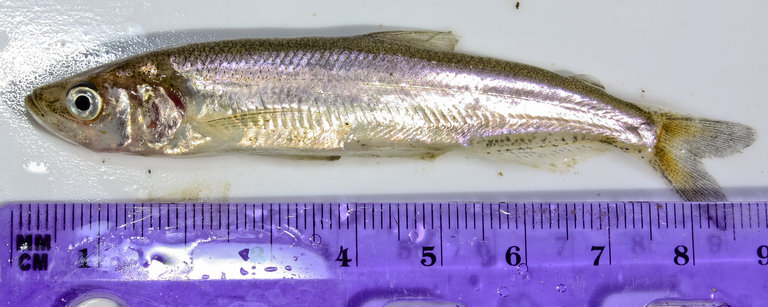
| Appearance | - The species has an elongated, streamlined body that is compressed laterally. English Wikipedia
- Its sides and underside are generally silver-white, while its back ranges from olive-green or brown to pinkish. English Wikipedia
- Its pectoral fins extend nearly to the bases of its pelvic fins. English Wikipedia
- The species has a forked tail with two equally sized lobes. English Wikipedia
- Its lateral line is incomplete and extends only to just below the dorsal fin. English Wikipedia
- Its dorsal fin has 8–10 rays and its anal fin has 15–19 rays. English Wikipedia
- Its lower jaw projects beyond its upper jaw when compressed. English Wikipedia
- Teeth occur on the tongue and in both jaws. English Wikipedia
- Males generally have a more angular anal fin, sometimes with a small protruding bump, whereas females have a rounder anal fin. English Wikipedia
- Spawning males are generally darker than females and have extensive stippling on their backs and along their scale margins. adfg.alaska.gov
- During spawning, males develop enlarged and stiffened portions of their pectoral, pelvic, anal, and dorsal fins. adfg.alaska.gov
| - Adults have brown or blue backs, silvery-white or light-blue sides, and white undersides. English Wikipedia
- The species has large canine-like teeth on the vomer bone and 19 to 31 anal-fin rays. English Wikipedia
- The adipose fin is sickle-shaped. English Wikipedia
- Male eulachon have longer paired fins than females. English Wikipedia
- Ripe males develop prominent breeding tubercles on their fins. English Wikipedia
- Adults have fine, sparse speckling restricted to their backs. English Wikipedia
- Adults have striae on the operculum that distinguish them from other smelts. English Wikipedia
- Eulachon have 4–6 gill rakers on the upper half of the gill arch. fisheries.noaa.gov
- Eulachon have concentric striations on their operculum and suboperculum. fisheries.noaa.gov
- Eulachon change from blue-silver in salt water to gray-brown and green during their movement into freshwater. adfg.alaska.gov
|
|---|
| Size | | No checked fact yet |
|---|
| Habitat | - The species generally inhabits bays and estuaries while spawning in coastal rivers. English Wikipedia
- The species can occupy marine, estuarine, and freshwater environments. English Wikipedia
- The species inhabits open water across most of the water column. English Wikipedia
- Marine populations prefer relatively shallow areas. English Wikipedia
- Spawning rivers are typically slow-moving because the fish cannot swim effectively through long stretches of fast-flowing water. adfg.alaska.gov
- Spawning sites are generally located in lower river or stream elevations. adfg.alaska.gov
- The species requires salinity levels between 2 and 18 parts per thousand. English Wikipedia
- Larvae require salinity between 0.4 and 10 parts per thousand and develop best at 5–10 parts per thousand. English Wikipedia
- Successful embryonic development requires water temperatures between 10 and 12 °C. English Wikipedia
| - Eulachon spawning rivers are generally slow-moving because the fish are weak swimmers. adfg.alaska.gov
- Eulachon primarily spawn in rivers with substantial spring snowmelt. swap.oregon.gov
- Clean gravel is required for spawning, while freshet flows help transport larvae to estuaries and the ocean. swap.oregon.gov
|
|---|
| Diet | - Juveniles younger than one year feed on chironomids, copepods, and cladocerans. English Wikipedia
- Amphipods and cladocerans remain important food sources during winter. English Wikipedia
- Juveniles and adults mainly consume small crustaceans, particularly copepods, cumaceans, and euphausiids. adfg.alaska.gov
- Newly hatched juveniles feed mainly on copepod larvae, other plankton, and insect larvae. adfg.alaska.gov
| - Eulachon feed primarily on plankton, fish eggs, insect larvae, ocean debris, and small crustaceans. English Wikipedia
- Adult eulachon primarily consume euphausiids, which are also known as krill. fisheries.noaa.gov
- Postlarval and juvenile eulachon consume planktonic crustaceans, particularly adult copepods. fisheries.noaa.gov
- Juvenile and adult eulachon feed mainly on euphausiids. adfg.alaska.gov
|
|---|
| Behaviour | - The species forms large shoals. English Wikipedia
- Individuals generally remain deeper during daylight and ascend at night to feed. English Wikipedia
- Individuals gather in large groups near river mouths before migrating upstream to spawn. English Wikipedia
- Males generally migrate to spawning grounds before females. English Wikipedia
- The species does not consistently return to one particular spawning stream and instead appears to select suitable streams in its general natal area. adfg.alaska.gov
| - Eulachon spend most of their adult lives in the ocean before returning to freshwater to spawn. English Wikipedia
- Spawning runs generally begin with males, followed by females around the middle of the run. English Wikipedia
- Eulachon juveniles do not perform daily vertical migrations from their preferred depths. fisheries.noaa.gov
- Eulachon gather in large schools near the mouths of spawning rivers as the spawning season approaches. adfg.alaska.gov
- Juvenile eulachon form schools near the ocean floor. swap.oregon.gov
- Eulachon sometimes mix with Northern Anchovy and Pacific Herring in schools. swap.oregon.gov
|
|---|
| Reproduction | | - Adult eulachon typically spawn between two and five years of age. fisheries.noaa.gov
- Spawning migration usually begins when river temperatures are between 0 and 10 degrees Celsius. fisheries.noaa.gov
- Newly hatched larvae measure between 4 and 8 mm long. fisheries.noaa.gov
- Eulachon eggs hatch in freshwater within 21 to 40 days depending on water temperature. adfg.alaska.gov
- Eulachon spawn in rivers between December and June. swap.oregon.gov
- Eulachon generally mature between two and four years of age. swap.oregon.gov
|
|---|
| Lifespan | No checked fact yet | - Eulachon spend three to six years at sea before returning to spawn. adfg.alaska.gov
|
|---|
| Conservation | - The species is classified as Least Concern on the IUCN Red List. English Wikipedia
- Watershed destruction and freshwater diversion, primarily for agriculture, threaten the species. English Wikipedia
- The San Francisco Bay-Delta population was listed as Endangered by the U.S. Fish and Wildlife Service on July 29, 2024. English Wikipedia
- Potential overharvesting by commercial, personal-use, and subsistence fisheries is identified as the main threat to the Alaskan resource. adfg.alaska.gov
| - The southern distinct population segment of eulachon was listed as threatened under the Endangered Species Act in 2010. English Wikipedia
- Overharvest, pollution, freshwater spawning habitat loss, and climate change are identified as threats to the species. English Wikipedia
- The southern distinct population segment experienced an abrupt abundance decline beginning in the mid-1990s. fisheries.noaa.gov
- The 2022 five-year review concluded that the southern population segment's threatened designation remained appropriate. fisheries.noaa.gov
- Offshore shrimp fishery bycatch is among the major threats to the southern population segment. fisheries.noaa.gov
- Potential overharvest from commercial, personal-use, and subsistence fisheries is identified as the main threat to eulachon in Alaska. adfg.alaska.gov
|
|---|
| Uses | No checked fact yet | - Eulachon have traditionally been an important food and trade item for Indigenous communities along the Pacific Coast. English Wikipedia
- Eulachon are processed to produce an oil known as eulachon grease. English Wikipedia
- Harvested eulachon may be fried, dried, smoked, or canned. English Wikipedia
|
|---|