Comparison

Eurasian Otter vs Honey Badger

Eurasian Otter (Lutra lutra) and Honey Badger (Mellivora capensis) both belong to the family Mustelidae (mustelids) and part ways below it. Both are recorded in 5 countries.

Eurasian Otter

Lutra lutra
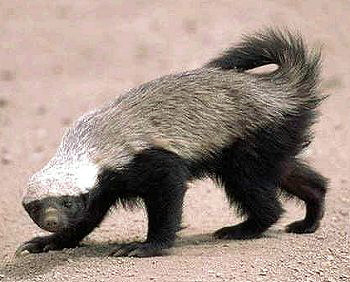
Honey Badger

Honey Badger

Mellivora capensis

en:User:Jaganath, CC BY-SA 3.0, via Wikimedia Commons

Side by side

Eurasian OtterHoney Badger
Scientific nameLutra lutra (Linnaeus, 1758)Mellivora capensis (Schreber, 1776)
English nameEurasian OtterHoney Badger
GroupMammalsMammals
ClassMammalia MammalMammalia Mammal
OrderCarnivora CarnivoresCarnivora Carnivores
FamilyMustelidae MustelidsMustelidae Mustelids
GenusLutra Eurasian OttersMellivora Ratels
Named in17581776
Red List categoryNear ThreatenedLeast Concern
Environmentfreshwater, marineNot recorded
Countries on record64 countries37 countries
GBIF occurrence records307,507 records2,204 records

Rows where the two agree are shown in grey.

Where each is found

Both recorded in 5 countries

Only Eurasian Otter (59)

Only Honey Badger (32)

From Catalogue of Life checklists and GBIF occurrence records. A country missing from a list means no record is held, which is not proof of absence.

Checked facts

Eurasian OtterHoney Badger
Appearance
  • The Eurasian otter has brown fur on its back and cream-coloured fur on its belly. English Wikipedia
  • The Eurasian otter has a shorter neck, broader face, greater spacing between its ears and a longer tail than the North American river otter. English Wikipedia
  • The Eurasian otter has dense bones associated with reduced buoyancy. English Wikipedia
  • The honey badger has short, sturdy legs and five toes on each foot. English Wikipedia
  • Its forelimbs have remarkably long claws, whereas its hind-leg claws are short. English Wikipedia
  • Its coat generally has a black lower body and a white or grey upper mantle extending to the base of the tail. animaldiversity.org
  • Individuals belonging to the cottoni subspecies have an entirely black coat. English Wikipedia
Size
Habitat
  • The Eurasian otter inhabits unpolluted freshwater lakes, streams, rivers, canals and ponds when sufficient food is available. English Wikipedia
  • The Eurasian otter also inhabits coastal saltwater environments but requires regular access to freshwater to clean its fur. English Wikipedia
  • In Andalusia, Eurasian otters use artificial lakes on golf courses. English Wikipedia
  • In western Nepal, the Eurasian otter has been documented at approximately 1,600 m elevation in the Barekot River. English Wikipedia
  • In western Nepal, the Eurasian otter has been documented at 1,337 m elevation in the Tubang River. English Wikipedia
  • Honey badgers inhabit tropical and subtropical green forests, thorn forests, open woodlands, riparian forests, grasslands, arid steppes, rocky hills, and deserts. animaldiversity.org
  • Honey badgers occupy elevations from sea level to approximately 4,050 m. animaldiversity.org
  • Honey badgers require sheltering places such as burrows or rock crevices. animaldiversity.org
  • Honey badgers are not historically found in the extremely dry parts of the Sahara Desert or along the Mediterranean coast. animaldiversity.org
Diet
  • The Eurasian otter occasionally hunts adult greylag geese. English Wikipedia
  • Cyprinids accounted for 97.77% of the analyzed Eurasian otter diet sequences in the Agri river system study. pmc.ncbi.nlm.nih.gov
  • Amphibians represented 0.85% of the analyzed diet sequences in the Agri river system study. pmc.ncbi.nlm.nih.gov
  • The Eurasian otters studied in the Agri river system showed marked selectivity in their prey consumption. pmc.ncbi.nlm.nih.gov
  • The Eurasian otter's prey composition in the Agri river system varied according to whether the water system was a river, lake or tributary. pmc.ncbi.nlm.nih.gov
  • Honey badgers consume insects, frogs, tortoises, turtles, lizards, rodents, snakes, birds, and eggs. English Wikipedia
  • Honey badgers also eat berries, roots, and bulbs. English Wikipedia
  • Honey badgers raid beehives to obtain bee larvae and honey. English Wikipedia
  • Honey badgers consume all parts of their prey, including bones, feathers, hair, and skin. English Wikipedia
Behaviour
  • The Eurasian otter is strongly territorial and typically lives alone. English Wikipedia
  • An individual Eurasian otter's territory can extend from 1 to 40 km in length, with approximately 18 km being usual. English Wikipedia
  • The Eurasian otter marks its territory using faeces known as spraints. English Wikipedia
  • Eurasian otter territories are defended against members of the same sex, allowing male and female territories to overlap. English Wikipedia
  • Honey badgers are predominantly solitary animals. English Wikipedia
  • Honey badgers may be active at any time of day depending on their location. English Wikipedia
  • Honey badgers in the Serengeti are mostly nocturnal during the dry season and active throughout the day during the wet season. English Wikipedia
  • Honey badgers are skilled diggers capable of excavating tunnels in hard ground within ten minutes. English Wikipedia
  • Honey badger burrows are generally 1–3 m long and have a single entrance and an unlined nesting chamber. English Wikipedia
  • Adult male honey badgers have an average home range of 548 km², compared with 138 km² for females. English Wikipedia
  • Honey badgers scent-mark their territories using anal gland secretions, feces, and urine. English Wikipedia
  • Honey badgers can repel larger predators by releasing a pungent yellow liquid from their anal glands. English Wikipedia
  • Honey badgers sometimes hunt in pairs in Africa. English Wikipedia
Reproduction
  • Honey badgers can breed throughout the year rather than during a fixed mating season. English Wikipedia
  • Female honey badgers have an estimated oestrus period of approximately 14 days. English Wikipedia
  • The gestation period of honey badgers is approximately 50–70 days. animaldiversity.org
  • Female honey badgers move their cubs between dens during the first three months after birth. animaldiversity.org
  • Honey badger cubs begin accompanying their mothers while foraging at approximately three months of age. animaldiversity.org
  • Female honey badgers care for their offspring for approximately 12–16 months. animaldiversity.org
  • Male honey badgers generally reach sexual maturity at two to three years of age. animaldiversity.org
Distribution
  • The Eurasian otter's distribution includes Europe, North Africa and parts of Asia extending to the Palestine region. English Wikipedia
  • Honey badgers occur across most of sub-Saharan Africa, from South Africa's Western Cape to southern Morocco and southwestern Algeria. English Wikipedia
  • The species' range extends beyond Africa through Arabia, Iran, Western Asia, Turkmenistan, and the Indian Peninsula. English Wikipedia
Conservation
  • The Eurasian otter is listed as Near Threatened on the IUCN Red List. English Wikipedia
  • The Eurasian otter is listed as endangered in Pakistan, India, Bangladesh, Myanmar and Thailand. English Wikipedia
  • The Eurasian otter is listed as critically endangered in Mongolia. English Wikipedia
  • The Eurasian otter is classified as endangered in Italy's Official Italian Red List. pmc.ncbi.nlm.nih.gov
  • In Hong Kong, the Eurasian otter is protected under the Wild Animals Protection Ordinance Cap 170. English Wikipedia
  • The number of sites with Eurasian otter presence in the United Kingdom increased by 55% between 1994 and 2002. English Wikipedia
  • The honey badger is classified as Least Concern on the IUCN Red List. English Wikipedia
  • Honey badgers are threatened by killings associated with beekeeping and farming, including poisoning and trapping. English Wikipedia
UsesNo checked fact yet
  • Honey badgers are used in traditional medicine and consumed as bushmeat. English Wikipedia
Other
  • The honey badger is the only living species in the genus Mellivora. English Wikipedia
  • The honey badger is the sole living representative of the subfamily Mellivorinae. English Wikipedia

In brief

Eurasian Otter

The Eurasian Otter is a semiaquatic carnivorous mammal in the family Mustelidae, order Carnivora and class Mammalia. It occurs in Europe, North Africa and parts of Asia extending to the Palestine region. It has brown fur on its back and cream-coloured fur on its belly. Full profile

Honey Badger

Mellivora capensis occurs across most of sub-Saharan Africa and extends through Arabia, Iran, Western Asia, Turkmenistan, and the Indian Peninsula. It is the only living species in the genus Mellivora and the sole living representative of the subfamily Mellivorinae. Full profile

Compare something else

Page built on 28 November 2026 from the data on the two species pages, where every source is listed.

Cite this page

ScientificNames.org. (2026). Eurasian Otter vs Honey Badger. Retrieved November 28, 2026, from https://scientificnames.org/compare/eurasian-otter-vs-honey-badger