Comparison
Abyssinian Longclaw vs Rosy-throated Longclaw
Abyssinian Longclaw (Macronyx flavicollis) and Rosy-throated Longclaw (Macronyx ameliae) both belong to the genus Macronyx (longclaw) and part ways below it.

Abyssinian Longclaw
Macronyx flavicollis
Pia Öberg from Uppsala, Sweden, CC BY-SA 2.0, via Wikimedia Commons

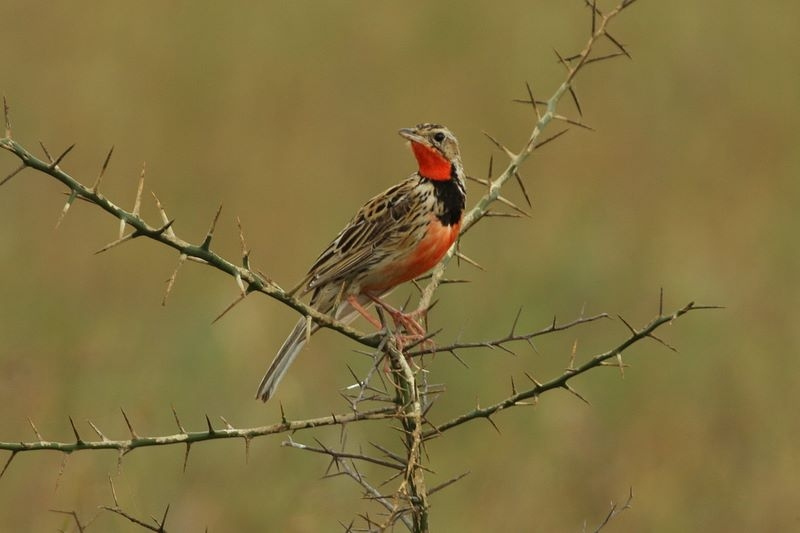
Rosy-throated Longclaw
Macronyx ameliae
Demetrius John Kessy from Arusha, Tanzania, CC BY 2.0, via Wikimedia Commons

Side by side
| Abyssinian Longclaw | Rosy-throated Longclaw | |
|---|---|---|
| Scientific name | Macronyx flavicollis Rüppell, 1840 | Macronyx ameliae Tarragon, 1845 |
| English name | Abyssinian Longclaw | Rosy-throated Longclaw |
| Group | Birds | Birds |
| Class | Aves Bird | Aves Bird |
| Order | Passeriformes Passerine | Passeriformes Passerine |
| Family | Motacillidae Pipits | Motacillidae Pipits |
| Genus | Macronyx Longclaw | Macronyx Longclaw |
| Named in | 1840 | 1845 |
| Red List category | Near Threatened | Least Concern |
| Countries on record | 1 country | 11 countries |
| GBIF occurrence records | 899 records | 6,297 records |
Rows where the two agree are shown in grey.
Where each is found
Only Abyssinian Longclaw (1)
Only Rosy-throated Longclaw (11)
- Angola
- Botswana
- Democratic Republic of the Congo
- Kenya
- Malawi
- Mozambique
- Namibia
- South Africa
- Tanzania
- Zambia
- Zimbabwe
From Catalogue of Life checklists and GBIF occurrence records. A country missing from a list means no record is held, which is not proof of absence.
Checked facts
| Abyssinian Longclaw | Rosy-throated Longclaw | |
|---|---|---|
| Appearance |
|
|
| Size |
|
|
| Habitat |
|
|
| Behaviour | No checked fact yet |
|
| Reproduction |
|
|
| Distribution |
|
|
| Conservation |
|
|
| Similar species |
| No checked fact yet |
| Name origin | No checked fact yet |
|
| Other | No checked fact yet |
|
In brief
Abyssinian Longclaw
Macronyx flavicollis inhabits wet grasslands and subtropical to tropical high-altitude environments in Ethiopia. It is distinguished by its saffron-colored neck and supercilium and a black necklace-like marking around the base of its neck. Full profile
Rosy-throated Longclaw
Macronyx ameliae occurs in Angola, Botswana, the Democratic Republic of the Congo, Kenya, Malawi, Mozambique, Namibia, South Africa, Tanzania, Zambia, and Zimbabwe. It is pink below and streaked brown above, with adult males having a broad black band across the chest. Full profile
Compare something else
Page built on 29 November 2026 from the data on the two species pages, where every source is listed.
Cite this page
ScientificNames.org. (2026). Abyssinian Longclaw vs Rosy-throated Longclaw. Retrieved November 29, 2026, from https://scientificnames.org/compare/abyssinian-longclaw-vs-rosy-throated-longclaw
“Abyssinian Longclaw vs Rosy-throated Longclaw.” ScientificNames.org, 2026, scientificnames.org/compare/abyssinian-longclaw-vs-rosy-throated-longclaw. Accessed 29 Nov. 2026.
ScientificNames.org. “Abyssinian Longclaw vs Rosy-throated Longclaw.” Accessed November 29, 2026. https://scientificnames.org/compare/abyssinian-longclaw-vs-rosy-throated-longclaw.
@misc{scientificnames_abyssinian_longclaw_vs_rosy_throated_longclaw,
  author = {{ScientificNames.org}},
  title = {Abyssinian Longclaw vs Rosy-throated Longclaw},
  year = {2026},
  url = {https://scientificnames.org/compare/abyssinian-longclaw-vs-rosy-throated-longclaw},
  note = {Accessed 2026-11-29}
}