Species · Birds
Abyssinian Longclaw Macronyx flavicollis
The scientific name of the Abyssinian Longclaw is Macronyx flavicollis. It is a species of bird in the family Motacillidae (pipits), order Passeriformes. The name dates from 1840.
- Scientific name
- Macronyx flavicollis Rüppell, 1840
- Common name
- Abyssinian Longclaw
- Genus
- Macronyx
- Family
- Motacillidae (Pipits)
- Order
- Passeriformes
- Class
- Aves
- Red List category
- NT Near Threatened
- Recorded in
- 1 country
- Name status
- accepted in the Catalogue of Life

Overview
Macronyx flavicollis inhabits wet grasslands and subtropical to tropical high-altitude environments in Ethiopia. It is distinguished by its saffron-colored neck and supercilium and a black necklace-like marking around the base of its neck.
Written 26 November 2026 from the sources listed below. Each statement was checked against the passage it cites; statements that could not be supported were removed.
Similar species
The yellow-throated longclaw (Macronyx croceus) resembles the Abyssinian Longclaw in appearance and behavior.[1]
Appearance
The Abyssinian Longclaw has a typically brown to black back. Its tail has white markings that are visible only during flight.[2][3]
Its neck and supercilium are saffron-colored. A black band around the base of the neck forms a necklace, which can sometimes appear as a narrow collection of spots.[4][5][6]
The remaining body plumage varies in color but usually has black stripes. The species typically measures approximately 20 cm in length.[7][8]
Habitat
The Abyssinian Longclaw inhabits wet grasslands in Ethiopia and occupies subtropical to tropical high-altitude environments.[9][10]
The species is endemic to Ethiopia and occurs in the western and southeastern Ethiopian Highlands, but not in the extreme north. It is endemic to the Ethiopian highlands.[11][12][13]
Reproduction and life cycle
The Abyssinian Longclaw typically breeds between June and August. It lays between two and four eggs per clutch.[14][15]
Individuals return to a previously constructed nest when laying eggs.[16]
Conservation
The Abyssinian Longclaw was categorized as Near Threatened in the cited account. Its reported area of occupancy or range is 453,000 km².[17][18]
A 1995 survey described the species as widespread but uncommon. Habitat loss and environmental degradation have been reported in the Bale Mountains area inhabited by the species.[19][20]
Habitat loss and environmental degradation have raised suspicions that the species' population is declining. Studies of its population trend are limited.[21][22]
No direct count of the species' individuals has been conducted, and the number of locations it occupies is unknown. The species was most recently assessed for the IUCN Red List in 2024.[23][24][25]
Classification of the Abyssinian Longclaw
| Kingdom | Animalia |
|---|---|
| Phylum | Chordata |
| Subphylum | Vertebrata |
| Infraphylum | Gnathostomata |
| Parvphylum | Osteichthyes |
| Megaclass | Tetrapoda |
| Class | Aves (Bird) |
| Order | Passeriformes (Passerine) |
| Family | Motacillidae (Pipits) |
| Genus | Macronyx (Longclaw) |
| Species | Macronyx flavicollis Rüppell, 1840 |
Where the Abyssinian Longclaw is found
Checklists and occurrence records place Macronyx flavicollis in 1 country. GBIF holds 899 georeferenced records of it.
Countries
Regions and cities with the most records
- Oromiya, Ethiopia 709
- Addis Ababa, Ethiopia 208
- Burayu, Ethiopia 108
- Amhara, Ethiopia 77
- Sebeta, Ethiopia 63
- Genet, Ethiopia 51
- Goba, Ethiopia 50
- Debre Birhan, Ethiopia 26
- Addis Ababa, Ethiopia 21
- Fichē, Ethiopia 17
- Kofelē, Ethiopia 13
- Mehal Mēda, Ethiopia 12
- Dodola, Ethiopia 11
- Āt’aye, Ethiopia 11
- Āsasa, Ethiopia 10
- Awasa, Ethiopia 8
- Bale Robe, Ethiopia 8
- Ādīs ‘Alem, Ethiopia 8
- Bishoftu, Ethiopia 5
- Metahāra, Ethiopia 5
- Shashamane, Ethiopia 4
- Sheno, Ethiopia 4
- Bahir Dar, Ethiopia 3
- Gimbi, Ethiopia 3
- Ziway, Ethiopia 3
- Āfar, Ethiopia 3
A number beside a place is its count of GBIF occurrence records. A place without a number comes from a checklist alone. Records show where a species has been observed or collected, which can include escapes and vagrants.
Common names
English
- Abyssinian Longclaw
- ABLO
Names in 26 other languages
- Catalan
- piula d'esperons d'Abissinia
- Chinese
- 黃頸長爪鶺鴒, 黄颈长爪鹡鸰
- Croatian
- etiopska trepteljka
- Czech
- linduškovec etiopský
- Danish
- Etiopisk Sporepiber
- Dutch
- Geelhalslangklauw
- Esperanto
- etiopia pipio
- Estonian
- etioopia kaeluskiur
- Finnish
- etiopianvästäräkki
- French
- Alouette sentinelle d'Abyssinie, Sentinelle d'Abyssinie, Sentinelle d’Abyssinie
- German
- Goldhalspieper
- Hungarian
- aranynyakú sarkantyúspityer
- Italian
- Unghialunga d'Abissinia
- Japanese
- チャバラツメナガタヒバリ
- Lithuanian
- etiopinis varnėninis kalviukas
- Norwegian
- etiopiapiplerke
- Polish
- szponnik górski
- Portuguese
- sentinela-abissínia, sentinela-da-abissínia
- Russian
- Эфиопский скворцовый конёк, Эфиопский шпорник
- Serbian
- Abisinska kandžašica
- Slovak
- pazúrnatka etiópska, ľabtuška etiópska
- Spanish
- Bisbita abisinio
- Swedish
- etiopienpiplärka, etiopisk sporrpiplärka
- Turkish
- Habeş İncirkuşu
- Ukrainian
- пікулик ефіопський
- Welsh
- aderyn hirewin Abysinia
Related species
- Yellow-throated LongclawMacronyx croceus
-
 Cape LongclawMacronyx capensis
-
 Sharpe's LongclawMacronyx sharpei
-
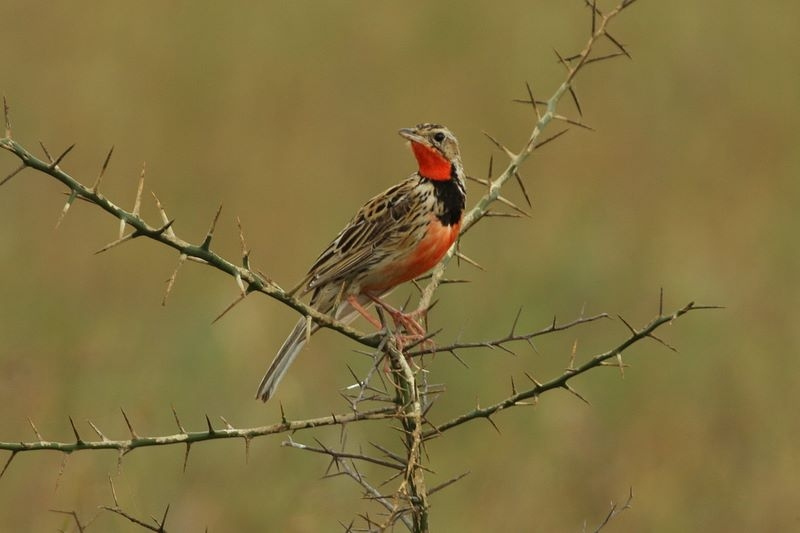 Rosy-throated LongclawMacronyx ameliae
- Grimwood's LongclawMacronyx grimwoodi
-
 Pangani LongclawMacronyx aurantiigula
-
 Fülleborn's LongclawMacronyx fuelleborni
-
 White WagtailMotacilla alba
Compare
Questions and answers
What is the scientific name of the Abyssinian Longclaw?
The scientific name of the Abyssinian Longclaw is Macronyx flavicollis. Written with its author, the full name is Macronyx flavicollis Rüppell, 1840.
Which family does the Abyssinian Longclaw belong to?
Macronyx flavicollis belongs to the family Motacillidae, in the order Passeriformes and the class Aves.
Where is the Abyssinian Longclaw found?
Checklists and occurrence records place Macronyx flavicollis in 1 country: Ethiopia.
What is the conservation status of the Abyssinian Longclaw?
The IUCN Red List category recorded for Macronyx flavicollis is Near Threatened (NT).
What other names does the Abyssinian Longclaw have?
Macronyx flavicollis is also known in English as ABLO.
How long is the Abyssinian Longclaw?
It typically measures approximately 20 cm in length.[8]
When does the Abyssinian Longclaw breed?
It typically breeds between June and August.[14]
How many eggs does the Abyssinian Longclaw lay?
It lays between two and four eggs per clutch.[15]
Sources
Passages the profile rests on
- The yellow-throated longclaw (Macronyx croceus) resembles the Abyssinian longclaw in appearance and behavior. Source passage: “The Abyssinian longclaw is very similar in both appearance and behavior to the yellow-throated longclaw (Macronyx croceus) of other parts of Africa.” — English Wikipedia
- The Abyssinian longclaw has a typically brown to black back. Source passage: “Abyssinian longclaws are typically brown to black colored on their back” — English Wikipedia
- The species has white markings on its tail that are visible only during flight. Source passage: “there are white marks on the tail that are only visible during flight.” — English Wikipedia
- The neck and supercilium of the Abyssinian longclaw are saffron-colored. Source passage: “On the neck and the supercilium (a stripe of plumage on the head) it is saffron colored.” — English Wikipedia
- The species has a black band around the base of its neck, described as a necklace. Source passage: “Around the base of the neck there is a black band described as a "necklace".” — English Wikipedia
- The black neck marking can sometimes appear as a narrow collection of spots. Source passage: “Sometimes the necklace can present as a narrow collection of spots around the neck as well.” — English Wikipedia
- The remaining body plumage varies in color but usually has black stripes. Source passage: “The rest of the body varies in color but usually has black stripes.” — English Wikipedia
- The Abyssinian longclaw typically measures approximately 20 cm in length. Source passage: “The normal length for the Abyssinian longclaw is around 20 cm (7.9 in).” — English Wikipedia
- The Abyssinian longclaw inhabits wet grasslands in Ethiopia. Source passage: “The bird's natural habitat is in the wet grasslands of Ethiopia.” — English Wikipedia
- The species occupies subtropical to tropical high-altitude environments. Source passage: “It lives in subtropical to tropical areas of high altitudes.” — English Wikipedia
- The Abyssinian longclaw is endemic to Ethiopia. Source passage: “It is endemic to Ethiopia.” — English Wikipedia
- The species occurs in the western and southeastern Ethiopian Highlands, but not in the extreme north. Source passage: “It is a common grassland bird of the western and south eastern Ethiopian Highlands, except in the extreme north where it does not occur.” — English Wikipedia
- The Abyssinian longclaw is endemic to the Ethiopian highlands. Source passage: “Macronyx flavicollis is endemic to the highlands of Ethiopia.” — datazone.birdlife.org
- The Abyssinian longclaw typically breeds between June and August. Source passage: “The Abyssinian longclaw typically breeds between the months of June and August.” — English Wikipedia
- The species lays between two and four eggs per clutch. Source passage: “When laying eggs, they tend to return to a nest they have built and lay between two to four eggs at a time.” — English Wikipedia
- Individuals return to a previously constructed nest when laying eggs. Source passage: “they tend to return to a nest they have built” — English Wikipedia
- The Abyssinian longclaw was categorized as Near Threatened in the cited account. Source passage: “The IUCN Red List categorizes the Abyssinian longclaw as "Near Threatened".” — English Wikipedia
- The species' reported area of occupancy or range in the cited account is 453,000 km². Source passage: “The area that the bird tends to live in is 453,000 km2 (175,000 sq mi) large” — English Wikipedia
- A 1995 survey described the species as widespread but uncommon. Source passage: “its frequency was described during a 1995 survey as "widespread" but "uncommon".” — English Wikipedia
- Habitat loss and environmental degradation have been reported in the Bale Mountains area inhabited by the species. Source passage: “The area of the Bale Mountains which Abyssinian longclaws live in has been undergoing habitat loss and degradation of the environment” — English Wikipedia
- Habitat loss and environmental degradation have raised suspicions that the species' population is declining. Source passage: “which has led to the suspicion that the population of the birds is decreasing accordingly.” — English Wikipedia
- Studies of the Abyssinian longclaw's population trend are limited. Source passage: “Studies on the population trend are limited” — English Wikipedia
- The cited account reports that no direct count of the species' individuals has been conducted. Source passage: “there has been no direct count of the quantity of individuals.” — English Wikipedia
- The number of locations occupied by the Abyssinian longclaw is unknown. Source passage: “Number of locations. Unknown.” — datazone.birdlife.org
- The species was most recently assessed for the IUCN Red List in 2024. Source passage: “Abyssinian Longclaw Macronyx flavicollis has most recently been assessed for The IUCN Red List of Threatened Species in 2024.” — iucnredlist.org
Data
- Catalogue of Life, 2026-10-16 XR cc by
- Global Biodiversity Information Facility CC BY 4.0
- Wikidata CC0
- GeoNames CC BY 4.0
- Wikimedia Commons per image; credit shown with each image
- Within the Catalogue of Life, this name comes from The Integrated Taxonomic Information System cc0
References
- Gill, Frank, & and Minturn Wright. (2006). Birds of the World: Recommended English Names.
This species in other databases
Page built on 29 November 2026. See how the catalog is made and all sources and licences.
Cite this page
ScientificNames.org. (2026). Macronyx flavicollis (Abyssinian Longclaw). Retrieved November 29, 2026, from https://scientificnames.org/species/macronyx-flavicollis
“Macronyx flavicollis (Abyssinian Longclaw).” ScientificNames.org, 2026, scientificnames.org/species/macronyx-flavicollis. Accessed 29 Nov. 2026.
ScientificNames.org. “Macronyx flavicollis (Abyssinian Longclaw).” Accessed November 29, 2026. https://scientificnames.org/species/macronyx-flavicollis.
@misc{scientificnames_macronyx_flavicollis_abyssinian_longclaw,
  author = {{ScientificNames.org}},
  title = {Macronyx flavicollis (Abyssinian Longclaw)},
  year = {2026},
  url = {https://scientificnames.org/species/macronyx-flavicollis},
  note = {Accessed 2026-11-29}
}