Comparison

Pink-eared Duck vs Mute Swan

Pink-eared Duck (Malacorhynchus membranaceus) and Mute Swan (Cygnus olor) both belong to the family Anatidae (ducks) and part ways below it. Both are recorded in 2 countries.
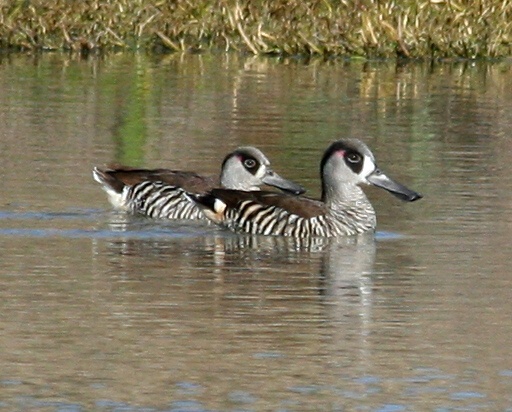
Pink-eared Duck

Pink-eared Duck

Malacorhynchus membranaceus

Jason Girvan, CC BY-SA 3.0, via Wikimedia Commons

Mute Swan

Mute Swan

Cygnus olor

Geni, CC BY-SA 4.0, via Wikimedia Commons

Side by side

Pink-eared DuckMute Swan
Scientific nameMalacorhynchus membranaceus (Latham, 1801)Cygnus olor (J. F. Gmelin, 1789)
English namePink-eared DuckMute Swan
GroupBirdsBirds
ClassAves BirdAves Bird
OrderAnseriformes DucksAnseriformes Ducks
FamilyAnatidae DucksAnatidae Ducks
GenusMalacorhynchusCygnus Swan
Named in18011789
Red List categoryLeast ConcernLeast Concern
EnvironmentNot recordedfreshwater, terrestrial
Countries on record2 countries79 countries
GBIF occurrence records140,277 records6,944,307 records

Rows where the two agree are shown in grey.

Where each is found

Both recorded in 2 countries

Only Mute Swan (77)

From Catalogue of Life checklists and GBIF occurrence records. A country missing from a list means no record is held, which is not proof of absence.

Checked facts

Pink-eared DuckMute Swan
Appearance
  • The Pink-eared Duck has a large spatulate bill similar to that of the Australasian shoveler. English Wikipedia
  • The species has a brown back and crown, barred black-and-white sides, and black eye patches on a white face. English Wikipedia
  • Juveniles are slightly duller in appearance than adults. English Wikipedia
  • The species has a pink spot at the corner of its head pattern. English Wikipedia
  • The pink spot is only noticeable when viewed at close distance. English Wikipedia
  • The Pink-eared Duck is the only known Anseriformes species with carotenoid pigments in its feathers. English Wikipedia
  • The species has a characteristic pink ear spot. English Wikipedia
  • The species has fine zebra-striped plumage and a long, shovel-shaped bill. ebird.org
  • Adult mute swans have entirely white plumage, dark grey legs and a bright orange bill with black markings around the nostrils and tip. English Wikipedia
  • Young mute swans have dull greyish-black bills during their first year rather than the orange bills of adults. English Wikipedia
Size
Habitat
  • The species occurs wherever standing water is available in Australia. English Wikipedia
  • The species is particularly associated with dry inland regions of Australia. English Wikipedia
  • The species occurs in regions where annual rainfall rarely exceeds 380 mm. English Wikipedia
  • Mute swans inhabit freshwater lagoons, lakes and slow-flowing rivers. English Wikipedia
  • Mute swans prefer medium-sized to large bodies of water. English Wikipedia
  • Outside the breeding season, mute swans may also use terrestrial habitats, particularly those near water. English Wikipedia
Diet
  • The Pink-eared Duck depends on plankton as a food source. English Wikipedia
  • The species also feeds on crustaceans, mollusks, and insects. English Wikipedia
  • The species filters algae and other plankton from water using pliable mandibular flaps. English Wikipedia
  • Mute swans feed on a wide variety of vegetation, including submerged aquatic plants. English Wikipedia
  • Mute swans commonly consume agricultural crops including oilseed rape and wheat. English Wikipedia
  • Mute swans also consume small quantities of aquatic insects, fish and frogs. English Wikipedia
  • The diet of mute swans consists predominantly of leaves and vegetative plant parts. datazone.birdlife.org
Behaviour
  • The Pink-eared Duck obtains food through a feeding method called vortexing. English Wikipedia
  • During vortex feeding, two ducks rotate around a central point with one bird's head opposite the other's tail. English Wikipedia
  • Vortex feeding concentrates food within a rotating column of water. English Wikipedia
  • The species is highly mobile. English Wikipedia
  • Mute swans are generally strongly territorial, with smaller lakes usually occupied by a single pair. English Wikipedia
  • Non-breeding juvenile mute swans commonly form flocks containing several hundred birds. English Wikipedia
  • Mute swans produce sounds including grunting, hoarse whistling and snorting. English Wikipedia
  • Mute swans commonly hiss at competitors or intruders entering their territory. English Wikipedia
  • Mute swans can dive several metres underwater and travel 40–50 m underwater to evade rivals or capture. English Wikipedia
Reproduction
  • Nesting is stimulated by the drying and subsequent filling of pools. English Wikipedia
  • Pool drying and refilling promotes increased levels of organic material that stimulate nesting. English Wikipedia
  • Large numbers of Pink-eared Ducks gather in shallow flood plains during favourable years. English Wikipedia
  • Reproduction may cease completely when environmental conditions are unsuitable. English Wikipedia
  • Mute swans construct large nests from waterside vegetation in shallow water, often on islands or near lake edges. English Wikipedia
  • Mute swans are monogamous and frequently reuse their nests in successive years. English Wikipedia
  • Typical mute swan clutches contain five to eight eggs. English Wikipedia
  • Female mute swans incubate their eggs for approximately 36 days. English Wikipedia
  • Mute swan cygnets normally hatch between May and July. English Wikipedia
  • Mute swan cygnets generally begin flying 60–65 days after hatching. English Wikipedia
  • Both male and female mute swans participate in caring for the nest. English Wikipedia
DistributionNo checked fact yet
Conservation
  • Animal welfare groups oppose duck hunting because they consider the practice unacceptably cruel. English Wikipedia
  • The Pink-eared Duck was most recently assessed for the IUCN Red List in 2024. iucnredlist.org
  • The total native mute swan population is approximately 500,000 birds at the end of the breeding season. English Wikipedia
  • Russia supports up to 350,000 birds within the native mute swan population. English Wikipedia
  • Mute swans have experienced mortality from collisions with power lines and lead poisoning. English Wikipedia
  • Mute swan populations in Western Europe were largely exterminated by hunting between the 13th and 19th centuries. English Wikipedia
Uses
  • The Pink-eared Duck is hunted in Australian regions except Tasmania. English Wikipedia
  • Mute swans were historically domesticated for food in Great Britain. English Wikipedia
Similar species
  • The extinct Scarlett's Duck from New Zealand was closely related to the Pink-eared Duck and slightly larger. English Wikipedia
  • The closest living relatives of the mute swan are the Australian black swan and the South American black-necked swan. English Wikipedia
  • The mute swan is a monotypic species with no living subspecies. English Wikipedia
Name origin
  • The English name Pink-eared Duck refers to the pink spot near the corner of the bird's black head pattern. English Wikipedia
  • The English name 'mute swan' refers to the species being less vocal than other swans. English Wikipedia

In brief

Pink-eared Duck

Malacorhynchus membranaceus occurs throughout Australia wherever standing water is available and is particularly associated with dry inland regions. It is distinguished by a characteristic pink ear spot, fine zebra-striped plumage, and a long, shovel-shaped bill. Full profile

Mute Swan

Cygnus olor inhabits freshwater lagoons, lakes and slow-flowing rivers. Adults have entirely white plumage, dark grey legs and a bright orange bill with black markings. Full profile

Compare something else

Page built on 29 November 2026 from the data on the two species pages, where every source is listed.

Cite this page

ScientificNames.org. (2026). Pink-eared Duck vs Mute Swan. Retrieved November 29, 2026, from https://scientificnames.org/compare/pink-eared-duck-vs-mute-swan