Species · Birds
Pink-eared Duck Malacorhynchus membranaceus
The scientific name of the Pink-eared Duck is Malacorhynchus membranaceus. It is a species of bird in the family Anatidae (ducks), order Anseriformes. The name dates from 1801.
- Scientific name
- Malacorhynchus membranaceus (Latham, 1801)
- Common name
- Pink-eared Duck
- Genus
- Malacorhynchus
- Family
- Anatidae (Ducks)
- Order
- Anseriformes
- Class
- Aves
- Red List category
- LC Least Concern
- Recorded in
- 2 countries
- Name status
- accepted in the Catalogue of Life
Overview
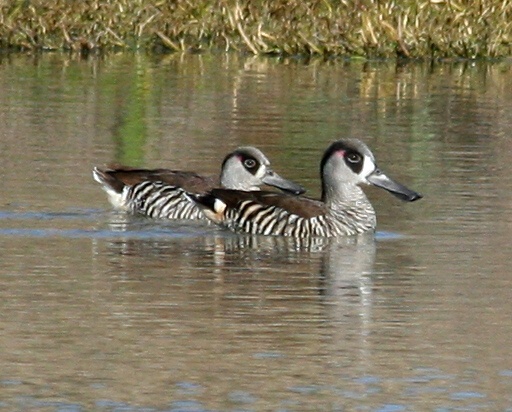
Malacorhynchus membranaceus occurs throughout Australia wherever standing water is available and is particularly associated with dry inland regions. It is distinguished by a characteristic pink ear spot, fine zebra-striped plumage, and a long, shovel-shaped bill.
Written 26 November 2026 from the sources listed below. Each statement was checked against the passage it cites; statements that could not be supported were removed.
Appearance
The Pink-eared Duck has a brown back and crown, barred black-and-white sides, and black eye patches on a white face. It has a large spatulate bill similar to that of the Australasian shoveler and measures 38–40 cm in length.[1][2][3]
The species has a pink spot near the corner of its black head pattern. The spot is only noticeable when viewed at close distance.[4][5][6]
Juveniles are slightly duller in appearance than adults. The Pink-eared Duck is the only known Anseriformes species with carotenoid pigments in its feathers.[7][8]
Habitat
The Pink-eared Duck occurs wherever standing water is available in Australia. It is particularly associated with dry inland regions where annual rainfall rarely exceeds 380 mm.[9][10][11]
The species is distributed throughout Australia and can occur anywhere in the country where standing water is present.[12][13]
Diet
The Pink-eared Duck depends on plankton as a food source and also feeds on crustaceans, mollusks, and insects.[14][15]
It filters algae and other plankton from water using pliable mandibular flaps.[16]
Behaviour
The Pink-eared Duck obtains food through a feeding method called vortexing. During vortex feeding, two ducks rotate around a central point, with one bird's head opposite the other's tail, concentrating food within a rotating column of water.[17][18][19]
The species is highly mobile.[20]
Reproduction and life cycle
Nesting is stimulated by the drying and subsequent filling of pools. This process promotes increased levels of organic material that stimulate nesting.[21][22]
Large numbers of Pink-eared Ducks gather in shallow flood plains during favourable years. Reproduction may cease completely when environmental conditions are unsuitable.[23][24]
Similar species
The extinct Scarlett's Duck from New Zealand was closely related to the Pink-eared Duck and was slightly larger.[25]
Uses
The Pink-eared Duck is hunted in Australian regions except Tasmania.[26]
Conservation
Animal welfare groups oppose duck hunting because they consider the practice unacceptably cruel.[27]
The Pink-eared Duck was most recently assessed for the IUCN Red List in 2024.[28]
Classification of the Pink-eared Duck
| Kingdom | Animalia |
|---|---|
| Phylum | Chordata |
| Subphylum | Vertebrata |
| Infraphylum | Gnathostomata |
| Parvphylum | Osteichthyes |
| Megaclass | Tetrapoda |
| Class | Aves (Bird) |
| Order | Anseriformes (Ducks) |
| Family | Anatidae (Ducks) |
| Genus | Malacorhynchus |
| Species | Malacorhynchus membranaceus (Latham, 1801) |
Where the Pink-eared Duck is found
Checklists and occurrence records place Malacorhynchus membranaceus in 2 countries across Oceania. GBIF holds 140,277 georeferenced records of it.
Countries
Regions and cities with the most records
- Victoria, Australia 46,806
- New South Wales, Australia 28,577
- Western Australia, Australia 18,839
- Queensland, Australia 16,518
- Perth, Australia 10,581
- South Australia, Australia 10,064
- Canberra, Australia 9,240
- Australian Capital Territory, Australia 9,166
- Northern Territory, Australia 8,305
- Tuggeranong, Australia 7,352
- Burwood, Australia 6,567
- Alice Springs, Australia 4,943
- Melbourne, Australia 4,545
- Balwyn North, Australia 4,367
- Geelong, Australia 3,894
- Frankston East, Australia 3,769
- St Albans, Australia 2,307
- Kwinana, Australia 2,252
- Brisbane, Australia 1,617
- Sydney, Australia 1,152
- Adelaide Hills, Australia 1,066
- Mount Barker, Australia 1,046
- Adelaide, Australia 1,036
- Maitland, Australia 800
- Narangba, Australia 690
- Goulburn, Australia 676
- Palmerston, Australia 671
- Darwin, Australia 656
- Newcastle, Australia 651
- Capalaba, Australia 585
- Torquay, Australia 538
- Logan City, Australia 527
- Griffith, Australia 523
- Bathurst, Australia 475
- Mildura, Australia 473
- Parramatta, Australia 456
2 more countries have a few records outside this range
These countries hold a few records of Malacorhynchus membranaceus but lie outside the range the checklists give for it. Such records are often zoo or garden specimens, museum material or vagrants, so the species is not counted as occurring there.
Range as the checklists state it
Australia
A number beside a place is its count of GBIF occurrence records. A place without a number comes from a checklist alone. Records show where a species has been observed or collected, which can include escapes and vagrants.
Common names
English
- Pink-eared Duck
- Pink Eared Duck
- Zebra Duck
Names in 26 other languages
- Arabic
- بط وردي الأذنين
- Catalan
- ànec cullerot zebrat
- Chinese
- 紅耳鴨, 红耳鸭
- Croatian
- prugasta patka
- Czech
- lžičák širokozobý
- Danish
- Zebraand
- Dutch
- Lepelbekeend
- Esperanto
- rozorela anaso
- Estonian
- koostnokk-part
- Finnish
- liuskanokkasorsa
- French
- Canard à oreilles roses, Malacorhynque à oreilles roses
- German
- Rosenohr-Ente, Rosenohrente, Spatelschnabelente
- Hungarian
- lapátcsőrű réce
- Italian
- Anatra guancerosa
- Japanese
- サザナミオオハシガモ
- Lithuanian
- raudonausė antis
- Norwegian
- leppeand
- Polish
- łopatonos
- Portuguese
- pato-d'orelhas-rosadas, pato-de-orelha-rosada, pato-de-orelhas-rosadas
- Russian
- Розовоухая утка
- Serbian
- Zebrasta plovka kašikara
- Slovak
- lopatárka zobatá
- Spanish
- Pato pachón
- Turkish
- Zebra Ördeği
- Ukrainian
- качка-лопатоніс
- Welsh
- hwyaden glustwridog
Synonyms
3 other scientific names have been used for this species and are now treated as synonyms of Malacorhynchus membranaceus.
- Anas membranacea Latham, 1801
- Malacorhynchus iodotis Lesson, RP, 1844
- Malacorhynchus membranaceus assimilis Mathews, GM, 1912
Related species
-
 Canada GooseBranta canadensis
-
 MallardAnas platyrhynchos
-
 Muscovy DuckCairina moschata
-
 Mute SwanCygnus olor
-
 Black SwanCygnus atratus
-
 Mandarin DuckAix galericulata
-
 Egyptian GooseAlopochen aegyptiaca
-
 Trumpeter SwanCygnus buccinator
Compare
Questions and answers
What is the scientific name of the Pink-eared Duck?
The scientific name of the Pink-eared Duck is Malacorhynchus membranaceus. Written with its author, the full name is Malacorhynchus membranaceus (Latham, 1801).
Which family does the Pink-eared Duck belong to?
Malacorhynchus membranaceus belongs to the family Anatidae, in the order Anseriformes and the class Aves.
Where is the Pink-eared Duck found?
Checklists and occurrence records place Malacorhynchus membranaceus in 2 countries: Australia and New Zealand.
What is the conservation status of the Pink-eared Duck?
The IUCN Red List category recorded for Malacorhynchus membranaceus is Least Concern (LC).
What other names does the Pink-eared Duck have?
Malacorhynchus membranaceus is also known in English as Pink Eared Duck and Zebra Duck.
Sources
Passages the profile rests on
- The Pink-eared Duck has a large spatulate bill similar to that of the Australasian shoveler. Source passage: “The pink-eared duck has a large spatulate bill like the Australasian shoveler” — English Wikipedia
- The Pink-eared Duck measures 38–40 cm in length. Source passage: “but is smaller at 38–40 cm length.” — English Wikipedia
- The species has a brown back and crown, barred black-and-white sides, and black eye patches on a white face. Source passage: “Its brown back and crown, black and white barred sides and black eye patches on its otherwise white face” — English Wikipedia
- The species has a pink spot at the corner of its head pattern. Source passage: “Its vernacular name refers to a pink spot in the corner formed by the black head pattern” — English Wikipedia
- The pink spot is only noticeable when viewed at close distance. Source passage: “it is only noticeable at close distance however” — English Wikipedia
- The English name Pink-eared Duck refers to the pink spot near the corner of the bird's black head pattern. Source passage: “Its vernacular name refers to a pink spot in the corner formed by the black head pattern” — English Wikipedia
- Juveniles are slightly duller in appearance than adults. Source passage: “Juveniles are slightly duller, but otherwise all plumages are similar.” — English Wikipedia
- The Pink-eared Duck is the only known Anseriformes species with carotenoid pigments in its feathers. Source passage: “This species is the only member of the order Anseriformes known to have carotenoid pigments in its feathers” — English Wikipedia
- The species occurs wherever standing water is available in Australia. Source passage: “these ducks can appear anywhere there is standing water” — English Wikipedia
- The species is particularly associated with dry inland regions of Australia. Source passage: “especially in dry inland regions” — English Wikipedia
- The species occurs in regions where annual rainfall rarely exceeds 380 mm. Source passage: “where annual rainfall rarely exceeds 15 in (380 mm).” — English Wikipedia
- The Pink-eared Duck is distributed throughout Australia. Source passage: “Widely distributed throughout Australia” — English Wikipedia
- The species can occur anywhere in Australia where standing water is present. Source passage: “these ducks can appear anywhere there is standing water” — English Wikipedia
- The Pink-eared Duck depends on plankton as a food source. Source passage: “They are dependent on plankton” — English Wikipedia
- The species also feeds on crustaceans, mollusks, and insects. Source passage: “as well as crustaceans, mollusks and insects.” — English Wikipedia
- The species filters algae and other plankton from water using pliable mandibular flaps. Source passage: “with pliable mandibular flaps that channel water in a manner that allow the ducks to filter algae and other plankton efficiently.” — English Wikipedia
- The Pink-eared Duck obtains food through a feeding method called vortexing. Source passage: “They also feed by vortexing” — English Wikipedia
- During vortex feeding, two ducks rotate around a central point with one bird's head opposite the other's tail. Source passage: “in which two ducks spin about a central point with the head of one opposite the tail of the other” — English Wikipedia
- Vortex feeding concentrates food within a rotating column of water. Source passage: “concentrating food in a gyrating water column.” — English Wikipedia
- The species is highly mobile. Source passage: “Widely distributed throughout Australia and highly mobile” — English Wikipedia
- Nesting is stimulated by the drying and subsequent filling of pools. Source passage: “Nesting is stimulated by the drying and filling of pools” — English Wikipedia
- Pool drying and refilling promotes increased levels of organic material that stimulate nesting. Source passage: “that promote increased levels of organic material.” — English Wikipedia
- Large numbers of Pink-eared Ducks gather in shallow flood plains during favourable years. Source passage: “In good years, large numbers of pink-eared ducks concentrate in shallow flood plains.” — English Wikipedia
- Reproduction may cease completely when environmental conditions are unsuitable. Source passage: “when conditions do not meet specifications, reproduction may be completely curtailed.” — English Wikipedia
- The extinct Scarlett's Duck from New Zealand was closely related to the Pink-eared Duck and slightly larger. Source passage: “a closely related, but slightly larger extinct form from New Zealand was described as Scarlett's duck” — English Wikipedia
- The Pink-eared Duck is hunted in Australian regions except Tasmania. Source passage: “The pink-eared duck is hunted in all regions in Australia except Tasmania.” — English Wikipedia
- Animal welfare groups oppose duck hunting because they consider the practice unacceptably cruel. Source passage: “The activity is opposed by animal welfare groups who consider the practice to be unacceptably cruel.” — English Wikipedia
- The Pink-eared Duck was most recently assessed for the IUCN Red List in 2024. Source passage: “has most recently been assessed for The IUCN Red List of Threatened Species in 2024.” — iucnredlist.org
Data
- Catalogue of Life, 2026-10-16 XR cc by
- Global Biodiversity Information Facility CC BY 4.0
- Wikidata CC0
- GeoNames CC BY 4.0
- Wikimedia Commons per image; credit shown with each image
- Within the Catalogue of Life, this name comes from The Integrated Taxonomic Information System cc0
References
- Gill, Frank, & and Minturn Wright. (2006). Birds of the World: Recommended English Names.
- Dickinson, E. C., and J. V. Remsen Jr., eds. (2013). The Howard and Moore Complete Checklist of the Birds of the World, 4th Edition, Vol. 1 Non-Passerines.
This species in other databases
Page built on 27 November 2026. See how the catalog is made and all sources and licences.
Cite this page
ScientificNames.org. (2026). Malacorhynchus membranaceus (Pink-eared Duck). Retrieved November 27, 2026, from https://scientificnames.org/species/malacorhynchus-membranaceus
“Malacorhynchus membranaceus (Pink-eared Duck).” ScientificNames.org, 2026, scientificnames.org/species/malacorhynchus-membranaceus. Accessed 27 Nov. 2026.
ScientificNames.org. “Malacorhynchus membranaceus (Pink-eared Duck).” Accessed November 27, 2026. https://scientificnames.org/species/malacorhynchus-membranaceus.
@misc{scientificnames_malacorhynchus_membranaceus_pink_eared_duck,
  author = {{ScientificNames.org}},
  title = {Malacorhynchus membranaceus (Pink-eared Duck)},
  year = {2026},
  url = {https://scientificnames.org/species/malacorhynchus-membranaceus},
  note = {Accessed 2026-11-27}
}