| Appearance | - The maned wolf has slender legs and a dense reddish coat. English Wikipedia
- The maned wolf has reddish-brown to golden-orange fur on its sides, black legs, and a distinctive black mane. English Wikipedia
- The maned wolf has a whitish tail-tip tuft and a white marking beneath its throat. English Wikipedia
- The maned wolf has large ears measuring approximately 18 cm long. English Wikipedia
- The maned wolf's mane can become erect to enlarge its profile during threats or aggressive displays. English Wikipedia
- Melanistic individuals occur in the species but are rare. English Wikipedia
- Young maned wolves have darker fur than adults. English Wikipedia
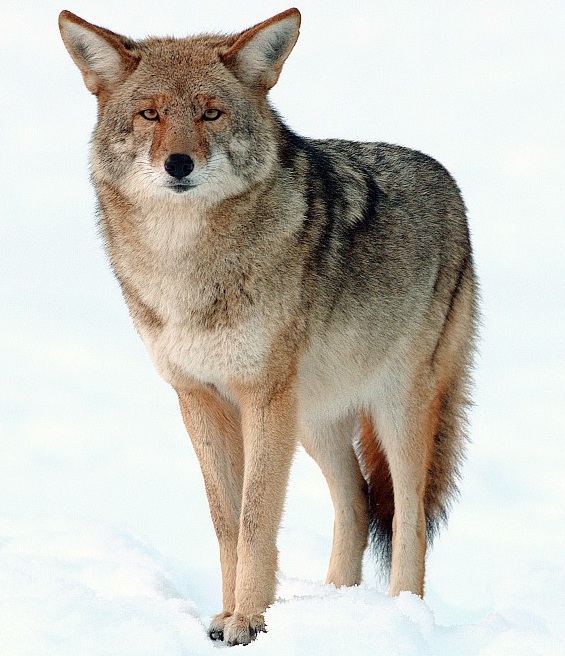
| - The coyote typically has a coat combining light gray, reddish or fulvous, black, and white coloration. English Wikipedia
- Coyotes have pointed ears, a narrow muzzle, and a bushy tail with a black tip. nps.gov
- Coyotes generally have a grey-brown coat with black-tipped hairs along their backs. nps.gov
- The coyote has longer ears and a relatively larger braincase than the gray wolf. English Wikipedia
- Coyotes carry their tails downward when walking or running. English Wikipedia
|
|---|
| Size | | - Male coyotes typically weigh between 8 and 20 kg. English Wikipedia
- Female coyotes typically weigh between 7 and 18 kg. English Wikipedia
- Adult coyotes have an average total body length, including the tail, of 1.0 to 1.35 m. English Wikipedia
- The coyote's tail measures approximately 40 cm in length. English Wikipedia
- The average shoulder height of coyotes ranges from 18 to 23 inches. nps.gov
- Coyotes average approximately 20 to 35 pounds in weight according to the Jewel Cave National Monument account. nps.gov
- Northern coyote subspecies average approximately 18 kg, compared with 11.5 kg for southern Mexican subspecies. English Wikipedia
|
|---|
| Habitat | - The maned wolf inhabits open and semi-open habitats, particularly grasslands containing scattered bushes and trees. English Wikipedia
- The maned wolf uses open fields for foraging and more enclosed areas such as riparian forests for resting. English Wikipedia
- The maned wolf's preferred habitats include grasslands, scrub prairies, and forests. English Wikipedia
- The maned wolf can survive in disturbed habitats, including burned areas and locations with substantial human influence. English Wikipedia
- The maned wolf inhabits grasslands, savannahs, swamplands, and scrub forests in central and eastern Brazil and northern Argentina. drum.lib.umd.edu
| |
|---|
| Diet | - The maned wolf is an omnivore whose diet includes both animal and plant matter. pmc.ncbi.nlm.nih.gov
- The maned wolf's diet averages approximately equal proportions of vegetable and animal matter. pmc.ncbi.nlm.nih.gov
- Solanum lycocarpum, commonly called wolf's fruit, is the most frequently consumed plant material. pmc.ncbi.nlm.nih.gov
- The maned wolf consumes small mammals, including rodents and armadillos. pmc.ncbi.nlm.nih.gov
- The maned wolf also consumes birds, reptiles, and invertebrates. pmc.ncbi.nlm.nih.gov
- Vegetable material represented 50.5% of the total dietary mass in the examined stomachs. pmc.ncbi.nlm.nih.gov
- Vertebrates represented 42.5% of the total dietary mass in the examined stomachs. pmc.ncbi.nlm.nih.gov
- The species has been recorded consuming more than 500 dietary items. pmc.ncbi.nlm.nih.gov
- The maned wolf's consumption of different dietary items varies seasonally and with habitat. pmc.ncbi.nlm.nih.gov
- Examined maned wolf stomachs contained anthropogenic materials including cooked rice, glass, and ceramic fragments. pmc.ncbi.nlm.nih.gov
| - Coyotes preferentially prey on Dall's sheep, white-tailed deer, eastern cottontail rabbits, and California voles. pmc.ncbi.nlm.nih.gov
- Coyotes avoid preying on small mammals, including carnivorans and arboreal species. pmc.ncbi.nlm.nih.gov
- Coyotes consume deer, rabbits, hares, rodents, birds, reptiles, amphibians, fish, and invertebrates. English Wikipedia
- Coyotes occasionally consume fruits and vegetables. English Wikipedia
- Coyotes in the southern United States may consume more frogs than coyotes in other regions. nps.gov
- Coyotes in the Yukon may consume more berries. nps.gov
- Vegetation consumption by coyotes is greatest during summer and autumn. research.fs.usda.gov
|
|---|
| Behaviour | | - Coyotes can live either in family units or in loosely organized packs of unrelated individuals. English Wikipedia
- Coyotes can hunt either individually or in groups. pmc.ncbi.nlm.nih.gov
- Coyotes may form groups of five to six adults under favorable conditions. nps.gov
- Coyote packs containing more than ten animals have been observed. nps.gov
- Coyotes may establish and defend territories or survive as nonterritorial transient individuals. pmc.ncbi.nlm.nih.gov
- Coyotes characteristically produce howls that rapidly change in tone and pitch. English Wikipedia
|
|---|
| Reproduction | - The maned wolf's mating season extends from November through April. English Wikipedia
- Gestation in the maned wolf lasts approximately 60–65 days. English Wikipedia
- A typical maned wolf litter contains two to six pups. English Wikipedia
- Maned wolf pups begin life with black fur and develop red fur after approximately ten weeks. English Wikipedia
- Both parents participate in caring for the pups, although females provide most parental care. English Wikipedia
- Maned wolves reach sexual maturity at approximately one year of age. English Wikipedia
| |
|---|
| Lifespan | - The estimated lifespan of maned wolves in captivity is 12–15 years. English Wikipedia
- A maned wolf at São Paulo Zoo was reported to have lived for 22 years. English Wikipedia
| No checked fact yet |
|---|
| Distribution | | - Coyotes are native to North America. English Wikipedia
- Coyotes occur throughout North and Central America. animaldiversity.org
- Coyotes have expanded their geographic range by approximately 40 percent over the past 120 years. research.fs.usda.gov
- Coyotes currently occur in every US state except Hawaii and extend as far north as the Arctic. nps.gov
- Coyotes were first sighted in eastern Panama in 2013. English Wikipedia
|
|---|
| Conservation | - The IUCN classifies the maned wolf as Near Threatened. pmc.ncbi.nlm.nih.gov
- Habitat loss and vehicle collisions threaten the maned wolf. English Wikipedia
- The maned wolf is listed as Endangered in the United States Fish and Wildlife Service species profile. ecos.fws.gov
- The maned wolf occurs in protected areas including Caraça and Emas National Parks in Brazil. English Wikipedia
| - The coyote is classified as Least Concern by the International Union for Conservation of Nature. English Wikipedia
- Human persecution is a major cause of coyote mortality. nps.gov
- Trapping for their pelts is one of the major causes of coyote mortality throughout their range. nps.gov
- Coyotes have expanded their range despite substantial persecution related to actual or perceived livestock predation. pmc.ncbi.nlm.nih.gov
|
|---|
| Uses | - Some Brazilian communities historically hunted maned wolves for body parts, particularly their eyes, which were believed to bring good luck. English Wikipedia
| No checked fact yet |
|---|
| Name origin | No checked fact yet | |
|---|
| Other | - The maned wolf is the only species in the genus Chrysocyon. English Wikipedia
- The maned wolf contributes to seed dispersal through the excretion of seeds from consumed plants. English Wikipedia
| No checked fact yet |
|---|