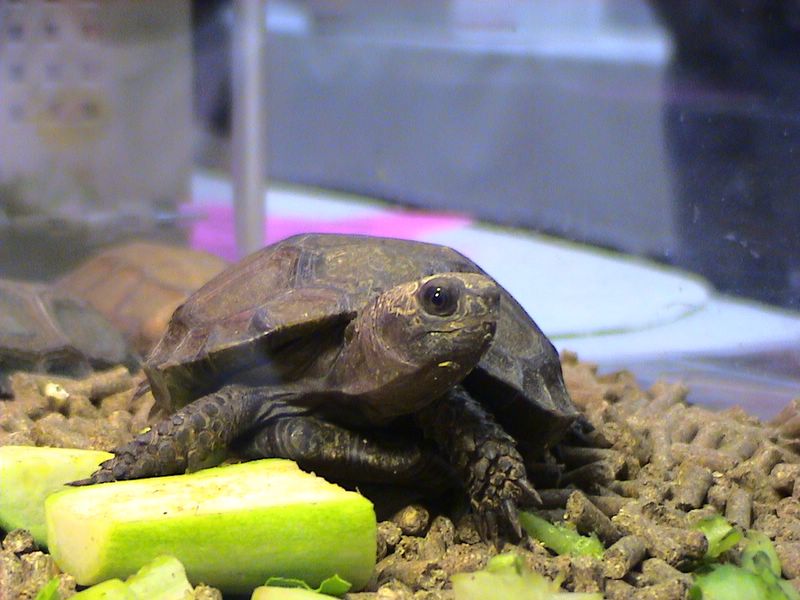
| Appearance | - Adults typically have dark brown or blackish coloration. English Wikipedia
- Juveniles have yellowish-brown upper shells marked with dark brown patterns. English Wikipedia
- The upper shell is broad and flattened, with a depth less than half its length. English Wikipedia
- The upper shell has upturned, strongly toothed front and rear margins. English Wikipedia
- The lower shell is large, with an extended throat region and a deeply indented rear lobe. English Wikipedia
- The head has two large prefrontal shields and one large frontal shield. English Wikipedia
- The species has an unhooked beak and weakly toothed jaws. English Wikipedia
- The front surfaces of the forelimbs bear large, pointed, overlapping bony bumps arranged in four or five longitudinal rows. English Wikipedia
- The hind limbs have large bony bumps on their soles and larger conical, spur-like bumps on their heels. English Wikipedia
| |
|---|
| Size | - The species is the largest tortoise inhabiting Asia. animaldiversity.org
- The brown tortoise can reach approximately 50 centimeters in length and 20 kilograms in weight. animaldiversity.org
- The Burmese brown subspecies can reach 60 centimeters in length and 37 kilograms in weight. animaldiversity.org
- The species has recorded carapace lengths of up to 600 millimeters and body masses of up to 40 kilograms. pmc.ncbi.nlm.nih.gov
| - The species is the largest mainland tortoise in Africa and the third-largest tortoise worldwide. English Wikipedia
- Adult males have an average body mass of approximately 81 kg. English Wikipedia
- Some males have been recorded weighing more than 120 kg. English Wikipedia
- Adult males have a straight carapace length of approximately 86 cm. English Wikipedia
- Adult females have a straight carapace length of approximately 57.8 cm. English Wikipedia
- Hatchlings measure approximately 44 mm in length and weigh around 40 g. English Wikipedia
- Young tortoises can reach lengths of 15–25 cm within their first few years. English Wikipedia
|
|---|
| Habitat | - The species inhabits evergreen forests at elevations between 600 and 1,500 meters. English Wikipedia
- The species occurs in highland tropical forests and favors cooler, moister conditions than other tortoises. animaldiversity.org
- Its habitats are generally temperate and moist environments influenced by monsoon rainfall. animaldiversity.org
- The species generally remains close to water sources such as ponds. animaldiversity.org
- The species prefers primary rainforests with steep slopes, moderate elevations, and proximity to rivers. pmc.ncbi.nlm.nih.gov
| - The species inhabits semiarid grasslands, savannas and thorn shrublands in the Sahel. English Wikipedia
- Individuals occupy hills, stable dunes and flat areas containing shrubs and tall grass. English Wikipedia
- The species also inhabits areas near intermittent streams and rivers. English Wikipedia
- Individuals excavate underground burrows to reach areas with higher moisture levels in arid habitats. English Wikipedia
- Wild individuals can excavate burrows reaching approximately 15 m deep and 30 m long. English Wikipedia
|
|---|
| Diet | - The species consumes whole fungi in the wild. English Wikipedia
- Its documented wild diet includes shoots of koster's curse (Miconia crenata). English Wikipedia
- The species eats leaves and petioles of Alocasia sarawakensis and Alocasia scabriuscula. English Wikipedia
- Its documented wild diet includes shoots of Begonia species and Phrynium species. English Wikipedia
- The species consumes shoots of vegetable fern (Diplazium esculentum). English Wikipedia
- The species eats flowers of wild ginger (Etlingera coccinea). English Wikipedia
- Plants of the genus Alocasia are among the most frequently consumed foods. English Wikipedia
- The species is predominantly herbivorous but may occasionally consume frogs, snails, and carrion in captivity. English Wikipedia
- Its typical diet includes grasses, vegetables, leaves, and fruits. animaldiversity.org
- The species occasionally consumes small invertebrates and amphibians. animaldiversity.org
- The Sundaic subspecies consumes fruits from 30 documented plant species. pmc.ncbi.nlm.nih.gov
- The Sundaic subspecies consumes seeds as large as those of Durio and Artocarpus, measuring more than 2 by 4 centimeters. pmc.ncbi.nlm.nih.gov
| - The species feeds primarily on grasses, succulent plants and hay. English Wikipedia
- Its diet can include flowers and cactus pads. English Wikipedia
- Wild individuals have been observed eating plants and algae growing on water surfaces. English Wikipedia
- Individuals occasionally consume carcasses of dead animals despite being predominantly herbivorous. English Wikipedia
- Wild individuals mostly consume dead goats and zebras carried downstream during the wet season. English Wikipedia
|
|---|
| Behaviour | - The species moves slowly even when threatened. animaldiversity.org
- The species is most active during twilight or during the day when temperatures are not too high. animaldiversity.org
- When the climate is excessively warm, individuals may burrow into damp soil and leaf litter. animaldiversity.org
- Individuals may soak in pools and small streams. animaldiversity.org
- The Sundaic subspecies is predominantly active during daylight, accounting for 93% of recorded activities. pmc.ncbi.nlm.nih.gov
- The Sundaic subspecies has a mean home range of 27.5 hectares, with a standard deviation of 28.8 hectares across three individuals. pmc.ncbi.nlm.nih.gov
- Males use head-bobbing to communicate with potential mates during courtship. animaldiversity.org
- Male courtship includes following females closely and attempting to mount them when they stop or slow down. animaldiversity.org
| - Individuals spend the hottest part of the day inside underground burrows. English Wikipedia
- The species undergoes aestivation while sheltering in burrows during hot periods. English Wikipedia
- Adult males are highly territorial and compete with one another for mating access to females. English Wikipedia
|
|---|
| Reproduction | - Females remain near their nests and protect them against predators and intruders. English Wikipedia
- Incubation periods have been reported to range from 60 to 90 days. English Wikipedia
- The southern subspecies has an estimated pivotal temperature for temperature-dependent sex determination of 29.29 degrees Celsius. English Wikipedia
- Higher incubation temperatures produce a higher proportion of female hatchlings, whereas lower temperatures produce more males. English Wikipedia
- Reported captive clutch sizes range from 21 to 53 eggs. animaldiversity.org
- Artificially incubated captive eggs have incubation periods of 63 to 84 days. animaldiversity.org
- Females may defend their nests by pushing or biting approaching predators. animaldiversity.org
| |
|---|
| Lifespan | No checked fact yet | - The lifespan of wild individuals is unknown but is believed to exceed 75 years. English Wikipedia
- Individuals kept in captivity have a reported lifespan of approximately 54 years. English Wikipedia
|
|---|
| Distribution | - The species occurs in Bangladesh, Cambodia, India, Indonesia, Malaysia, Myanmar, Thailand, and Vietnam. English Wikipedia
| |
|---|
| Conservation | - The Sundaic subspecies is classified as critically endangered. pmc.ncbi.nlm.nih.gov
- The species faces threats from deforestation, forest fires, agricultural activities, pet-trade exploitation, medicinal use, and climate change. pmc.ncbi.nlm.nih.gov
- The Sundaic subspecies is extremely rare throughout its geographic range. pmc.ncbi.nlm.nih.gov
- Fifteen priority areas with high habitat suitability but without formal protection were identified in Sumatra. pmc.ncbi.nlm.nih.gov
- A wildlife corridor connecting Gunung Talang to Kerinci Seblat National Park was proposed. pmc.ncbi.nlm.nih.gov
- The species' largest apparent limiting factors for lifespan are predation by humans and habitat destruction. animaldiversity.org
| - The species is classified as endangered. English Wikipedia
- Surveys indicate that the species occupies approximately 16.7% of its former range. English Wikipedia
- Competition with cattle for grazing resources is a documented threat to the species. English Wikipedia
- Collection from the wild for the pet trade threatens the species. English Wikipedia
- A total of 9,132 individuals were recorded as taken from the wild for the pet trade between 1990 and 2010. English Wikipedia
- The species faces moderate risk when kept as a pet. worldwildlife.org
- Providing suitable diet and habitat conditions for the species in captivity is difficult. worldwildlife.org
|
|---|
| Uses | | No checked fact yet |
|---|
| Other | | No checked fact yet |
|---|