Species · Reptiles
Asian Forest Tortoise Manouria emys
The scientific name of the Asian Forest Tortoise is Manouria emys. It is a species of reptile in the family Testudinidae (tortoises), order Testudines. The name dates from 1844.
- Scientific name
- Manouria emys (Schlegel & Müller, 1844)
- Common name
- Asian Forest Tortoise
- Genus
- Manouria
- Family
- Testudinidae (Tortoises)
- Order
- Testudines
- Class
- Reptilia
- Red List category
- CR Critically Endangered
- Recorded in
- 6 countries
- Name status
- accepted in the Catalogue of Life
Overview
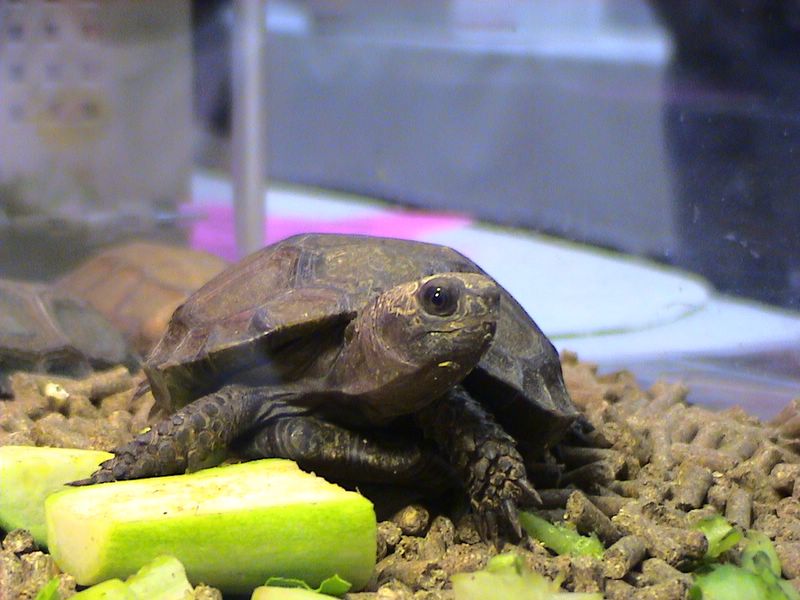
The Asian Forest Tortoise (Manouria emys) is a reptile in the family Testudinidae, order Testudines, and class Reptilia. Two subspecies are recognized. It inhabits evergreen forests at elevations between 600 and 1,500 meters and occurs in Bangladesh, Cambodia, India, Indonesia, Malaysia, Myanmar, Thailand, and Vietnam. It is the largest tortoise inhabiting Asia and has a broad, flattened upper shell with strongly toothed front and rear margins.
Written 26 November 2026 from the sources listed below. Each statement was checked against the passage it cites; statements that could not be supported were removed.
Appearance
Adults typically have dark brown or blackish coloration. Juveniles have yellowish-brown upper shells marked with dark brown patterns.[1][2]
The upper shell is broad and flattened, with a depth less than half its length. Its front and rear margins are upturned and strongly toothed.[3][4]
The lower shell is large, with an extended throat region and a deeply indented rear lobe. The head has two large prefrontal shields and one large frontal shield, an unhooked beak, and weakly toothed jaws.[5][6][7]
The front surfaces of the forelimbs bear large, pointed, overlapping bony bumps arranged in four or five longitudinal rows. The hind limbs have large bony bumps on their soles and larger conical, spur-like bumps on their heels.[8][9]
Habitat
The Asian Forest Tortoise inhabits evergreen forests at elevations between 600 and 1,500 meters. It occurs in highland tropical forests and favors cooler, moister conditions than other tortoises.[10][11]
Its habitats are generally temperate and moist environments influenced by monsoon rainfall. It prefers primary rainforests with steep slopes, moderate elevations, and proximity to rivers.[12][13]
The species generally remains close to water sources such as ponds.[14]
Diet
The Asian Forest Tortoise is predominantly herbivorous. Its typical diet includes grasses, vegetables, leaves, and fruits, and it consumes whole fungi in the wild.[15][16][17]
Documented wild foods include shoots of koster's curse (Miconia crenata), leaves and petioles of Alocasia sarawakensis and Alocasia scabriuscula, and shoots of Begonia species and Phrynium species. Plants of the genus Alocasia are among its most frequently consumed foods.[18][19][20][21]
Other documented foods include shoots of vegetable fern (Diplazium esculentum) and flowers of wild ginger (Etlingera coccinea).[22][23]
The species occasionally consumes small invertebrates and amphibians. Frogs, snails, and carrion may also be consumed in captivity.[16][24]
The Sundaic subspecies consumes fruits from 30 documented plant species. Its diet also includes seeds as large as those of Durio and Artocarpus, measuring more than 2 by 4 centimeters.[25][26]
Behaviour
The Asian Forest Tortoise moves slowly even when threatened. It is most active during twilight or during the day when temperatures are not too high.[27][28]
When the climate is excessively warm, individuals may burrow into damp soil and leaf litter. They may also soak in pools and small streams.[29][30]
The Sundaic subspecies is predominantly active during daylight, accounting for 93% of recorded activities. Its mean home range is 27.5 hectares, with a standard deviation of 28.8 hectares across three individuals.[31][32]
Males use head-bobbing to communicate with potential mates during courtship. They follow females closely and attempt to mount them when they stop or slow down.[33][34]
Reproduction and life cycle
Females remain near their nests and protect them against predators and intruders. They may defend their nests by pushing or biting approaching predators.[35][36]
Reported incubation periods range from 60 to 90 days. Artificially incubated captive eggs have incubation periods of 63 to 84 days.[37][38]
Reported captive clutch sizes range from 21 to 53 eggs.[39]
The southern subspecies has an estimated pivotal temperature for temperature-dependent sex determination of 29.29 degrees Celsius. Higher incubation temperatures produce a higher proportion of female hatchlings, whereas lower temperatures produce more males.[40][41]
Conservation
The Sundaic subspecies is classified as critically endangered and is extremely rare throughout its geographic range.[42][43]
The species faces threats from deforestation, forest fires, agricultural activities, pet-trade exploitation, medicinal use, and climate change. Predation by humans and habitat destruction are its largest apparent limiting factors for lifespan.[44][45]
Fifteen priority areas with high habitat suitability but without formal protection were identified in Sumatra. A wildlife corridor connecting Gunung Talang to Kerinci Seblat National Park was proposed.[46][47]
Uses
The Asian Forest Tortoise is exploited for the pet trade and medicinal use.[48]
Classification of the Asian Forest Tortoise
| Kingdom | Animalia |
|---|---|
| Phylum | Chordata |
| Subphylum | Vertebrata |
| Infraphylum | Gnathostomata |
| Parvphylum | Osteichthyes |
| Megaclass | Tetrapoda |
| Class | Reptilia (Reptile) |
| Order | Testudines (Turtle) |
| Suborder | Cryptodira |
| Superfamily | Testudinoidea |
| Family | Testudinidae (Tortoises) |
| Genus | Manouria (Indochinese Tortoises) |
| Species | Manouria emys (Schlegel & Müller, 1844) |
Where the Asian Forest Tortoise is found
Checklists and occurrence records place Manouria emys in 6 countries across Asia. GBIF holds 281 georeferenced records of it.
Countries
Regions and cities with the most records
- Phetchaburi, Thailand 57
- Mizoram, India 27
- Sabah, Malaysia 26
- Aizawl, India 18
- Madhya Pradesh, India 15
- Sarawak, Malaysia 8
- Kuching, Malaysia 7
- Bau, Malaysia 5
- Jambi, Indonesia 4
- Aceh, Indonesia 3
- Lampung, Indonesia 3
- Serchhīp, India 3
- Nagaland, India 1
- Assam, India
1 more country has a few records outside this range
These countries hold a few records of Manouria emys but lie outside the range the checklists give for it. Such records are often zoo or garden specimens, museum material or vagrants, so the species is not counted as occurring there.
Range as the checklists state it
India (Assam, Nagaland), Bangladesh,
A number beside a place is its count of GBIF occurrence records. A place without a number comes from a checklist alone. Records show where a species has been observed or collected, which can include escapes and vagrants.
Common names
English
- Asian Forest Tortoise
- Asian Brown Tortoise
- Asian Giant Tortoise
- Asian Tortoise
- Black Giant Tortoise
- Brown Tortoise
- Burmese Brown Tortoise
- Burmese Mountain Tortoise
- Six-legged Tortoise
Names in 12 other languages
- Arabic
- سلحفاة البنية الآسيوية, سلحفاة الغابات الآسيوية
- Bengali
- এশীয় শিলা কচ্ছপ
- Chinese
- 亞洲棕龜
- Czech
- želva mohutná
- French
- Tortue brune
- German
- Braune Landschildkröte, Braune Waldschildkröte, Braune hinterindische Landschildkröte
- Hungarian
- barna teknős
- Indonesian
- Baning Coklat
- Japanese
- エミスムツアシガメ
- Portuguese
- Jabuti-gigante-asiático
- Russian
- Коричневая черепаха
- Thai
- เต่าหก
Synonyms
9 other scientific names have been used for this species and are now treated as synonyms of Manouria emys.
- Geochelone emys (Schlegel & Müller, 1840)
- Manouria fusca Gray, 1854
- Manouria fusca Gray, 1861
- Teleopus luxatus Le Conte, 1854
- Testudo (Scapia) falconeri Gray, 1869
- Testudo emydoides Duméril, Bibron & Duméril, 1851
- Testudo emys Schlegel & Müller, 1840
- Testudo nutapundi Reimann, 1979
- Testudo phayrei Blyth, 1853
Subspecies and varieties
- Manouria emys emys (Asian Brown Giant Tortoise) subspecies
- Manouria emys phayrei (Burmese Black Giant Tortoise) subspecies
Related species
-
 Impressed TortoiseManouria impressa
-
 Aldabra Giant TortoiseAldabrachelys gigantea
-
 African Spurred TortoiseCentrochelys sulcata
-
 Gopher TortoiseGopherus polyphemus
-
 Desert TortoiseGopherus agassizii
-
 Hermann's TortoiseTestudo hermanni
-
 Red-footed TortoiseChelonoidis carbonarius
-
 Indian Star TortoiseGeochelone elegans
Compare
Questions and answers
What is the scientific name of the Asian Forest Tortoise?
The scientific name of the Asian Forest Tortoise is Manouria emys. Written with its author, the full name is Manouria emys (Schlegel & Müller, 1844).
Which family does the Asian Forest Tortoise belong to?
Manouria emys belongs to the family Testudinidae, in the order Testudines and the class Reptilia.
Where is the Asian Forest Tortoise found?
Checklists and occurrence records place Manouria emys in 6 countries: Thailand, Indonesia, Malaysia, India, Bangladesh and Myanmar.
What is the conservation status of the Asian Forest Tortoise?
The IUCN Red List category recorded for Manouria emys is Critically Endangered (CR).
What other names does the Asian Forest Tortoise have?
Manouria emys is also known in English as Asian Brown Tortoise, Asian Giant Tortoise, Asian Tortoise, Black Giant Tortoise, Brown Tortoise and Burmese Brown Tortoise.
How big do Asian tortoises get?
The Asian Forest Tortoise is the largest tortoise inhabiting Asia. The species has recorded carapace lengths of up to 600 millimeters and body masses of up to 40 kilograms. The brown tortoise can reach approximately 50 centimeters in length and 20 kilograms in weight, while the Burmese brown subspecies can reach 60 centimeters and 37 kilograms.[49][50][51][52]
What is the diet of tortoises?
The Asian Forest Tortoise is predominantly herbivorous. Its typical diet includes grasses, vegetables, leaves, fruits, and fungi, along with documented wild foods such as Alocasia leaves and shoots, Begonia shoots, and wild ginger flowers.[15][19][20][23][21][16][17]
Sources
Passages the profile rests on
- Adults typically have dark brown or blackish coloration. Source passage: “Adults are dark brown or blackish.” — English Wikipedia
- Juveniles have yellowish-brown upper shells marked with dark brown patterns. Source passage: “Juveniles have a yellowish-brown carapace with dark-brown markings.” — English Wikipedia
- The upper shell is broad and flattened, with a depth less than half its length. Source passage: “The carapace is considerably depressed (flattened), its depth less than half its length.” — English Wikipedia
- The upper shell has upturned, strongly toothed front and rear margins. Source passage: “Anterior and posterior margins are reverted (upturned) and strongly serrated (toothed).” — English Wikipedia
- The lower shell is large, with an extended throat region and a deeply indented rear lobe. Source passage: “The lower shell (plastron) is large, with the gular region (throat area) produced (slightly extended) and typically notched (indented). The hind lobe (rear section) is deeply notched (indented).” — English Wikipedia
- The head has two large prefrontal shields and one large frontal shield. Source passage: “The head is moderate in size, featuring two large prefrontal shields and a large frontal shield.” — English Wikipedia
- The species has an unhooked beak and weakly toothed jaws. Source passage: “The beak is not hooked. Jaws are feebly denticulated (weakly toothed)” — English Wikipedia
- The front surfaces of the forelimbs bear large, pointed, overlapping bony bumps arranged in four or five longitudinal rows. Source passage: “Anterior forelimb surfaces have large, bony, pointed, imbricate tubercles (overlapping bumps) in four or five longitudinal series.” — English Wikipedia
- The hind limbs have large bony bumps on their soles and larger conical, spur-like bumps on their heels. Source passage: “Hind limbs bear large bony tubercles (bumps) on the plantar surface (sole), with larger, conical, spur-like tubercles (bumps) on the heel” — English Wikipedia
- The species inhabits evergreen forests at elevations between 600 and 1,500 meters. Source passage: “The preferred natural habitat of Manouria emys is evergreen forest, at elevations of 600–1,500 m (2,000–4,900 ft).” — English Wikipedia
- The species occurs in highland tropical forests and favors cooler, moister conditions than other tortoises. Source passage: “M. emys are typically found in highland tropical forests, and prefers cooler and moister conditions than other tortoise species.” — animaldiversity.org
- Its habitats are generally temperate and moist environments influenced by monsoon rainfall. Source passage: “Brown tortoises are found in temperate, moist habitats that are influenced by monsoon rains.” — animaldiversity.org
- The species prefers primary rainforests with steep slopes, moderate elevations, and proximity to rivers. Source passage: “Habitat preference analysis at both local and island‐wide scales showed a consistent preference for primary rainforests with steep slopes at moderate altitudes, and near rivers” — pmc.ncbi.nlm.nih.gov
- The species generally remains close to water sources such as ponds. Source passage: “these tortoises never wander far from a water source, such as a pond.” — animaldiversity.org
- The species consumes whole fungi in the wild. Source passage: “Manouria emys has been observed in the wild to consume whole fungi” — English Wikipedia
- The species is predominantly herbivorous but may occasionally consume frogs, snails, and carrion in captivity. Source passage: “In captivity, individuals have accepted a wide variety of food, predominantly being herbivorous but occasionally consuming frogs, snails, or carrion when presented.” — English Wikipedia
- Its typical diet includes grasses, vegetables, leaves, and fruits. Source passage: “Their diet typically consists of grasses, vegetables, leaves, and fruits.” — animaldiversity.org
- Its documented wild diet includes shoots of koster's curse (Miconia crenata). Source passage: “shoots of koster's curse (Miconia crenata)” — English Wikipedia
- The species eats leaves and petioles of Alocasia sarawakensis and Alocasia scabriuscula. Source passage: “leaves and petioles of elephant ears (Alocasia sarawakensis and Alocasia scabriuscula)” — English Wikipedia
- Its documented wild diet includes shoots of Begonia species and Phrynium species. Source passage: “shoots of Begonia sp., shoots of Phrynium sp.” — English Wikipedia
- Plants of the genus Alocasia are among the most frequently consumed foods. Source passage: “Most commonly eaten were plants of the genus Alocasia” — English Wikipedia
- The species consumes shoots of vegetable fern (Diplazium esculentum). Source passage: “shoots of vegetable fern (Diplazium esculentum)” — English Wikipedia
- The species eats flowers of wild ginger (Etlingera coccinea). Source passage: “flowers of wild ginger (Etlingera coccinea).” — English Wikipedia
- The species occasionally consumes small invertebrates and amphibians. Source passage: “They have been known to eat other animals on occasion, most of which were small invertebrates and amphibians.” — animaldiversity.org
- The Sundaic subspecies consumes fruits from 30 documented plant species. Source passage: “They consumed the fruits of 30 of these plants” — pmc.ncbi.nlm.nih.gov
- The Sundaic subspecies consumes seeds as large as those of Durio and Artocarpus, measuring more than 2 by 4 centimeters. Source passage: “swallowing seeds as large as those of Durio and Artocarpus (>2 × 4 cm)” — pmc.ncbi.nlm.nih.gov
- The species moves slowly even when threatened. Source passage: “Manouria emys moves very slowly, even when threatened.” — animaldiversity.org
- The species is most active during twilight or during the day when temperatures are not too high. Source passage: “The species is most active during twilight, or during the day if the temperature is not too high.” — animaldiversity.org
- When the climate is excessively warm, individuals may burrow into damp soil and leaf litter. Source passage: “If the climate is too warm, brown tortoises may burrow into damp soil and leaf litter.” — animaldiversity.org
- Individuals may soak in pools and small streams. Source passage: “They also are found soaking in pools and small streams.” — animaldiversity.org
- The Sundaic subspecies is predominantly active during daylight, accounting for 93% of recorded activities. Source passage: “Sundaic giant tortoises were predominantly diurnal (93% of activities)” — pmc.ncbi.nlm.nih.gov
- The Sundaic subspecies has a mean home range of 27.5 hectares, with a standard deviation of 28.8 hectares across three individuals. Source passage: “had a mean home range of 27.5 ha (±28.8 SD; N = 3 individuals” — pmc.ncbi.nlm.nih.gov
- Males use head-bobbing to communicate with potential mates during courtship. Source passage: “During courtship, males head-bob to communicate with prospective mates.” — animaldiversity.org
- Male courtship includes following females closely and attempting to mount them when they stop or slow down. Source passage: “If the female slows down or stops, the male usually attempts to mount her.” — animaldiversity.org
- Females remain near their nests and protect them against predators and intruders. Source passage: “She then sits on and near the nest to protect it, and will "chase" predators and intruders away.” — English Wikipedia
- Females may defend their nests by pushing or biting approaching predators. Source passage: “she first attempts to drive it away by pushing and even biting.” — animaldiversity.org
- Incubation periods have been reported to range from 60 to 90 days. Source passage: “Incubation time ranged from 60 to 90 days.” — English Wikipedia
- Artificially incubated captive eggs have incubation periods of 63 to 84 days. Source passage: “Incubation time ranges from 63-84 days, also in captive situations with artificial incubation.” — animaldiversity.org
- Reported captive clutch sizes range from 21 to 53 eggs. Source passage: “Reported clutch sizes range from 21 to 53 eggs, but these are all from captive females.” — animaldiversity.org
- The southern subspecies has an estimated pivotal temperature for temperature-dependent sex determination of 29.29 degrees Celsius. Source passage: “an estimated pivotal temperature of 29.29°C was determined.” — English Wikipedia
- Higher incubation temperatures produce a higher proportion of female hatchlings, whereas lower temperatures produce more males. Source passage: “Incubation temperatures higher than this produce high rates of female hatchlings, and lower than this produce high rates of males.” — English Wikipedia
- The Sundaic subspecies is classified as critically endangered. Source passage: “Sundaic giant tortoises (Manouria emys emys) are the largest chelonians in Asia. Classified as critically endangered” — pmc.ncbi.nlm.nih.gov
- The Sundaic subspecies is extremely rare throughout its geographic range. Source passage: “they are extremely rare throughout their range.” — pmc.ncbi.nlm.nih.gov
- The species faces threats from deforestation, forest fires, agricultural activities, pet-trade exploitation, medicinal use, and climate change. Source passage: “these tortoises are threatened by habitat loss due to deforestation, forest fires, agricultural activities, exploitation for the pet trade and medicinal use, and climate change” — pmc.ncbi.nlm.nih.gov
- The species' largest apparent limiting factors for lifespan are predation by humans and habitat destruction. Source passage: “The biggest limiting factor in lifespan seems to be predation, either by humans or from habitat destruction.” — animaldiversity.org
- Fifteen priority areas with high habitat suitability but without formal protection were identified in Sumatra. Source passage: “We identified 15 “priority areas,” that is, those with high habitat suitability but lacking formal protection.” — pmc.ncbi.nlm.nih.gov
- A wildlife corridor connecting Gunung Talang to Kerinci Seblat National Park was proposed. Source passage: “prompting us to propose a wildlife corridor connecting it to Kerinci Seblat National Park.” — pmc.ncbi.nlm.nih.gov
- The species is exploited for the pet trade and medicinal use. Source passage: “exploitation for the pet trade and medicinal use” — pmc.ncbi.nlm.nih.gov
- The species is the largest tortoise inhabiting Asia. Source passage: “Manouria emys is the largest tortoise inhabiting Asia.” — animaldiversity.org
- The brown tortoise can reach approximately 50 centimeters in length and 20 kilograms in weight. Source passage: “The brown tortoise can grow to 50 centimeters and weigh 20 kilograms.” — animaldiversity.org
- The Burmese brown subspecies can reach 60 centimeters in length and 37 kilograms in weight. Source passage: “The Burmese brown tortoise is larger (it can grow to 60 centimeters and weigh 37 kilograms)” — animaldiversity.org
- The species has recorded carapace lengths of up to 600 millimeters and body masses of up to 40 kilograms. Source passage: “with carapace lengths up to 600 mm and body masses reaching 40 kg” — pmc.ncbi.nlm.nih.gov
Data
- Catalogue of Life, 2026-10-16 XR cc by
- Global Biodiversity Information Facility CC BY 4.0
- Wikidata CC0
- GeoNames CC BY 4.0
- Wikimedia Commons per image; credit shown with each image
- Within the Catalogue of Life, this name comes from The Reptile Database cc by
References
- Lidth de Jeude, T. W. van (1896) On Testudo emys Schleg. and Mull. and its affinities. Notes Leyden Museum, 17, 197 - 204. where the name was published
- Schlegel, H., & Müller, S. (1844). Over de Schildpadden van den Indischen Archipel. In: Temminck,V. (1839-1847) Verhandelingen over de Natuurlijke Geschiedenis Der Nederlandsche Overzeesche Bezittingen, Door de Leden Der Natuurkundige Commisie in Oost-Indie En Andere Schrijvers. Leijden Folio. Afd. 1 Zoologie in 12 Afleveringen, Met 45 Gekl. Pl. - Vitg. Door C.J. Temminck, Leiden, Leuchtmans U. Hoeck in Comm.: 29-36.
- Blyth, E. (1854). Notices and descriptions of various reptiles, new or little-known. Part I. J. Asiat. Soc. Bengal 22 [1853]: 639-655.
- Gray, J. E. (1855). Description of a new genus and some new species of tortoises. Ann. Mag. Nat. Hist. (2) 15: 67-69.
- Gray, J. E. (1861). On the genus Manouria and its affinities. Ann. Mag. Nat. Hist. (3) 7: 215-217.
- Theobald, & William. (1868). Catalogue of the reptiles of British Birma, embracing the provinces of Pegu, Martaban, and Tenasserim; with descriptions of new or little-known species. Zool. J. Linnean Soc. 10: 4-67.
- Stoliczka, F. (1871). Note on Testudo Phayrei. Ann. Mag. Nat. Hist. (4) 8: 212.
- Anderson, J. (1871). On Testudo Phayrei, Theob. & Dr. Gray. Ann. Mag. Nat. Hist. (4) 8: 324-330.
- Gray, J. E. (1871). On Testudo phayrei and Scapia Falconeri. Ann. Mag. Nat. Hist. (4) 7: 445-447.
- Gray, J. E. (1872). On the genera Manouria and Scapia. Ann. Mag. Nat. Hist. (4) 10: 218-219.
- Baur, G. (1888). Osteologische Notizen über Reptilien. Fortsetzung III, IV, V. Zool. Anz. 11: 417-424, 592-597, 736-740.
- Boulenger, G. A. (1893). Viaggio di Leonardo Fea in Birmania e Regioni Vicine LII. Concluding report on the reptiles and batrachians obtained in Burma by Signor L. Fea, dealing with the collection made in Pegu and the Karin Hills in 1887-88. Annali Mus. Civ. Genova (2) 13: 304-347.
- Mell, R. (1938). Beiträge zur Fauna Sinica. VI. Aus der Biologie chinesischer Schildkröten. Archiv Für Naturgeschichte, N.F., 7 (3): 390-475.
- Nutaphand, W,. (1979). The Turtles of Thailand. Bangkok (Siamfarm Zool. Garden), 222 Pp.
- Pritchard, P. C. H., & Trebbau, P. (1984). Phrynops (Batrachemys) zuliae new species. In: The Turtles of Venezuela, Pp. 135-142.
- Ernst,C.H. and Barbour,R.W. (1989). Turtles of the World. Smithsonian Institution Press, Washington D.C. - London.
- Bhupathy, S. (1994). The distribution of the Asian brown tortoise (Manouria emys) in India and the taxonomic status of subspecies. J. Bombay Nat. Hist. Soc. 91 (1):147-148.
- Choudhury, A. U. (1996). Taxonomy of the brown hill tortoise Manouria emys (Schlegel and Muller) and its distribution in Indian subcontinent. Cheetal 35 (3-4): 36-39.
- Manthey, U., & Grossmann, W. (1997). Amphibien & Reptilien Südostasiens. Natur Und Tier Verlag (Münster), 512 Pp. (ISBN 3-931587-12-6).
- Bour, R. (1998). Histoire du genre Manouria Gray, 1854, et des espèces actuelles incluses. Manouria 1 (1): 1-9 [2002?].
- Cox, Merel J.; Van Dijk, Peter Paul; Jarujin Nabhitabhata & Thirakhupt,Kumthorn. (1998). A Photographic Guide to Snakes and Other Reptiles of Peninsular Malaysia, Singapore and Thailand. Ralph Curtis Publishing, 144 Pp.
- Chan-ard,T.; Grossmann,W.; Gumprecht,A. & Schulz,K. D. (1999). Amphibians and reptiles of peninsular Malaysia and Thailand - an illustrated checklist [bilingual English and German]. Bushmaster Publications, Würselen, Gemany, 240 Pp. [Book Review in Russ. J Herp. 7: 87].
- Pauwels,O.S.G. et al. (2000). Herpetological investigations in Phang-Nga Province, southern Peninsular Thailand, with a list of reptile species and notes on their biology. Dumerilia 4 (2): 123-154.
- Grossmann, W., & Tillack, F. (2001). Bemerkungen zur Herpetofauna des Khao Lak, Phang Nga, thailändische Halbinsel. Teil II: Reptilia: Serpentes; Testudines; Diskussion. Sauria 23 (1): 25-40.
- Choudhury, & Anwaruddin. (2001). Some chelonian records from Mizoram. J. Bombay Nat. Hist. Soc. 92 (2):184-190.
This species in other databases
Page built on 26 November 2026. See how the catalog is made and all sources and licences.
Cite this page
ScientificNames.org. (2026). Manouria emys (Asian Forest Tortoise). Retrieved November 26, 2026, from https://scientificnames.org/species/manouria-emys
“Manouria emys (Asian Forest Tortoise).” ScientificNames.org, 2026, scientificnames.org/species/manouria-emys. Accessed 26 Nov. 2026.
ScientificNames.org. “Manouria emys (Asian Forest Tortoise).” Accessed November 26, 2026. https://scientificnames.org/species/manouria-emys.
@misc{scientificnames_manouria_emys_asian_forest_tortoise,
  author = {{ScientificNames.org}},
  title = {Manouria emys (Asian Forest Tortoise)},
  year = {2026},
  url = {https://scientificnames.org/species/manouria-emys},
  note = {Accessed 2026-11-26}
}