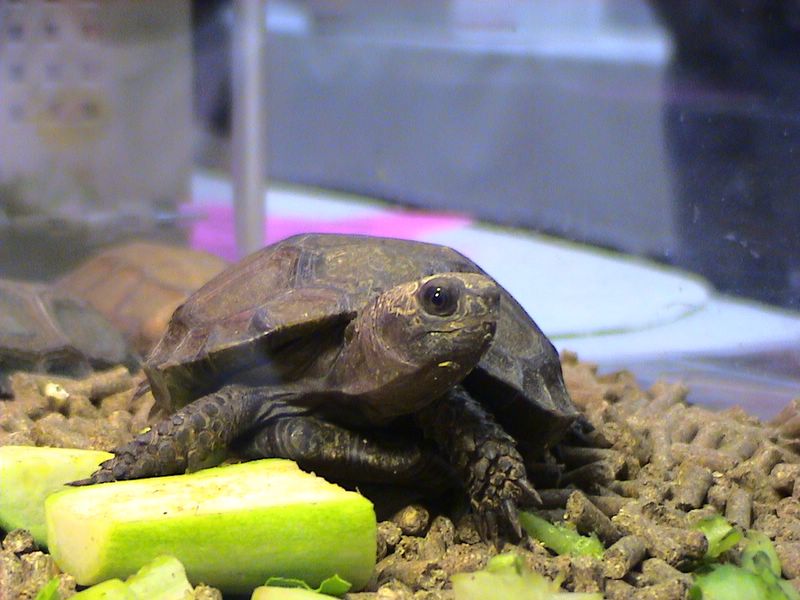
| Appearance | - Adults typically have dark brown or blackish coloration. English Wikipedia
- Juveniles have yellowish-brown upper shells marked with dark brown patterns. English Wikipedia
- The upper shell is broad and flattened, with a depth less than half its length. English Wikipedia
- The upper shell has upturned, strongly toothed front and rear margins. English Wikipedia
- The lower shell is large, with an extended throat region and a deeply indented rear lobe. English Wikipedia
- The head has two large prefrontal shields and one large frontal shield. English Wikipedia
- The species has an unhooked beak and weakly toothed jaws. English Wikipedia
- The front surfaces of the forelimbs bear large, pointed, overlapping bony bumps arranged in four or five longitudinal rows. English Wikipedia
- The hind limbs have large bony bumps on their soles and larger conical, spur-like bumps on their heels. English Wikipedia
| - The gopher tortoise has a dark brown to gray-black upper body and a yellow underside of its shell. English Wikipedia
- The species has forefeet adapted for digging and elephantine hind feet. English Wikipedia
- The front legs have protective scales that help shield them during burrowing. English Wikipedia
- Adult males have a concave plastron, whereas females have a flat plastron. English Wikipedia
- The male generally has a longer gular projection than the female. English Wikipedia
|
|---|
| Size | - The species is the largest tortoise inhabiting Asia. animaldiversity.org
- The brown tortoise can reach approximately 50 centimeters in length and 20 kilograms in weight. animaldiversity.org
- The Burmese brown subspecies can reach 60 centimeters in length and 37 kilograms in weight. animaldiversity.org
- The species has recorded carapace lengths of up to 600 millimeters and body masses of up to 40 kilograms. pmc.ncbi.nlm.nih.gov
| |
|---|
| Habitat | - The species inhabits evergreen forests at elevations between 600 and 1,500 meters. English Wikipedia
- The species occurs in highland tropical forests and favors cooler, moister conditions than other tortoises. animaldiversity.org
- Its habitats are generally temperate and moist environments influenced by monsoon rainfall. animaldiversity.org
- The species generally remains close to water sources such as ponds. animaldiversity.org
- The species prefers primary rainforests with steep slopes, moderate elevations, and proximity to rivers. pmc.ncbi.nlm.nih.gov
| |
|---|
| Diet | - The species consumes whole fungi in the wild. English Wikipedia
- Its documented wild diet includes shoots of koster's curse (Miconia crenata). English Wikipedia
- The species eats leaves and petioles of Alocasia sarawakensis and Alocasia scabriuscula. English Wikipedia
- Its documented wild diet includes shoots of Begonia species and Phrynium species. English Wikipedia
- The species consumes shoots of vegetable fern (Diplazium esculentum). English Wikipedia
- The species eats flowers of wild ginger (Etlingera coccinea). English Wikipedia
- Plants of the genus Alocasia are among the most frequently consumed foods. English Wikipedia
- The species is predominantly herbivorous but may occasionally consume frogs, snails, and carrion in captivity. English Wikipedia
- Its typical diet includes grasses, vegetables, leaves, and fruits. animaldiversity.org
- The species occasionally consumes small invertebrates and amphibians. animaldiversity.org
- The Sundaic subspecies consumes fruits from 30 documented plant species. pmc.ncbi.nlm.nih.gov
- The Sundaic subspecies consumes seeds as large as those of Durio and Artocarpus, measuring more than 2 by 4 centimeters. pmc.ncbi.nlm.nih.gov
| - The gopher tortoise is herbivorous and feeds opportunistically on vegetation. English Wikipedia
- Its diet includes more than 300 plant species. English Wikipedia
- The species mainly consumes broad-leaved grasses, regular grasses, wiregrass, and terrestrial legumes. English Wikipedia
- The species also eats shoots, stems, leaves, and pine needles. English Wikipedia
- Fruits consumed include gopher apple, pawpaw, blackberries, and saw palmetto berries. English Wikipedia
- The species also consumes mushrooms. English Wikipedia
- Juveniles consume more legumes and fewer grasses than mature tortoises. English Wikipedia
- Gopher tortoises generally obtain water from their food and usually drink standing water only during extreme drought. English Wikipedia
|
|---|
| Behaviour | - The species moves slowly even when threatened. animaldiversity.org
- The species is most active during twilight or during the day when temperatures are not too high. animaldiversity.org
- When the climate is excessively warm, individuals may burrow into damp soil and leaf litter. animaldiversity.org
- Individuals may soak in pools and small streams. animaldiversity.org
- The Sundaic subspecies is predominantly active during daylight, accounting for 93% of recorded activities. pmc.ncbi.nlm.nih.gov
- The Sundaic subspecies has a mean home range of 27.5 hectares, with a standard deviation of 28.8 hectares across three individuals. pmc.ncbi.nlm.nih.gov
- Males use head-bobbing to communicate with potential mates during courtship. animaldiversity.org
- Male courtship includes following females closely and attempting to mount them when they stop or slow down. animaldiversity.org
| - Gopher tortoises spend up to 80 percent of their time in burrows. English Wikipedia
- Their burrows average approximately 4.6 metres in length and 2 metres in depth. English Wikipedia
- Individual tortoises require approximately four acres of living space on average. English Wikipedia
- Outside the breeding season, gopher tortoises are solitary and occupy small home ranges. English Wikipedia
- Gopher tortoises generally forage over short distances of 100 metres or less. English Wikipedia
- When searching for a new foraging site, individuals may travel up to two miles. English Wikipedia
- Their activity increases during the warmer months of spring and summer. English Wikipedia
|
|---|
| Reproduction | - Females remain near their nests and protect them against predators and intruders. English Wikipedia
- Incubation periods have been reported to range from 60 to 90 days. English Wikipedia
- The southern subspecies has an estimated pivotal temperature for temperature-dependent sex determination of 29.29 degrees Celsius. English Wikipedia
- Higher incubation temperatures produce a higher proportion of female hatchlings, whereas lower temperatures produce more males. English Wikipedia
- Reported captive clutch sizes range from 21 to 53 eggs. animaldiversity.org
- Artificially incubated captive eggs have incubation periods of 63 to 84 days. animaldiversity.org
- Females may defend their nests by pushing or biting approaching predators. animaldiversity.org
| - Gopher tortoises reach sexual maturity between approximately 9 and 20 years of age. English Wikipedia
- Females typically produce one clutch of eggs annually. English Wikipedia
- Females generally lay between three and fourteen eggs per clutch. English Wikipedia
- A female may lay as many as 25 eggs in one clutch. English Wikipedia
- Females deposit their eggs in sandy mounds close to their burrow entrances. English Wikipedia
- Egg incubation generally lasts between 70 and 100 days. English Wikipedia
- Nest temperatures above 30 °C produce female hatchlings, while temperatures below 30 °C produce males. English Wikipedia
- Newly hatched tortoises have straight carapace lengths of approximately 2.5 to 5.1 cm. English Wikipedia
|
|---|
| Distribution | - The species occurs in Bangladesh, Cambodia, India, Indonesia, Malaysia, Myanmar, Thailand, and Vietnam. English Wikipedia
| |
|---|
| Conservation | - The Sundaic subspecies is classified as critically endangered. pmc.ncbi.nlm.nih.gov
- The species faces threats from deforestation, forest fires, agricultural activities, pet-trade exploitation, medicinal use, and climate change. pmc.ncbi.nlm.nih.gov
- The Sundaic subspecies is extremely rare throughout its geographic range. pmc.ncbi.nlm.nih.gov
- Fifteen priority areas with high habitat suitability but without formal protection were identified in Sumatra. pmc.ncbi.nlm.nih.gov
- A wildlife corridor connecting Gunung Talang to Kerinci Seblat National Park was proposed. pmc.ncbi.nlm.nih.gov
- The species' largest apparent limiting factors for lifespan are predation by humans and habitat destruction. animaldiversity.org
| - Habitat destruction and degradation are among the principal threats to gopher tortoises. English Wikipedia
- The species is classified as Vulnerable on the IUCN Red List in the cited document. English Wikipedia
- The species is considered Vulnerable by NatureServe. English Wikipedia
- The U.S. Fish and Wildlife Service lists populations west of the Mobile and Tombigbee Rivers in Alabama, Mississippi, and Louisiana as threatened. English Wikipedia
- Gopher tortoise burrows provide shelter for hundreds of other animal species. English Wikipedia
- Head-start and release programs have demonstrated effectiveness in addressing population decline. English Wikipedia
|
|---|
| Uses | | No checked fact yet |
|---|
| Other | | - The gopher tortoise is the state reptile of Georgia and the state tortoise of Florida. English Wikipedia
- The species is regarded as a keystone species because its burrows support other wildlife. English Wikipedia
|
|---|