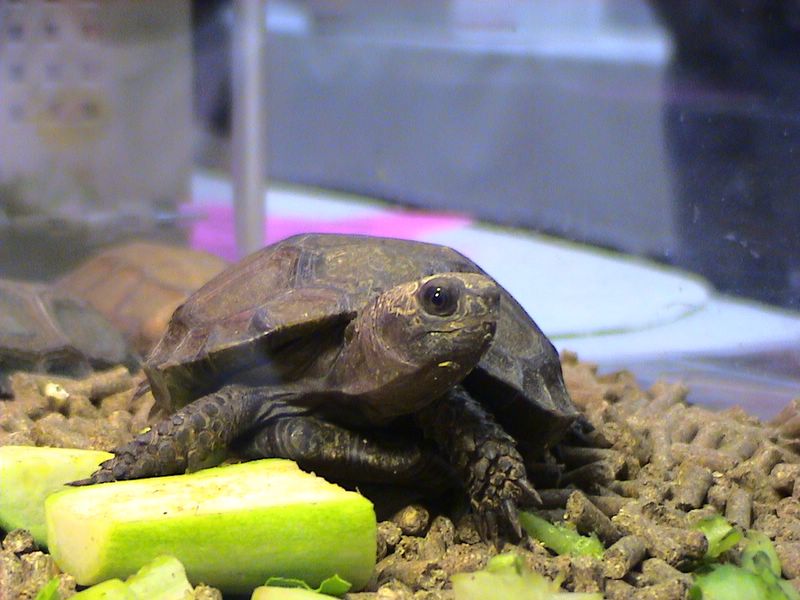
| Appearance | | - Adults typically have dark brown or blackish coloration. English Wikipedia
- Juveniles have yellowish-brown upper shells marked with dark brown patterns. English Wikipedia
- The upper shell is broad and flattened, with a depth less than half its length. English Wikipedia
- The upper shell has upturned, strongly toothed front and rear margins. English Wikipedia
- The lower shell is large, with an extended throat region and a deeply indented rear lobe. English Wikipedia
- The head has two large prefrontal shields and one large frontal shield. English Wikipedia
- The species has an unhooked beak and weakly toothed jaws. English Wikipedia
- The front surfaces of the forelimbs bear large, pointed, overlapping bony bumps arranged in four or five longitudinal rows. English Wikipedia
- The hind limbs have large bony bumps on their soles and larger conical, spur-like bumps on their heels. English Wikipedia
|
|---|
| Size | | - The species is the largest tortoise inhabiting Asia. animaldiversity.org
- The brown tortoise can reach approximately 50 centimeters in length and 20 kilograms in weight. animaldiversity.org
- The Burmese brown subspecies can reach 60 centimeters in length and 37 kilograms in weight. animaldiversity.org
- The species has recorded carapace lengths of up to 600 millimeters and body masses of up to 40 kilograms. pmc.ncbi.nlm.nih.gov
|
|---|
| Habitat | | - The species inhabits evergreen forests at elevations between 600 and 1,500 meters. English Wikipedia
- The species occurs in highland tropical forests and favors cooler, moister conditions than other tortoises. animaldiversity.org
- Its habitats are generally temperate and moist environments influenced by monsoon rainfall. animaldiversity.org
- The species generally remains close to water sources such as ponds. animaldiversity.org
- The species prefers primary rainforests with steep slopes, moderate elevations, and proximity to rivers. pmc.ncbi.nlm.nih.gov
|
|---|
| Diet | - Mushrooms constitute the primary component of the wild diet. English Wikipedia
- Beetles and other larvae may be consumed accidentally while feeding. English Wikipedia
- Wild feeding occurs primarily during the wet season from May through July. English Wikipedia
- Captive impressed tortoises can be fed salads twice weekly, with greens and vegetables mixed into a mushroom-based diet. journals.ku.edu
| - The species consumes whole fungi in the wild. English Wikipedia
- Its documented wild diet includes shoots of koster's curse (Miconia crenata). English Wikipedia
- The species eats leaves and petioles of Alocasia sarawakensis and Alocasia scabriuscula. English Wikipedia
- Its documented wild diet includes shoots of Begonia species and Phrynium species. English Wikipedia
- The species consumes shoots of vegetable fern (Diplazium esculentum). English Wikipedia
- The species eats flowers of wild ginger (Etlingera coccinea). English Wikipedia
- Plants of the genus Alocasia are among the most frequently consumed foods. English Wikipedia
- The species is predominantly herbivorous but may occasionally consume frogs, snails, and carrion in captivity. English Wikipedia
- Its typical diet includes grasses, vegetables, leaves, and fruits. animaldiversity.org
- The species occasionally consumes small invertebrates and amphibians. animaldiversity.org
- The Sundaic subspecies consumes fruits from 30 documented plant species. pmc.ncbi.nlm.nih.gov
- The Sundaic subspecies consumes seeds as large as those of Durio and Artocarpus, measuring more than 2 by 4 centimeters. pmc.ncbi.nlm.nih.gov
|
|---|
| Behaviour | - The species is non-territorial. English Wikipedia
- The species has a relatively sedentary lifestyle. English Wikipedia
- Seasonal conditions and resource availability strongly influence the tortoise's movement and use of space. English Wikipedia
- The tortoises are most active at temperatures between 12 and 30 degrees Celsius and humidity between 60% and 100%. English Wikipedia
- Hiding under leaves or vegetation is the species' primary behavior. English Wikipedia
- Individuals may bask after periods of inactivity. English Wikipedia
- Basking helps the tortoises raise their body temperature and supports digestion. English Wikipedia
| - The species moves slowly even when threatened. animaldiversity.org
- The species is most active during twilight or during the day when temperatures are not too high. animaldiversity.org
- When the climate is excessively warm, individuals may burrow into damp soil and leaf litter. animaldiversity.org
- Individuals may soak in pools and small streams. animaldiversity.org
- The Sundaic subspecies is predominantly active during daylight, accounting for 93% of recorded activities. pmc.ncbi.nlm.nih.gov
- The Sundaic subspecies has a mean home range of 27.5 hectares, with a standard deviation of 28.8 hectares across three individuals. pmc.ncbi.nlm.nih.gov
- Males use head-bobbing to communicate with potential mates during courtship. animaldiversity.org
- Male courtship includes following females closely and attempting to mount them when they stop or slow down. animaldiversity.org
|
|---|
| Reproduction | | - Females remain near their nests and protect them against predators and intruders. English Wikipedia
- Incubation periods have been reported to range from 60 to 90 days. English Wikipedia
- The southern subspecies has an estimated pivotal temperature for temperature-dependent sex determination of 29.29 degrees Celsius. English Wikipedia
- Higher incubation temperatures produce a higher proportion of female hatchlings, whereas lower temperatures produce more males. English Wikipedia
- Reported captive clutch sizes range from 21 to 53 eggs. animaldiversity.org
- Artificially incubated captive eggs have incubation periods of 63 to 84 days. animaldiversity.org
- Females may defend their nests by pushing or biting approaching predators. animaldiversity.org
|
|---|
| Distribution | - The species occurs in Myanmar, southern China, Thailand, Laos, Vietnam, Cambodia, Malaysia and Northeast India. English Wikipedia
| - The species occurs in Bangladesh, Cambodia, India, Indonesia, Malaysia, Myanmar, Thailand, and Vietnam. English Wikipedia
|
|---|
| Conservation | | - The Sundaic subspecies is classified as critically endangered. pmc.ncbi.nlm.nih.gov
- The species faces threats from deforestation, forest fires, agricultural activities, pet-trade exploitation, medicinal use, and climate change. pmc.ncbi.nlm.nih.gov
- The Sundaic subspecies is extremely rare throughout its geographic range. pmc.ncbi.nlm.nih.gov
- Fifteen priority areas with high habitat suitability but without formal protection were identified in Sumatra. pmc.ncbi.nlm.nih.gov
- A wildlife corridor connecting Gunung Talang to Kerinci Seblat National Park was proposed. pmc.ncbi.nlm.nih.gov
- The species' largest apparent limiting factors for lifespan are predation by humans and habitat destruction. animaldiversity.org
|
|---|
| Uses | | |
|---|
| Name origin | - The species' name refers to the shape and appearance of the carapace scutes. English Wikipedia
| No checked fact yet |
|---|
| Other | No checked fact yet | |
|---|