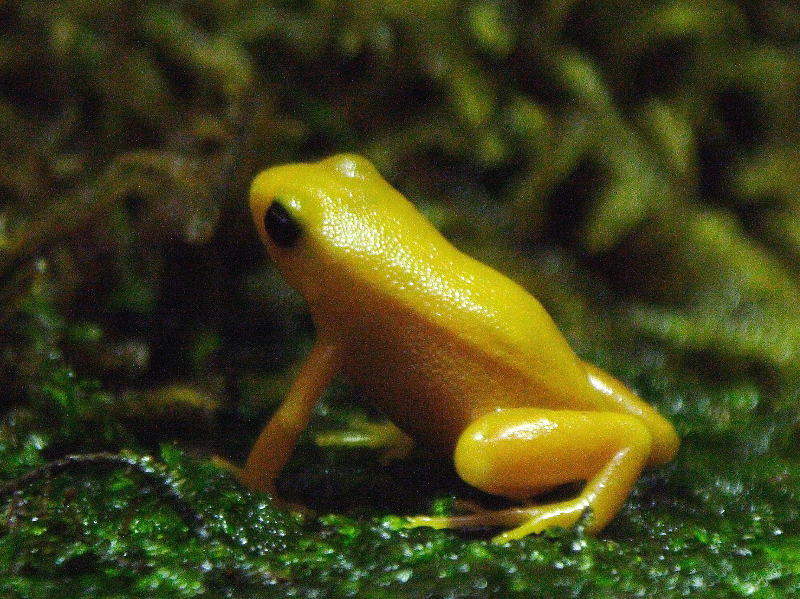
| Appearance | - Adults display uniformly yellow, orange, or red coloration. English Wikipedia
- The inner legs have red flash markings. English Wikipedia
- The species has a visible but relatively small tympanum. English Wikipedia
- Its bright coloration serves as a warning to potential predators about its toxicity. English Wikipedia
- Its eyes are jet black. animaldiversity.org
- Golden mantellas have bright yellow, orange, or red coloration, with red markings on the upper surface of their hind legs. nationalzoo.si.edu
- The eyes are generally black, although the upper iris may occasionally contain some gold coloration. nationalzoo.si.edu
- Newly developed froglets are olive green with dark dorsal markings and dark bands on their hind limbs. nationalzoo.si.edu
| - The species has a yellow back and upper head, blue legs, and black flanks and sides of the head. English Wikipedia
- The species has a black underside marked with blue spots. English Wikipedia
- The species displays warning coloration associated with alkaloid toxins in its skin. English Wikipedia
- Individuals vary in leg coloration, with some having darker or greyer legs. English Wikipedia
- Individuals in the far north of the species' range may have a reddish lower back. English Wikipedia
- Individuals in the southern part of the species' range commonly have some brown coloration on their legs. English Wikipedia
- Females are noticeably larger on average than males. English Wikipedia
- Males possess a horseshoe-shaped blue spot on the lower jaw. English Wikipedia
- The sexes can be distinguished by their vocal signals, which are emitted specifically by males. English Wikipedia
|
|---|
| Size | - Adult snout-to-vent lengths are typically approximately 1.25 inches, with reported measurements reaching 1.5 inches. animaldiversity.org
- Adults are approximately 2.5 centimeters long. nationalzoo.si.edu
| |
|---|
| Habitat | | No checked fact yet |
|---|
| Diet | - The species feeds on small invertebrates, particularly mites, ants, flies, and collembolans. English Wikipedia
- The species is entirely insectivorous and commonly consumes termites, ants, and fruit flies. animaldiversity.org
- Tadpoles primarily consume algae and detritus, although they may also eat some animal matter. animaldiversity.org
- Newly metamorphosed froglets begin eating springtails and small aphids. animaldiversity.org
- The species eats termites, fruit flies, ants, and many other insects. nationalzoo.si.edu
| No checked fact yet |
|---|
| Behaviour | - The species remains largely inactive during the winter months from May through October. English Wikipedia
- Golden mantellas are commonly active during daylight hours in summer. English Wikipedia
- Individuals typically live in groups containing approximately twice as many males as females. English Wikipedia
- Males frequently call from concealed positions near water. English Wikipedia
- Male calls consist of repeated clicking sounds. English Wikipedia
- The species is colonial and forms groups distributed throughout southeastern Madagascar. animaldiversity.org
- The wild population has an approximate male-to-female ratio of two to one. animaldiversity.org
- Golden mantellas are active during the day and hunt for food throughout the day. animaldiversity.org
- Golden mantellas are active during daylight hours. nationalzoo.si.edu
| |
|---|
| Reproduction | - Eggs are deposited on land in moist leaf litter near water. English Wikipedia
- Rainfall carries newly hatched tadpoles from terrestrial egg-laying sites into water. English Wikipedia
- The species does not exhibit typical amplexus, with the male instead moving over the female's back in a form described as virtual amplexus. English Wikipedia
- Eggs hatch within approximately two to six days of being laid. animaldiversity.org
- Tadpoles generally metamorphose into froglets six to eight weeks after hatching. animaldiversity.org
- Newly metamorphosed froglets measure approximately 10 to 14 mm in snout-to-vent length. animaldiversity.org
- Sexual maturity is reached between 12 and 14 months of age. animaldiversity.org
- Clutches contain between 12 and 30 eggs, each measuring 2 to 3 mm in diameter. animaldiversity.org
- Adults provide no further parental care after laying their eggs. animaldiversity.org
- Males produce a series of short vocal notes, with three clicks per note, to attract females. animaldiversity.org
- Courtship generally takes place in concealed locations beneath bark, logs, or rocks. animaldiversity.org
- Egg-laying sites include damp moss, log crevices, and locations beneath damp bark or rocks adjacent to water. animaldiversity.org
- Females deposit eggs in damp leaf litter, moss, or beneath bark and rocks near water. nationalzoo.si.edu
- Clutches contain between 20 and 60 white eggs, each measuring up to 2 mm in diameter. nationalzoo.si.edu
- Tadpoles hatch approximately two weeks after the eggs are laid. nationalzoo.si.edu
- Tadpoles take approximately 70 days to metamorphose into froglets. nationalzoo.si.edu
| - The species' reproductive season extends from September through December. English Wikipedia
- The species deposits eggs on canyon walls or beneath rocks. English Wikipedia
- The eggs are flooded with water and complete their development in temporary pools. English Wikipedia
|
|---|
| Lifespan | | - The species has a typical maximum lifespan of approximately three years. English Wikipedia
|
|---|
| Distribution | - The species has a highly restricted distribution in three areas centered around Moramanga, including Beparasy and Ambohibary Communes, Torotorofotsy Wetland, and Ambakoana. English Wikipedia
- The species occurs in isolated habitat patches throughout southeastern Madagascar. animaldiversity.org
- The species is endemic to central-eastern Madagascar. nationalzoo.si.edu
| - The species is endemic to Isalo National Park and areas south of the park in Madagascar. English Wikipedia
|
|---|
| Conservation | - Wild populations are declining due to overcollection for the pet industry, introduced predators, deforestation, and human encroachment. animaldiversity.org
- The species is classified as critically endangered. nationalzoo.si.edu
- The species survives in a forest fragment smaller than four square miles or ten square kilometers, surrounded by degraded land. nationalzoo.si.edu
- The remaining forest habitat is threatened by subsistence agriculture, timber extraction, fires, and expanding settlements. nationalzoo.si.edu
- Government restrictions on animal exports have substantially reduced trade in the species. nationalzoo.si.edu
- The species is classified as Critically Endangered and is endemic to Madagascar's eastern rainforests. kar.kent.ac.uk
| - The species is locally common but endangered because of habitat loss and collection for the pet trade. English Wikipedia
|
|---|
| Uses | - Individuals are collected from the wild for the pet trade, while some are bred in captivity. animaldiversity.org
| |
|---|
| Similar species | No checked fact yet | - A population with intermediate characteristics between this species and Mantella betsileo has an unresolved taxonomic position. English Wikipedia
- The intermediate population is sometimes designated Mantella cf. expectata. English Wikipedia
- The desert mantella is described as a likely undescribed species closely related to the blue-legged mantella. English Wikipedia
- The name Mantella aff. expectata has sometimes been applied to the desert mantella. English Wikipedia
|
|---|
| Name origin | - The species name aurantiaca derives from the Latin word aurantiacus, meaning gold. English Wikipedia
| No checked fact yet |
|---|
| Other | - The species obtains its skin toxins from its diet. English Wikipedia
- Its skin toxins include pumiliotoxin, allopumiliotoxin, homopumiliotoxin alkaloids, pyrrolizidines, indolizidines, and quinolizidines. English Wikipedia
| |
|---|