Species · Amphibians
Golden Mantella Mantella aurantiaca
The scientific name of the Golden Mantella is Mantella aurantiaca. It is a species of amphibian in the family Mantellidae (madagascar frogs), order Anura. The name dates from 1900.
- Scientific name
- Mantella aurantiaca Mocquard, 1900
- Common name
- Golden Mantella
- Genus
- Mantella
- Family
- Mantellidae (Madagascar Frogs)
- Order
- Anura
- Class
- Amphibia
- Red List category
- EN Endangered
- Recorded in
- 1 country
- Name status
- accepted in the Catalogue of Life
Overview
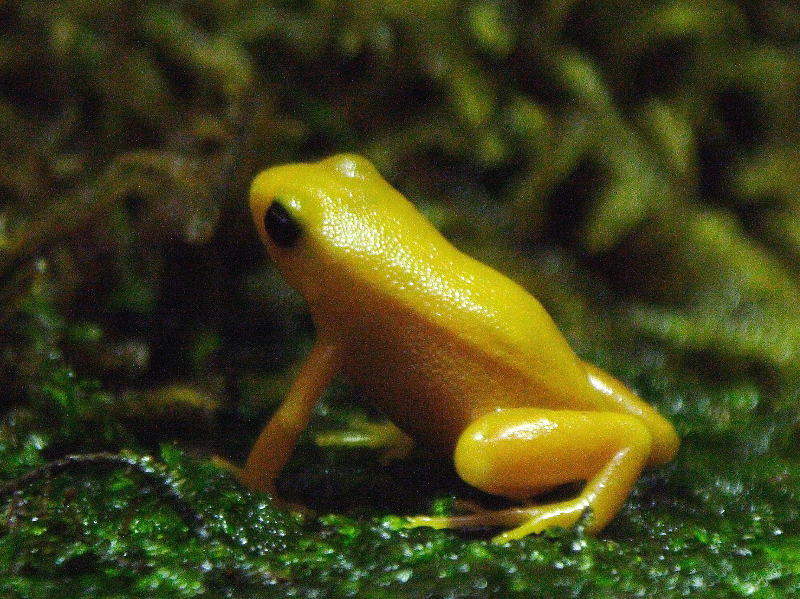
Mantella aurantiaca is endemic to central-eastern Madagascar and occurs in isolated habitat patches in southeastern Madagascar. It is distinguished by bright yellow, orange, or red coloration and red markings on its hind legs.
Written 26 November 2026 from the sources listed below. Each statement was checked against the passage it cites; statements that could not be supported were removed.
Appearance
Adults display uniformly yellow, orange, or red coloration. Red flash markings occur on the inner legs, and the upper surface of the hind legs also has red markings.[1][2][3]
The eyes are generally black, although the upper iris may occasionally contain gold coloration. The tympanum is visible but relatively small.[4][5][6]
Adult snout-to-vent lengths are typically approximately 1.25 inches, with reported measurements reaching 1.5 inches. Adults are also reported to be approximately 2.5 centimeters long.[7][8]
Bright coloration serves as a warning to potential predators about the species' toxicity.[9]
Habitat
The Golden Mantella is terrestrial and inhabits Madagascar. It occurs in montane pandanus forests around Andasibe, including sunny forest areas and vegetation in swampy locations.[10][11][12]
Its distribution is highly restricted, with three areas centered around Moramanga, including Beparasy and Ambohibary Communes, Torotorofotsy Wetland, and Ambakoana. It also occurs in isolated habitat patches throughout southeastern Madagascar.[13][14]
The species inhabits mossy or grassy forest-debris mounds bordering shallow swampy water. It is found at elevations of approximately 900 meters, with other records placing it above 900 meters.[15][16][17]
Diet
The Golden Mantella is entirely insectivorous and feeds on small invertebrates, particularly mites, ants, flies, collembolans, termites, and fruit flies.[18][19][20]
Tadpoles primarily consume algae and detritus, although they may also eat some animal matter. Newly metamorphosed froglets begin eating springtails and small aphids.[21][22]
Behaviour
Golden Mantellas are active during daylight hours and hunt for food throughout the day. They remain largely inactive during the winter months from May through October.[23][24][25][26]
The species is colonial, and individuals typically live in groups containing approximately twice as many males as females. The wild population has an approximate male-to-female ratio of two to one.[27][28][29]
Males frequently call from concealed positions near water. Their calls consist of repeated clicking sounds, with three clicks per short vocal note, to attract females.[30][31][32]
Reproduction and life cycle
Courtship generally takes place in concealed locations beneath bark, logs, or rocks. The species does not exhibit typical amplexus; instead, the male moves over the female's back in a form described as virtual amplexus.[33][34]
Females deposit eggs on land in moist leaf litter, damp moss, log crevices, or beneath damp bark and rocks near water. Clutches are reported to contain between 12 and 30 eggs measuring 2 to 3 mm in diameter, or between 20 and 60 white eggs measuring up to 2 mm in diameter.[35][36][37][38][39]
Eggs hatch within approximately two to six days in one reported account, while another gives approximately two weeks. Rainfall carries newly hatched tadpoles from terrestrial egg-laying sites into water.[40][41][42]
Tadpoles generally metamorphose into froglets six to eight weeks after hatching, with another reported duration of approximately 70 days. Newly metamorphosed froglets measure approximately 10 to 14 mm in snout-to-vent length and are olive green with dark dorsal markings and dark bands on their hind limbs.[43][44][45][46]
Sexual maturity is reached between 12 and 14 months of age. Adults provide no further parental care after laying their eggs.[47][48]
Conservation
The Golden Mantella is classified as Critically Endangered. Its wild populations are declining due to overcollection for the pet industry, introduced predators, deforestation, and human encroachment.[49][50][51]
The species survives in a forest fragment smaller than four square miles or ten square kilometers, surrounded by degraded land. Its remaining forest habitat is threatened by subsistence agriculture, timber extraction, fires, and expanding settlements.[52][53]
Government restrictions on animal exports have substantially reduced trade in the species.[54]
Uses
Individuals are collected from the wild for the pet trade, while some are bred in captivity.[55]
Classification of the Golden Mantella
| Kingdom | Animalia |
|---|---|
| Phylum | Chordata |
| Subphylum | Vertebrata |
| Infraphylum | Gnathostomata |
| Parvphylum | Osteichthyes |
| Megaclass | Tetrapoda |
| Class | Amphibia (Amphibians) |
| Order | Anura (Frogs) |
| Family | Mantellidae (Madagascar Frogs) |
| Subfamily | Mantellinae |
| Genus | Mantella (Golden Frogs) |
| Species | Mantella aurantiaca Mocquard, 1900 |
Where the Golden Mantella is found
Checklists and occurrence records place Mantella aurantiaca in 1 country. GBIF holds 456 georeferenced records of it.
Countries
Regions and cities with the most records
- Moramanga, Madagascar 34
- Ambohidratrimo, Madagascar 6
- Ivato, Madagascar 6
- Manjakandriana, Madagascar 4
- Ambodimanga II, Madagascar 3
A number beside a place is its count of GBIF occurrence records. A place without a number comes from a checklist alone. Records show where a species has been observed or collected, which can include escapes and vagrants.
Common names
English
- Golden Mantella
- Ginger Tree Frog
- Golden Frog
- Madagascan Golden Frog
- Madagascan Golden Mantella
- Malagasy Golden Frog
- Malagasy Golden Mantella
- Orange Mantella
- Red Mantella
- Yellow Mantella
Names in 7 other languages
- Czech
- mantela zlatá
- French
- Grenouille dorée, Mantelle dorée, Mantelle dor�e
- German
- Goldfröschchen
- Japanese
- マダガスカルキンイロガエル
- Polish
- mantella złota
- Russian
- Золотая мантелла
- Spanish
- Mantella dorada malgache
Synonyms
2 other scientific names have been used for this species and are now treated as synonyms of Mantella aurantiaca.
- Mantella aurantiaca aurantiaca Mocquard, 1900
- Mantella aurantiaca rubra Staniszewski, 1996
Related species
-
 Baron's MantellaMantella baroni
-
 Blue-legged MantellaMantella expectata
-
 Green MantellaMantella viridis
-
 Climbing MantellaMantella laevigata
-
 Madagascan MantellaMantella madagascariensis
-
 Brown MantellaMantella betsileo
-
 Black-eared MantellaMantella milotympanum
-
 Cowan's MantellaMantella cowanii
Compare
Questions and answers
What is the scientific name of the Golden Mantella?
The scientific name of the Golden Mantella is Mantella aurantiaca. Written with its author, the full name is Mantella aurantiaca Mocquard, 1900.
Which family does the Golden Mantella belong to?
Mantella aurantiaca belongs to the family Mantellidae, in the order Anura and the class Amphibia.
Where is the Golden Mantella found?
Checklists and occurrence records place Mantella aurantiaca in 1 country: Madagascar.
What is the conservation status of the Golden Mantella?
The IUCN Red List category recorded for Mantella aurantiaca is Endangered (EN).
What other names does the Golden Mantella have?
Mantella aurantiaca is also known in English as Ginger Tree Frog, Golden Frog, Madagascan Golden Frog, Madagascan Golden Mantella, Malagasy Golden Frog and Malagasy Golden Mantella.
What is the average lifespan of a golden mantella frog?
The average lifespan of a Golden Mantella is approximately eight years.[56][57]
Why is the golden mantella frog endangered?
The Golden Mantella is endangered because of overcollection for the pet industry, introduced predators, deforestation, and human encroachment. Its remaining forest habitat is threatened by subsistence agriculture, timber extraction, fires, and expanding settlements.[49][50][53]
What are some interesting facts about the golden mantella frog?
The Golden Mantella has bright yellow, orange, or red coloration that warns potential predators about its toxicity. Its skin toxins are obtained from its diet and include pumiliotoxin, allopumiliotoxin, homopumiliotoxin alkaloids, pyrrolizidines, indolizidines, and quinolizidines. Its species name, aurantiaca, derives from the Latin word aurantiacus, meaning gold.[1][9][58][59][60]
Sources
Passages the profile rests on
- Adults display uniformly yellow, orange, or red coloration. Source passage: “The golden mantella is a uniformly yellow, orange, or red frog” — English Wikipedia
- The inner legs have red flash markings. Source passage: “The inner leg displays red flash marks.” — English Wikipedia
- Golden mantellas have bright yellow, orange, or red coloration, with red markings on the upper surface of their hind legs. Source passage: “Golden mantella frogs are bright yellow, orange or red with some red on the upper surface of the hind legs.” — nationalzoo.si.edu
- The species has a visible but relatively small tympanum. Source passage: “The tympanum is visible, but small.” — English Wikipedia
- Its eyes are jet black. Source passage: “The eyes of this species are jet black.” — animaldiversity.org
- The eyes are generally black, although the upper iris may occasionally contain some gold coloration. Source passage: “Their eyes are typically black, although they may occasionally have a little bit of gold in the upper portion of the iris.” — nationalzoo.si.edu
- Adult snout-to-vent lengths are typically approximately 1.25 inches, with reported measurements reaching 1.5 inches. Source passage: “Adult snout vent lengths (SVLs) are typically 1.25 inches, although 1.5 inch SVLs have been reported.” — animaldiversity.org
- Adults are approximately 2.5 centimeters long. Source passage: “Very small, golden mantella frogs are about 1 inch (2.5 centimeters) long.” — nationalzoo.si.edu
- Its bright coloration serves as a warning to potential predators about its toxicity. Source passage: “Brightly colored skin warns predators that the frog is poisonous.” — English Wikipedia
- The species is terrestrial and inhabits Madagascar. Source passage: “a small, terrestrial frog endemic to Madagascar.” — English Wikipedia
- The species inhabits montane pandanus forests around Andasibe. Source passage: “Mantella aurantiaca occupy the montane pandanus forests around Andasibe” — animaldiversity.org
- Golden mantellas inhabit sunny areas of pandanus forests and vegetation in swampy locations. Source passage: “They live in sunny areas of pandanus forests. They tend to occur amongst vegetation in swampy sites.” — nationalzoo.si.edu
- The species has a highly restricted distribution in three areas centered around Moramanga, including Beparasy and Ambohibary Communes, Torotorofotsy Wetland, and Ambakoana. Source passage: “three distinct areas centered on the town of Moramanga - Beparasy and Ambohibary Communes, Torotorofotsy Wetland northwest of Andasibe, and in the area of Ambakoana.” — English Wikipedia
- The species occurs in isolated habitat patches throughout southeastern Madagascar. Source passage: “they are typically found in isolated patches ranging throughout southeastern Madagascar.” — animaldiversity.org
- Golden mantellas are found at elevations of approximately 900 meters. Source passage: “they are found at an altitude of about 900 meters.” — animaldiversity.org
- The species inhabits mossy or grassy forest-debris mounds bordering shallow swampy water. Source passage: “They usually inhabit mossy or grassy mounds of forest debris that border shallow swampy waters.” — animaldiversity.org
- The species occurs at elevations exceeding 900 meters. Source passage: “where it occurs in a highly restricted area at elevations over 900 meters.” — nationalzoo.si.edu
- The species feeds on small invertebrates, particularly mites, ants, flies, and collembolans. Source passage: “this mainly consists of mites, ants, flies, and collembolans.” — English Wikipedia
- The species is entirely insectivorous and commonly consumes termites, ants, and fruit flies. Source passage: “Mantella aurantiaca are entirely insectivorous. A diet commonly consists of termites ( Isoptera ), ants ( Formicidae ), fruitflies ( Drosphila )” — animaldiversity.org
- The species eats termites, fruit flies, ants, and many other insects. Source passage: “The golden mantella frog is an insectivorous species, feeding on termites, fruit flies, ants and a huge range of other insects.” — nationalzoo.si.edu
- Tadpoles primarily consume algae and detritus, although they may also eat some animal matter. Source passage: “The tadpoles are primarily herbivores, feeding on algae and detritus, although some meat matter may be incorporated into the diet.” — animaldiversity.org
- Newly metamorphosed froglets begin eating springtails and small aphids. Source passage: “begin feeding on the more typical adult insect (springtails and small aphids)” — animaldiversity.org
- The species remains largely inactive during the winter months from May through October. Source passage: “remains largely inactive during the winter months of May–October.” — English Wikipedia
- Golden mantellas are commonly active during daylight hours in summer. Source passage: “During the summer, the golden mantella is commonly active during the day.” — English Wikipedia
- Golden mantellas are active during the day and hunt for food throughout the day. Source passage: “They are diurnal (day-active) in nature, hunting basically all day for food.” — animaldiversity.org
- Golden mantellas are active during daylight hours. Source passage: “The golden frog is active during the day.” — nationalzoo.si.edu
- Individuals typically live in groups containing approximately twice as many males as females. Source passage: “They live in groups of typically twice as many males as there are females.” — English Wikipedia
- The species is colonial and forms groups distributed throughout southeastern Madagascar. Source passage: “Mantella aurantiaca are usually colonial in nature, living in groups scattered throughout southeastern Madagascar.” — animaldiversity.org
- The wild population has an approximate male-to-female ratio of two to one. Source passage: “The male to female ratio in the wild is about 2 to 1” — animaldiversity.org
- Males frequently call from concealed positions near water. Source passage: “Males often call from concealed positions near a water source.” — English Wikipedia
- Male calls consist of repeated clicking sounds. Source passage: “The call is a rather pleasant, repeated click.” — English Wikipedia
- Males produce a series of short vocal notes, with three clicks per note, to attract females. Source passage: “Males use a call consisting of a series of short notes, with three clicks per note, to attract female mates.” — animaldiversity.org
- The species does not exhibit typical amplexus, with the male instead moving over the female's back in a form described as virtual amplexus. Source passage: “The frogs do not seem to engage in typical amplexus but rather the male only moves himself over the female's back in virtual amplexus.” — English Wikipedia
- Courtship generally takes place in concealed locations beneath bark, logs, or rocks. Source passage: “The actual courtship process of this species is rather secretive and usually takes place under bark, logs, or rocks.” — animaldiversity.org
- Eggs are deposited on land in moist leaf litter near water. Source passage: “Eggs are laid on land in moist leaf litter near water” — English Wikipedia
- Clutches contain between 12 and 30 eggs, each measuring 2 to 3 mm in diameter. Source passage: “Clutches consist of 12 to 30 eggs, 2 to 3 mm in diameter” — animaldiversity.org
- Egg-laying sites include damp moss, log crevices, and locations beneath damp bark or rocks adjacent to water. Source passage: “These sites usually include damp moss, crevices in logs, underneath damp bark or rocks and are always adjacent to a water source” — animaldiversity.org
- Females deposit eggs in damp leaf litter, moss, or beneath bark and rocks near water. Source passage: “The females lay eggs in damp leaf litter, moss or underbark and rocks next to a water source.” — nationalzoo.si.edu
- Clutches contain between 20 and 60 white eggs, each measuring up to 2 mm in diameter. Source passage: “Each clutch contains 20 to 60 white eggs, each one measuring up to 0.08 inches (2 millimeters) in diameter.” — nationalzoo.si.edu
- Rainfall carries newly hatched tadpoles from terrestrial egg-laying sites into water. Source passage: “when rains arrive the tadpoles are washed from land into water.” — English Wikipedia
- Eggs hatch within approximately two to six days of being laid. Source passage: “Eggs undergo rapid terrestrial development (2-6 day hatch period)” — animaldiversity.org
- Tadpoles hatch approximately two weeks after the eggs are laid. Source passage: “Two weeks later, the tadpoles hatch out.” — nationalzoo.si.edu
- Tadpoles generally metamorphose into froglets six to eight weeks after hatching. Source passage: “Tadpoles typically metamorphose into froglets 6 to 8 weeks after hatching.” — animaldiversity.org
- Newly metamorphosed froglets measure approximately 10 to 14 mm in snout-to-vent length. Source passage: “they are usually 10 to 14 mm in SVL” — animaldiversity.org
- Newly developed froglets are olive green with dark dorsal markings and dark bands on their hind limbs. Source passage: “Young froglets are olive green with dark marks on the back and dark bands on the hind limbs.” — nationalzoo.si.edu
- Tadpoles take approximately 70 days to metamorphose into froglets. Source passage: “It takes around 70 days for the tadpoles to metamorphose into froglets” — nationalzoo.si.edu
- Sexual maturity is reached between 12 and 14 months of age. Source passage: “Sexual maturity is reached in 12 to 14 months.” — animaldiversity.org
- Adults provide no further parental care after laying their eggs. Source passage: “Once the eggs are laid, parent golden mantellas have no further involvement in the development of their young.” — animaldiversity.org
- Wild populations are declining due to overcollection for the pet industry, introduced predators, deforestation, and human encroachment. Source passage: “Overcollection for the pet industry, introduced predatory species, major deforestation in Madagascar and human encroachment are all among the leading causes fueling this raging decline.” — animaldiversity.org
- The species is classified as critically endangered. Source passage: “Golden mantella frogs are critically endangered.” — nationalzoo.si.edu
- The species is classified as Critically Endangered and is endemic to Madagascar's eastern rainforests. Source passage: “The golden mantella (Mantella aurantiaca) is a Critically Endangered (CR) frog, endemic to the Eastern rainforests of Madagascar.” — kar.kent.ac.uk
- The species survives in a forest fragment smaller than four square miles or ten square kilometers, surrounded by degraded land. Source passage: “This species lives only in a small (less than 4 square miles or 10 square kilometers) fragment of forest surrounded by degraded land.” — nationalzoo.si.edu
- The remaining forest habitat is threatened by subsistence agriculture, timber extraction, fires, and expanding settlements. Source passage: “The remaining forest is under threat from subsistence agriculture, timber extraction, fires and expanding human settlements.” — nationalzoo.si.edu
- Government restrictions on animal exports have substantially reduced trade in the species. Source passage: “Recently, governments have begun limiting the exportation of animals, which has greatly reduced trade.” — nationalzoo.si.edu
- Individuals are collected from the wild for the pet trade, while some are bred in captivity. Source passage: “Many individuals are captured from the wild for the pet trade while some are now captive bred.” — animaldiversity.org
- The typical lifespan of this species is approximately eight years. Source passage: “Mantella aurantiaca typically has a life span of 8 years.” — animaldiversity.org
- The average lifespan of golden mantellas is eight years. Source passage: “The average life span of golden mantella frogs is eight years.” — nationalzoo.si.edu
- The species obtains its skin toxins from its diet. Source passage: “The frogs derive their skin toxins from their diet.” — English Wikipedia
- Its skin toxins include pumiliotoxin, allopumiliotoxin, homopumiliotoxin alkaloids, pyrrolizidines, indolizidines, and quinolizidines. Source passage: “These toxins include pumiliotoxin, allopumiliotoxin, homopumiliotoxin alkaloids, pyrrolizidines, indolizidines and quinolizidines.” — English Wikipedia
- The species name aurantiaca derives from the Latin word aurantiacus, meaning gold. Source passage: “The species name comes from the Latin aurantiacus meaning gold.” — English Wikipedia
Data
- Catalogue of Life, 2026-10-16 XR cc by
- Global Biodiversity Information Facility CC BY 4.0
- Wikidata CC0
- GeoNames CC BY 4.0
- Wikimedia Commons per image; credit shown with each image
- Within the Catalogue of Life, this name comes from The Integrated Taxonomic Information System cc0
This species in other databases
Page built on 28 November 2026. See how the catalog is made and all sources and licences.
Cite this page
ScientificNames.org. (2026). Mantella aurantiaca (Golden Mantella). Retrieved November 28, 2026, from https://scientificnames.org/species/mantella-aurantiaca
“Mantella aurantiaca (Golden Mantella).” ScientificNames.org, 2026, scientificnames.org/species/mantella-aurantiaca. Accessed 28 Nov. 2026.
ScientificNames.org. “Mantella aurantiaca (Golden Mantella).” Accessed November 28, 2026. https://scientificnames.org/species/mantella-aurantiaca.
@misc{scientificnames_mantella_aurantiaca_golden_mantella,
  author = {{ScientificNames.org}},
  title = {Mantella aurantiaca (Golden Mantella)},
  year = {2026},
  url = {https://scientificnames.org/species/mantella-aurantiaca},
  note = {Accessed 2026-11-28}
}