| Appearance | - The species generally has brown or black coloration, with males more commonly displaying darker coloration than females. English Wikipedia
- Male specimens have bright reddish-orange bands of hairs above and below their eyes. English Wikipedia
- Male specimens have thick white hairs covering their palps. English Wikipedia
- Females typically have dull brown or black coloration and a circular band of white hairs on the head. English Wikipedia
- The female's white head marking can resemble a circular halo. English Wikipedia
- The species has a rectangular or oval-shaped abdomen. English Wikipedia
- The species has relatively short legs. English Wikipedia
- The species has a rectangular cephalothorax that projects above the remainder of the carapace. English Wikipedia
- The species has four pairs of eyes arranged in a horizontal row around the upper part of its head. English Wikipedia
- The frontal eye pair is larger and more developed than the other eye pairs. English Wikipedia
- The chelicerae have one forward-facing retromarginal tooth and two backward-facing promarginal teeth. English Wikipedia
- Females have a contrasting white crescent-shaped marking behind their eyes. collections.qm.qld.gov.au
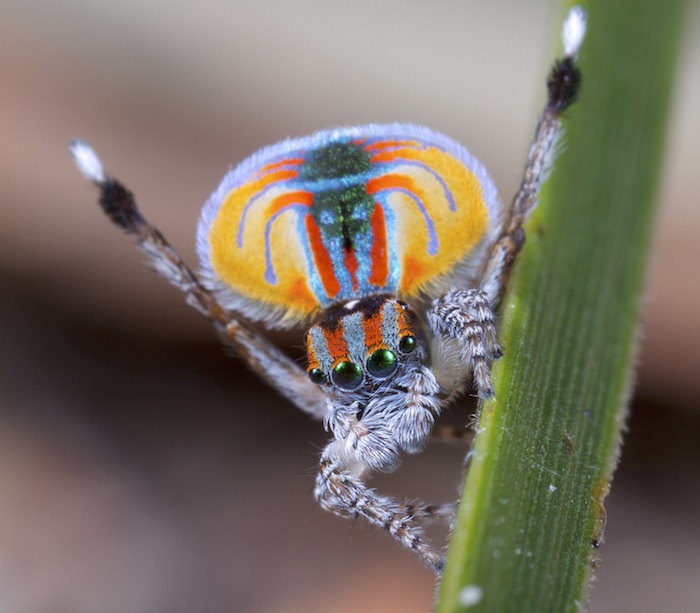
| - Adult males have red, blue, and black coloration and colourful abdominal flaps edged with white hairs. English Wikipedia
- Female and immature specimens are brown and have colour patterns that distinguish them from related species. English Wikipedia
- Male abdominal scales produce the species' characteristic colourful display. English Wikipedia
- Specialized male abdominal scales can reflect visible and ultraviolet light. English Wikipedia
- Immature males lack the abdominal fan and specialized third legs found in mature males. English Wikipedia
|
|---|
| Size | | |
|---|
| Habitat | - The species occurs in temperate and subtropical forests in Australia. English Wikipedia
- The species commonly shelters under leaf litter, leaves, grass, ferns, rocks, and logs. English Wikipedia
- The species can inhabit houses. English Wikipedia
- The species occurs in warmer and drier environments, including Australian shrublands and dry grasslands. English Wikipedia
- In New Zealand, the species occurs in environments ranging from seashores to mountains. English Wikipedia
| - Individuals occur in habitats ranging from sand dunes to grasslands. English Wikipedia
- Peacock spiders are commonly ground-dwelling and occur on leaf litter and dry twigs. English Wikipedia
|
|---|
| Diet | | - The species feeds primarily on insects and other spiders. English Wikipedia
- Individuals capture prey by stalking it visually, chasing it, and jumping onto it to deliver a fatal bite. English Wikipedia
|
|---|
| Behaviour | - The species is primarily active during daylight hours. English Wikipedia
- The species hunts by actively tracking and ambushing prey rather than constructing capture webs. English Wikipedia
- During hunting, individuals stalk prey and approach it carefully before pouncing. English Wikipedia
- The species uses silk threads to traverse its environment, including as a rope for climbing down. English Wikipedia
- The species uses its frontal limbs to grab prey before injecting it with venom and digestive enzymes through its fangs. English Wikipedia
- Males perform elaborate visual courtship dances involving raised third pairs of legs and lateral abdomen movements. English Wikipedia
- During courtship, males approach females cautiously using zigzag movements. English Wikipedia
- Females may reject courting males by imitating their abdomen-swinging movements. English Wikipedia
- Males engage in competitive displays when they encounter one another during the mating season. English Wikipedia
- During male competitive displays, the abdomen is held immobile and bent to one side. English Wikipedia
- Male competitive encounters typically end when one individual retreats after their appendages make contact. English Wikipedia
- The species is not considered territorial based on observations of males coexisting without further aggressive behaviour after competing displays. English Wikipedia
| - The species is active during daylight hours. English Wikipedia
- Individuals have been observed jumping up to 40 times their body length. English Wikipedia
- Males raise and expand their abdominal flaps during courtship to display a circular field of colour. English Wikipedia
- Males raise their third pair of legs during courtship, displaying black hairs and white tips. English Wikipedia
- Males use a clapping motion of their third pair of legs to attract female attention. English Wikipedia
- During courtship, males vibrate their abdomens, wave their raised legs and tails, and dance sideways. English Wikipedia
- Female mating preferences are more strongly influenced by male visual displays than by vibrational signals. English Wikipedia
- Male visual courtship displays typically last approximately 24 minutes on average. English Wikipedia
- Male visual courtship displays can last between six and fifty minutes. English Wikipedia
- Male courtship vibrations include rumble-rumps, crunch rolls, and grind-revs. English Wikipedia
- Rumble-rump vibrations can begin before a male visually detects a female. English Wikipedia
- Females may attack, kill, and consume males whose courtship displays continue despite their lack of interest. English Wikipedia
- Female aggression toward males can also occur after mating. English Wikipedia
- Males and females use contact pheromones deposited on silk drag-lines as chemical signals. English Wikipedia
- Female pheromones can trigger male courtship without visual cues. English Wikipedia
|
|---|
| Reproduction | - The mating season occurs around August, when mature males appear and females emerge shortly afterward. English Wikipedia
- Females retreat into their nests after the mating season to lay and guard their eggs until hatching. English Wikipedia
- The mating season ends around December. English Wikipedia
| |
|---|
| Distribution | - The species is recorded from both Australia and New Zealand. English Wikipedia
- In Australia, the species is recorded in the Australian Capital Territory, New South Wales, Queensland, South Australia, Tasmania, Victoria, and Western Australia. English Wikipedia
- In New Zealand, the species occurs throughout the North Island and in the South Island. English Wikipedia
| - The species occurs in Queensland, New South Wales, the Australian Capital Territory, Western Australia, and Tasmania. English Wikipedia
|
|---|
| Other | - The species has excellent movement-based peripheral vision due to the arrangement of its eyes. English Wikipedia
- The species has strong binocular vision and depth perception. English Wikipedia
- The species lacks light-sensitive tapeta on its lateral eyes. English Wikipedia
- The species has six highly developed retinal muscles that allow 50-degree displacement of the retina. English Wikipedia
| No checked fact yet |
|---|