| Appearance | - The spider has a black body and legs covered with grey setae, producing a salt-and-pepper appearance. English Wikipedia
- Its abdomen is generally grey, while its cephalothorax and legs are black. English Wikipedia
- Its pedipalps are densely covered with grey or black setae. English Wikipedia
- Males have an obovate-rectangular abdomen, whereas females have an obovate abdomen. English Wikipedia
- Males have longer front legs, whereas females have longer hind legs. English Wikipedia
- Male clypei bear long black or dark-grey setae, while female clypei have a dense band of white or grey setae. English Wikipedia
- Its grayscale coloration provides camouflage against its rocky surroundings. English Wikipedia
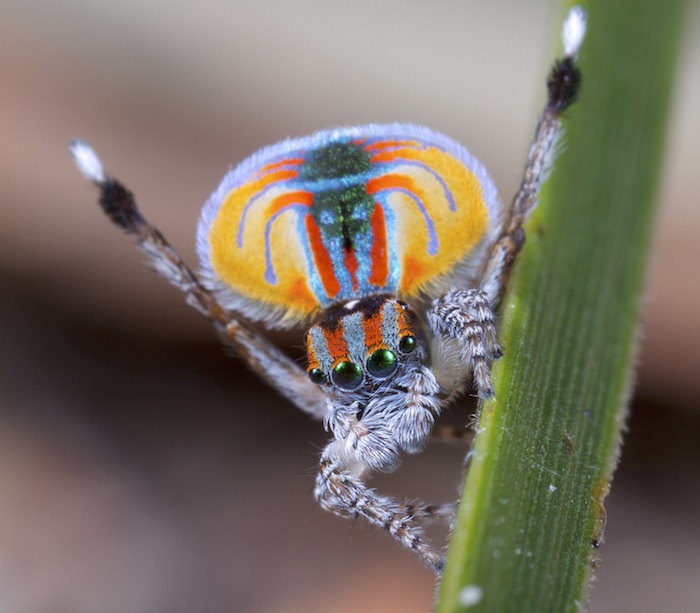
| - Adult males have red, blue, and black coloration and colourful abdominal flaps edged with white hairs. English Wikipedia
- Female and immature specimens are brown and have colour patterns that distinguish them from related species. English Wikipedia
- Male abdominal scales produce the species' characteristic colourful display. English Wikipedia
- Specialized male abdominal scales can reflect visible and ultraviolet light. English Wikipedia
- Immature males lack the abdominal fan and specialized third legs found in mature males. English Wikipedia
|
|---|
| Size | - Adults measure between 4.8 and 8.8 mm in body length. English Wikipedia
- Its retreat nests are approximately one body length wide and two to three body lengths long. English Wikipedia
| |
|---|
| Habitat | | - Individuals occur in habitats ranging from sand dunes to grasslands. English Wikipedia
- Peacock spiders are commonly ground-dwelling and occur on leaf litter and dry twigs. English Wikipedia
|
|---|
| Diet | | - The species feeds primarily on insects and other spiders. English Wikipedia
- Individuals capture prey by stalking it visually, chasing it, and jumping onto it to deliver a fatal bite. English Wikipedia
|
|---|
| Behaviour | - The species is most likely to be observed between September and April. English Wikipedia
- The species retreats into its nest when sunlight and warmth are lacking. English Wikipedia
- It constructs cigar-shaped retreat nests beneath shaded pebbles, in rock crevices, or inside shells. English Wikipedia
- Nests built inside shells provide an air pocket during tidal inundation. English Wikipedia
- Its daily movement routine is dependent on photoreceptors in its three pairs of secondary eyes. English Wikipedia
- The species moves by hopping but also uses stealthy locomotion when pursuing prey. English Wikipedia
- The species performs approximately 21 different display interactions within its own species. English Wikipedia
- Its displays include raising and lowering the abdomen and rotating the raised abdomen. English Wikipedia
- Males use abdomen-twitching displays during interactions with females, including zigzagging approaches and stationary displays at female nests. English Wikipedia
- Male-male abdomen-twitching displays have been observed at nest sites during interactions between resident and intruding spiders. English Wikipedia
- Male-male dominance or aggression displays can involve a raised cephalothorax, tilted-up abdomen, and erect first and third leg pairs. English Wikipedia
- Male individuals have not been conclusively shown to identify females of their own species using airborne pheromones alone. English Wikipedia
- Females release contact pheromones in silk webbing, allowing the chemical signals to persist longer. English Wikipedia
- Spiders receive contact pheromones using chemosensitive chelicerates. English Wikipedia
- Cannibalism occurs in this species away from nest sites and is most frequent in female-female interactions. English Wikipedia
- Female-male interactions show the second-highest reported frequency of cannibalism. English Wikipedia
- Male-female interactions, in which males kill and eat females, have relatively low cannibalism percentages. English Wikipedia
- It stalks moths with camouflage matching their background less frequently than moths against contrasting backgrounds. English Wikipedia
- When approaching prey, the spider can repeatedly detour and reorient itself before attacking. English Wikipedia
- Its prey-approach detours occur whether or not the prey is moving. English Wikipedia
- The species has been observed escaping another spider by leaping from a rock and hanging from a single strand of web. English Wikipedia
| - The species is active during daylight hours. English Wikipedia
- Individuals have been observed jumping up to 40 times their body length. English Wikipedia
- Males raise and expand their abdominal flaps during courtship to display a circular field of colour. English Wikipedia
- Males raise their third pair of legs during courtship, displaying black hairs and white tips. English Wikipedia
- Males use a clapping motion of their third pair of legs to attract female attention. English Wikipedia
- During courtship, males vibrate their abdomens, wave their raised legs and tails, and dance sideways. English Wikipedia
- Female mating preferences are more strongly influenced by male visual displays than by vibrational signals. English Wikipedia
- Male visual courtship displays typically last approximately 24 minutes on average. English Wikipedia
- Male visual courtship displays can last between six and fifty minutes. English Wikipedia
- Male courtship vibrations include rumble-rumps, crunch rolls, and grind-revs. English Wikipedia
- Rumble-rump vibrations can begin before a male visually detects a female. English Wikipedia
- Females may attack, kill, and consume males whose courtship displays continue despite their lack of interest. English Wikipedia
- Female aggression toward males can also occur after mating. English Wikipedia
- Males and females use contact pheromones deposited on silk drag-lines as chemical signals. English Wikipedia
- Female pheromones can trigger male courtship without visual cues. English Wikipedia
|
|---|
| Reproduction | No checked fact yet | |
|---|
| Distribution | - The species is endemic to New Zealand. English Wikipedia
- Its known range includes the eastern coast of New Zealand's South Island, including Banks Peninsula and Kaikoura. English Wikipedia
- The species also occurs along the southernmost coastline of New Zealand's North Island. English Wikipedia
| - The species occurs in Queensland, New South Wales, the Australian Capital Territory, Western Australia, and Tasmania. English Wikipedia
|
|---|
| Other | - A 2024 redescription using DNA analysis confirmed the species' phylogeny and restored its classification in the genus Maratus. English Wikipedia
| No checked fact yet |
|---|