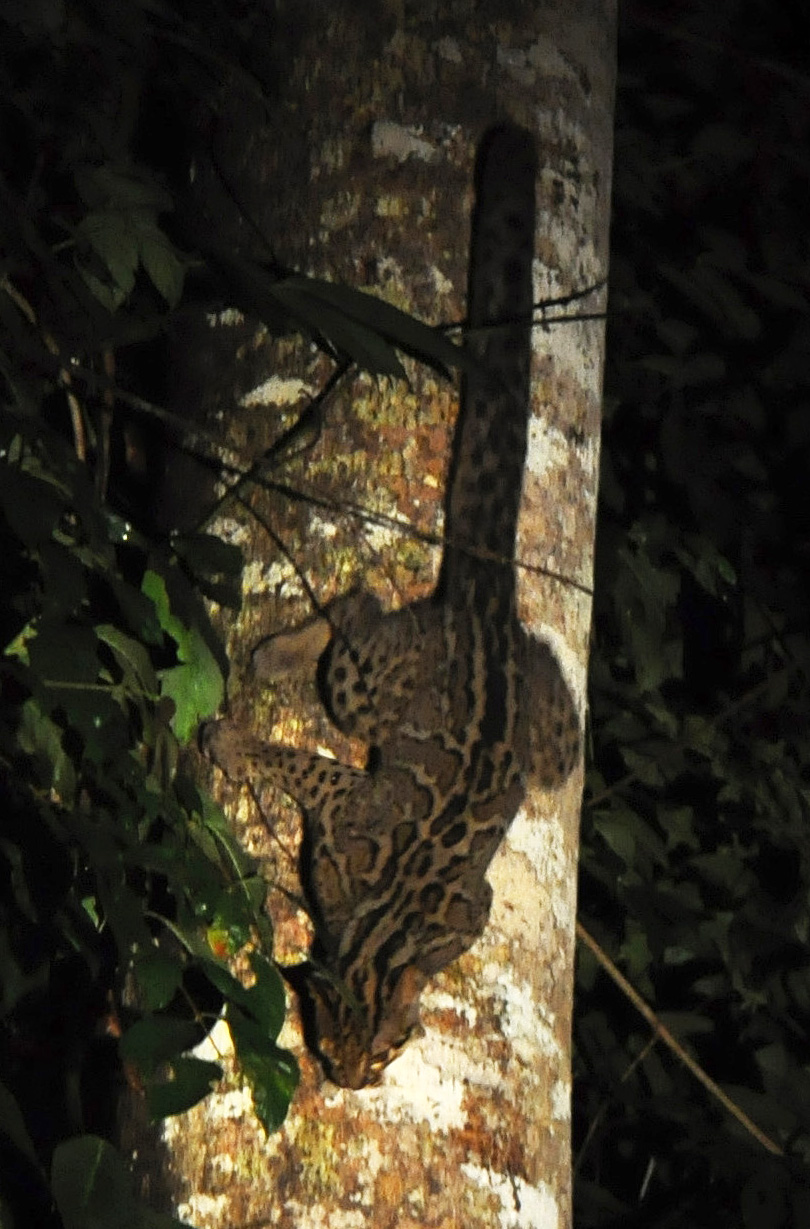
| Appearance | - The marbled cat has fur ranging from brownish-grey to ochreous brown on its upper body and greyish to buff on its underside. English Wikipedia
- The marbled cat has irregular dark-edged blotches on its flanks that merge into a marble-like pattern. English Wikipedia
- The marbled cat has rounded ears and a very long tail. English Wikipedia
- The marbled cat has thick, soft fur. English Wikipedia
- The marbled cat has unusually large canine teeth relative to its body size. animaldiversity.org
- Young marbled cats have mottled brown coats before developing adult markings at approximately four months. animaldiversity.org
| - The tiger has an orange coat with white areas and distinctive black or dark brown stripes. English Wikipedia
- Each tiger has a unique pattern of dark stripes. English Wikipedia
- The tiger has a muscular body, large head, strong forelimbs, wide front paws and a long tail. English Wikipedia
- The tiger has five digits on its front feet and four on its back feet, equipped with retractile claws. English Wikipedia
- The tiger's claws can reach 10 cm in length. English Wikipedia
- The tiger has rounded ears and eyes with round pupils. English Wikipedia
- The tiger's snout ends in a triangular pink tip bearing small black dots. English Wikipedia
|
|---|
| Size | | |
|---|
| Habitat | - The marbled cat inhabits moist tropical forests and mixed deciduous-evergreen forests. English Wikipedia
- The marbled cat has been recorded in peat swamp forests in Borneo. English Wikipedia
- The marbled cat has been recorded in mixed swamp forest and tall interior forest in Kalimantan. English Wikipedia
- The marbled cat has been recorded in habitats ranging from sea level to 3,000 m elevation. animaldiversity.org
- Recorded habitats include secondary forests, clearings, logged forests and rocky scrub. animaldiversity.org
- The marbled cat is primarily associated with an arboreal lifestyle. animaldiversity.org
| - Tigers primarily inhabit forest environments. English Wikipedia
- Tigers inhabit Korean pine and temperate broadleaf and mixed forests in the Amur-Ussuri region of Russia and China. English Wikipedia
- Tigers inhabit mangrove forests in the Sundarbans. English Wikipedia
- Tigers in Sumatra occupy lowland peat swamp forests and rugged montane forests. English Wikipedia
- Tigers have been documented in temperate forests at elevations reaching 4,200 metres in Bhutan. English Wikipedia
|
|---|
| Diet | - The marbled cat preys on birds, squirrels, other rodents and reptiles. English Wikipedia
- The marbled cat has been observed hunting a Phayre's leaf monkey in Thailand. English Wikipedia
- The marbled cat's recorded potential mammalian prey includes tree squirrels, tree shrews, rats, mice, small primates and fruit bats. animaldiversity.org
- Birds up to the size of pheasants are considered potential primary prey of the marbled cat. animaldiversity.org
| - Tigers primarily prey on hoofed mammals, capturing them through ambush. English Wikipedia
- Seven prey species were identified in the tiger diet analyzed in the Chitwan study. pmc.ncbi.nlm.nih.gov
- No livestock remains were detected in the tiger scats analyzed in the Chitwan study. pmc.ncbi.nlm.nih.gov
- Reported tiger prey species include spotted deer, wild boar, barking deer, sambar and gaur. pmc.ncbi.nlm.nih.gov
|
|---|
| Behaviour | | - Tigers generally live alone and defend their home ranges against members of the same sex. English Wikipedia
- Tigers are territorial hunters that capture prey through ambush. pmc.ncbi.nlm.nih.gov
- Tigers in Chitwan National Park avoided locations frequently visited by people and were more active at night. English Wikipedia
- Radio-collared tigers in Sundarbans National Park were most active from dawn to early morning, reaching peak activity around 7 a.m. English Wikipedia
|
|---|
| Reproduction | - The gestation period of the marbled cat is estimated at 66–82 days. English Wikipedia
- Recorded captive marbled cat litters have included two kittens. English Wikipedia
- Newborn marbled cat kittens have recorded weights of 61–85 g. English Wikipedia
- Marbled cat kittens begin eating solid food at approximately two months of age. English Wikipedia
- Marbled cats reach sexual maturity at approximately 21–22 months of age. English Wikipedia
- Captive marbled cat females experience estrus monthly without seasonal variation. animaldiversity.org
| - Male tiger home ranges overlap with those of multiple females with whom they mate. English Wikipedia
- Female tigers usually give birth to two or three cubs. English Wikipedia
- Tiger cubs remain with their mothers for approximately two years. English Wikipedia
- Young tigers establish their own home ranges after becoming independent. English Wikipedia
|
|---|
| Distribution | - The marbled cat occurs from the eastern Himalayas through Southeast Asia to southwestern China. English Wikipedia
- The marbled cat's distribution includes the islands of Sumatra and Borneo. English Wikipedia
- The marbled cat has been recorded in Nepal, northern India, Myanmar, Laos, Thailand, Vietnam, Cambodia and peninsular Malaysia. animaldiversity.org
- The marbled cat's distribution in India is confined to northeastern forests. English Wikipedia
- A marbled cat was recorded for the first time in eastern Nepal in January 2018. English Wikipedia
| No checked fact yet |
|---|
| Conservation | - The marbled cat has been classified as Near Threatened on the IUCN Red List since 2015. English Wikipedia
- Forest loss and degradation are the primary threats to the marbled cat. English Wikipedia
- Indiscriminate snaring is considered a major threat to the marbled cat. English Wikipedia
- The marbled cat is listed in CITES Appendix I. English Wikipedia
- Hunting of the marbled cat is prohibited in Bangladesh, Cambodia, China, Indonesia, Malaysia, Myanmar, Nepal and Thailand. English Wikipedia
| - The tiger is classified as Endangered on the IUCN Red List. English Wikipedia
- Tiger populations have lost at least 93 percent of their historical range since the early twentieth century. English Wikipedia
- Habitat destruction and fragmentation caused by deforestation are major threats to tigers. English Wikipedia
- Poaching for fur and illegal trade in tiger body parts for medicinal purposes threaten the species. English Wikipedia
- Tigers are legally protected in every country within their range. English Wikipedia
- Conservation measures include action plans, anti-poaching patrols and population monitoring schemes. English Wikipedia
- Wildlife corridors have been established in several countries where tigers occur. English Wikipedia
|
|---|
| Uses | | - Tigers have been kept in captivity since ancient times and trained for circus and entertainment performances. English Wikipedia
|
|---|
| Similar species | - The marbled cat is closely related to the Asian golden cat and the bay cat. English Wikipedia
- The marbled cat's physical appearance is often compared with that of the clouded leopard. animaldiversity.org
| No checked fact yet |
|---|
| Other | No checked fact yet | - Carl Linnaeus described the tiger in 1758 using the scientific name Felis tigris. English Wikipedia
- The tiger was assigned to the genus Panthera by Reginald Innes Pocock in 1929. English Wikipedia
|
|---|