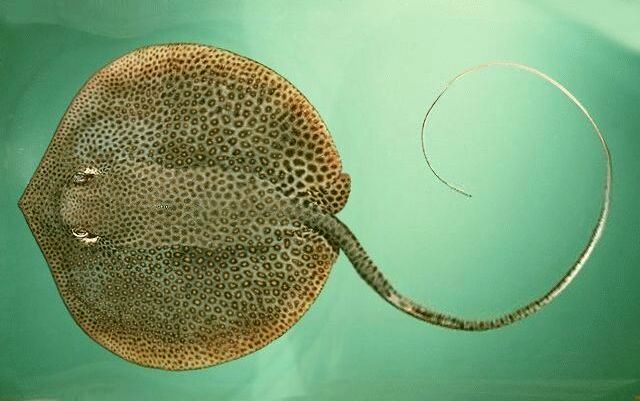
| Appearance | - The species has a diamond-shaped pectoral disc that is more than 1.4 times wider than it is long. English Wikipedia
- Its pectoral disc has sinuous anterior margins that converge toward a rounded snout with a slightly projecting tip. English Wikipedia
- Its eyes are small and positioned immediately in front of much larger spiracles. English Wikipedia
- Its mouth contains five papillae across the floor. English Wikipedia
- Its upper surface is brown to reddish brown, becoming darker toward the tail tip, while its underside is white. English Wikipedia
- Its dorsal surface has distinctive large white spots beside the eyes and around the center of the disc. English Wikipedia
- Its dorsal surface has rows of white spots extending along either side of the pectoral disc. pmc.ncbi.nlm.nih.gov
- Its natural dorsal spot patterns are individually distinctive enough to identify individual rays. pmc.ncbi.nlm.nih.gov
| - The reticulate whipray has a diamond-shaped pectoral disc that is wider than it is long. English Wikipedia
- Adult reticulate whiprays generally have closely spaced dark brown spots or reticulations against a beige to yellow-brown dorsal background. English Wikipedia
- The underside of the reticulate whipray is pale white and unmarked. English Wikipedia
- Juvenile reticulate whiprays have yellowish upper surfaces with densely packed tiny dark spots. English Wikipedia
- Adult reticulate whiprays develop a broad band of flattened, heart-shaped dermal denticles extending from between the eyes to the tail spine. English Wikipedia
- The reticulate whipray has two large pearl thorns at the center of its back. English Wikipedia
- The reticulate whipray has small triangular pelvic fins. English Wikipedia
- The reticulate whipray has a whip-like, extremely thin tail that lacks fin folds. English Wikipedia
- The reticulate whipray usually has one serrated stinging spine on the upper surface of its tail. English Wikipedia
|
|---|
| Size | | - The reticulate whipray can reach a disc width of 2 metres. English Wikipedia
- The reticulate whipray can reach a total length of 6 metres. English Wikipedia
- The reticulate whipray has been reported to weigh up to 120 kilograms. English Wikipedia
- An intact reticulate whipray tail measures approximately 3–3.5 times the length of its disc. English Wikipedia
- Newborn reticulate whiprays off South Africa measure approximately 28–30 centimetres across. English Wikipedia
- Newborn reticulate whiprays off Australia measure approximately 21–28 centimetres across. English Wikipedia
|
|---|
| Habitat | - The species occurs in inshore coastal habitats, river mouths, estuaries and deeper waters. English Wikipedia
- Off Tofo, individuals have been observed swimming over reefs at depths of 15–25 metres. English Wikipedia
- Off Tofo, individuals have been observed in water temperatures of 23–28 °C. English Wikipedia
- In southern Mozambique, individuals regularly use inshore reefs along approximately 350 kilometres of coastline. pmc.ncbi.nlm.nih.gov
- Individuals off southern Mozambique have been recorded using multiple inshore environments. pmc.ncbi.nlm.nih.gov
| - The reticulate whipray inhabits coral reefs, brackish waters and marine environments. English Wikipedia
- The reticulate whipray occurs over sandy flats near beaches, in lagoons and around coral reefs. English Wikipedia
- The reticulate whipray occurs from the intertidal zone to offshore waters at depths of 50 metres or more. English Wikipedia
- The reticulate whipray tolerates low salinities and can enter estuaries and mangrove swamps. English Wikipedia
- The preferred water temperature of the reticulate whipray is 23–26 °C. English Wikipedia
- In Shark Bay, Western Australia, the reticulate whipray uses intertidal sand flats during warm periods and deeper seagrass patches during cold periods. English Wikipedia
|
|---|
| Diet | No checked fact yet | - The reticulate whipray feeds on crabs, shrimps, mantis shrimps, bivalves, gastropods, worms, jellyfish and bony fishes. English Wikipedia
- Fishes constitute approximately two-thirds of the reticulate whipray's diet in the western Indian Ocean. English Wikipedia
- Ponyfish and anchovies are particularly important fish prey for reticulate whiprays in the western Indian Ocean. English Wikipedia
- Reticulate whiprays in Australian waters are known to consume penaeid prawns. English Wikipedia
|
|---|
| Behaviour | - Individuals off Tofo are frequently accompanied by multiple cobia. English Wikipedia
- Individual rays have been reliably recognized through photographic identification over periods of six years. pmc.ncbi.nlm.nih.gov
- One individual made a documented return movement of 400 kilometres between Tofo Beach and the Bazaruto Archipelago. pmc.ncbi.nlm.nih.gov
| - The reticulate whipray is generally inactive during daytime and rests motionless on the seabed, sometimes buried in sand. English Wikipedia
- In Shark Bay, Western Australia, reticulate whiprays rest individually or in small groups in very shallow water during high tide. English Wikipedia
- Reticulate whiprays sometimes form mixed-species resting groups with cowtail stingrays. English Wikipedia
- Mixed-species resting groups of reticulate whiprays and cowtail stingrays can form circular arrangements with their tails pointing outward. English Wikipedia
|
|---|
| Reproduction | - The species is aplacentally viviparous. English Wikipedia
- Developing embryos initially receive nourishment from yolk and subsequently from histotroph secreted by the mother. English Wikipedia
- A female has been recorded carrying a single late-term fetus. English Wikipedia
- Several presumably pregnant females have been recorded in Bazaruto Archipelago National Park. pmc.ncbi.nlm.nih.gov
| |
|---|
| Distribution | - Its reported range extends from Mozambique through the Indian Ocean to northern Australia. English Wikipedia
| - The reticulate whipray occurs in the Red Sea, western Indian Ocean and Arabian Sea. English Wikipedia
- The reticulate whipray has expanded into the eastern Mediterranean through the Suez Canal. English Wikipedia
- The reticulate whipray is now common in the southeastern Mediterranean. English Wikipedia
|
|---|
| Conservation | - The species is classified as Data Deficient on the IUCN Red List. English Wikipedia
- The species is considered rare across much of its distribution. English Wikipedia
- Intensive fishing occurs across much of its geographic range. English Wikipedia
- Its large body size may increase its vulnerability to fishing pressure. English Wikipedia
- FishBase reports a vulnerability score of 86 out of 100 for the species. fishbase.se
| - The reticulate whipray is classified as Endangered by the International Union for Conservation of Nature. English Wikipedia
- The reticulate whipray is vulnerable to population depletion because of its large size, inshore habitat preferences and slow reproductive rate. English Wikipedia
- Global reticulate whipray populations are suspected to have declined by 50–75% over the last 75 years. English Wikipedia
- Habitat degradation threatens the reticulate whipray. English Wikipedia
|
|---|
| Uses | - The species is occasionally caught incidentally by demersal longline fisheries. English Wikipedia
- The species is occasionally caught incidentally by bottom trawl, trammel net and seine net fisheries. English Wikipedia
- The meat and cartilage of the species have commercial value, and its skin may also be valuable. English Wikipedia
- An individual has been recorded as having been speared by artisanal fishers in Mozambique. English Wikipedia
| - Reticulate whiprays are fished for their meat, skin and cartilage. English Wikipedia
- Reticulate whiprays are sometimes processed into fishmeal for the poultry industry. English Wikipedia
- Some reticulate whipray wings are exported to Malaysia and Thailand. English Wikipedia
- The tail of the reticulate whipray may be sold as a curio. English Wikipedia
- The reticulate whipray is occasionally sold in the home aquarium trade. English Wikipedia
|
|---|
| Other | No checked fact yet | - The reticulate whipray is closely related to Himantura undulata, Himantura leoparda, Himantura tutul and Himantura australis. English Wikipedia
- The reticulate whipray has a very low minimum population doubling rate, requiring more than 14 years. fishbase.se
- FishBase reports a vulnerability score of 90 out of 100 for the reticulate whipray. fishbase.se
|
|---|