| Appearance | - The European badger has a stocky, wedge-shaped body, a small head, a thick short neck, and a short tail. English Wikipedia
- Its back and sides are generally light silvery-grey with straw-coloured highlights. English Wikipedia
- The European badger has strong, elongated claws with blunt ends adapted for digging. English Wikipedia
- Adult males generally have broader heads and thicker necks than females. English Wikipedia
- The European badger has a massive, heavy skull with a prominent sagittal crest. animaldiversity.org
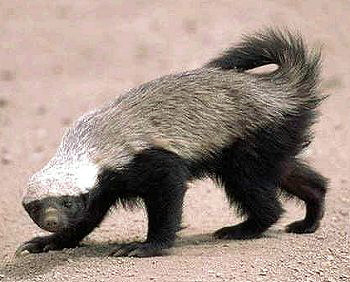
| - The honey badger has short, sturdy legs and five toes on each foot. English Wikipedia
- Its forelimbs have remarkably long claws, whereas its hind-leg claws are short. English Wikipedia
- Its coat generally has a black lower body and a white or grey upper mantle extending to the base of the tail. animaldiversity.org
- Individuals belonging to the cottoni subspecies have an entirely black coat. English Wikipedia
|
|---|
| Size | | |
|---|
| Habitat | - European badgers prefer sett locations covered by trees, shrubs, or rocks. animaldiversity.org
- European badgers favour well-drained soils that are easy to excavate and relatively undisturbed by humans. animaldiversity.org
- European badgers can inhabit mountainous areas at elevations of up to 2,000 m. English Wikipedia
| - Honey badgers inhabit tropical and subtropical green forests, thorn forests, open woodlands, riparian forests, grasslands, arid steppes, rocky hills, and deserts. animaldiversity.org
- Honey badgers occupy elevations from sea level to approximately 4,050 m. animaldiversity.org
- Honey badgers require sheltering places such as burrows or rock crevices. animaldiversity.org
- Honey badgers are not historically found in the extremely dry parts of the Sahara Desert or along the Mediterranean coast. animaldiversity.org
|
|---|
| Diet | - European badgers are omnivores that consume earthworms, large insects, small mammals, carrion, cereals, and tubers. English Wikipedia
- Earthworms are one of the primary prey items of European badgers. animaldiversity.org
| - Honey badgers consume insects, frogs, tortoises, turtles, lizards, rodents, snakes, birds, and eggs. English Wikipedia
- Honey badgers also eat berries, roots, and bulbs. English Wikipedia
- Honey badgers raid beehives to obtain bee larvae and honey. English Wikipedia
- Honey badgers consume all parts of their prey, including bones, feathers, hair, and skin. English Wikipedia
|
|---|
| Behaviour | - European badgers are nocturnal and social animals that sleep during the day in underground setts. English Wikipedia
- European badgers form social groups containing an average of six adults. English Wikipedia
- European badger social groups can contain as many as 23 individuals. English Wikipedia
- European badger territories range from approximately 30 hectares in optimal conditions to 150 hectares in marginal areas. English Wikipedia
- European badgers construct extensive underground burrow systems with multiple chambers and entrances. English Wikipedia
- Some European badger sett systems extend for 35–81 m. English Wikipedia
- European badgers maintain sett cleanliness by bringing in fresh bedding and removing soiled material. English Wikipedia
- European badgers deposit faeces in strategically located latrines outside their setts or along routes between setts. English Wikipedia
- European badgers may share underground burrows with rabbits, red foxes, and raccoon dogs. English Wikipedia
- European badgers communicate through growling, barking, whickering, and screaming vocalizations. English Wikipedia
| - Honey badgers are predominantly solitary animals. English Wikipedia
- Honey badgers may be active at any time of day depending on their location. English Wikipedia
- Honey badgers in the Serengeti are mostly nocturnal during the dry season and active throughout the day during the wet season. English Wikipedia
- Honey badgers are skilled diggers capable of excavating tunnels in hard ground within ten minutes. English Wikipedia
- Honey badger burrows are generally 1–3 m long and have a single entrance and an unlined nesting chamber. English Wikipedia
- Adult male honey badgers have an average home range of 548 km², compared with 138 km² for females. English Wikipedia
- Honey badgers scent-mark their territories using anal gland secretions, feces, and urine. English Wikipedia
- Honey badgers can repel larger predators by releasing a pungent yellow liquid from their anal glands. English Wikipedia
- Honey badgers sometimes hunt in pairs in Africa. English Wikipedia
|
|---|
| Reproduction | - European badger litters typically contain an average of three cubs, with recorded litter sizes ranging from one to six. animaldiversity.org
- European badger gestation lasts between nine and twelve months. animaldiversity.org
- European badger cubs emerge from their dens approximately eight to ten weeks after birth. animaldiversity.org
- European badger cubs are generally weaned at approximately two and a half months. animaldiversity.org
- Male and female European badgers reach sexual maturity at approximately one year of age. animaldiversity.org
- Female European badgers provide nursing and solid food to their cubs after weaning. animaldiversity.org
| - Honey badgers can breed throughout the year rather than during a fixed mating season. English Wikipedia
- Female honey badgers have an estimated oestrus period of approximately 14 days. English Wikipedia
- The gestation period of honey badgers is approximately 50–70 days. animaldiversity.org
- Female honey badgers move their cubs between dens during the first three months after birth. animaldiversity.org
- Honey badger cubs begin accompanying their mothers while foraging at approximately three months of age. animaldiversity.org
- Female honey badgers care for their offspring for approximately 12–16 months. animaldiversity.org
- Male honey badgers generally reach sexual maturity at two to three years of age. animaldiversity.org
|
|---|
| Distribution | - European badgers are native to most of Europe and parts of West and Central Asia. English Wikipedia
- The European badger occurs from Ireland and Spain eastward to Russia, China, and Japan. animaldiversity.org
| - Honey badgers occur across most of sub-Saharan Africa, from South Africa's Western Cape to southern Morocco and southwestern Algeria. English Wikipedia
- The species' range extends beyond Africa through Arabia, Iran, Western Asia, Turkmenistan, and the Indian Peninsula. English Wikipedia
|
|---|
| Conservation | - The European badger is classified as Least Concern on the IUCN Red List. English Wikipedia
- The European badger population is considered stable or increasing in parts of its range. English Wikipedia
- The European badger can carry bovine tuberculosis, which can spread between species and harm cattle. English Wikipedia
| - The honey badger is classified as Least Concern on the IUCN Red List. English Wikipedia
- Honey badgers are threatened by killings associated with beekeeping and farming, including poisoning and trapping. English Wikipedia
|
|---|
| Uses | No checked fact yet | - Honey badgers are used in traditional medicine and consumed as bushmeat. English Wikipedia
|
|---|
| Other | No checked fact yet | - The honey badger is the only living species in the genus Mellivora. English Wikipedia
- The honey badger is the sole living representative of the subfamily Mellivorinae. English Wikipedia
|
|---|