Comparison
Honey Badger vs European Pine Marten
Honey Badger (Mellivora capensis) and European Pine Marten (Martes martes) both belong to the family Mustelidae (mustelids) and part ways below it.
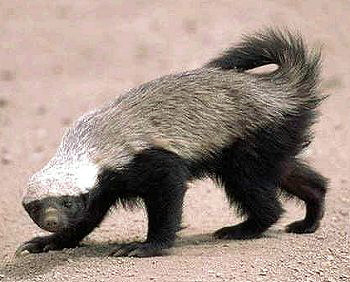


Side by side
| Honey Badger | European Pine Marten | |
|---|---|---|
| Scientific name | Mellivora capensis (Schreber, 1776) | Martes martes (Linnaeus, 1758) |
| English name | Honey Badger | European Pine Marten |
| Group | Mammals | Mammals |
| Class | Mammalia Mammal | Mammalia Mammal |
| Order | Carnivora Carnivores | Carnivora Carnivores |
| Family | Mustelidae Mustelids | Mustelidae Mustelids |
| Genus | Mellivora Ratels | Martes Martens |
| Named in | 1776 | 1758 |
| Red List category | Least Concern | Least Concern |
| Environment | Not recorded | terrestrial |
| Countries on record | 37 countries | 38 countries |
| GBIF occurrence records | 2,204 records | 137,878 records |
Rows where the two agree are shown in grey.
Where each is found
Only Honey Badger (37)
- Angola
- Benin
- Botswana
- Burkina Faso
- Cameroon
- Central African Republic
- Chad
- Democratic Republic of the Congo
- Equatorial Guinea
- Eswatini
- Ethiopia
- Gabon
- Guinea
- India
- Iran
- Israel
- Ivory Coast
- Kenya
- Liberia
- Malawi
- Mauritania
- Morocco
- Mozambique
- Namibia
- Nepal
- Niger
- Nigeria
- Oman
- Republic of the Congo
- Senegal
- South Africa
- South Sudan
- Sudan
- Tanzania
- Western Sahara
- Zambia
- Zimbabwe
Only European Pine Marten (38)
- Aland Islands
- Andorra
- Austria
- Belarus
- Belgium
- Bosnia and Herzegovina
- Bulgaria
- Croatia
- Czechia
- Denmark
- Estonia
- Finland
- France
- Germany
- Greece
- Hungary
- Ireland
- Italy
- Latvia
- Liechtenstein
- Lithuania
- Luxembourg
- Moldova
- Montenegro
- Norway
- Poland
- Portugal
- Romania
- Russia
- Serbia
- Slovakia
- Slovenia
- Spain
- Sweden
- Switzerland
- The Netherlands
- Ukraine
- United Kingdom
From Catalogue of Life checklists and GBIF occurrence records. A country missing from a list means no record is held, which is not proof of absence.
Checked facts
| Honey Badger | European Pine Marten | |
|---|---|---|
| Appearance |
| No checked fact yet |
| Size |
| No checked fact yet |
| Habitat |
| No checked fact yet |
| Diet |
| No checked fact yet |
| Behaviour |
| No checked fact yet |
| Reproduction |
| No checked fact yet |
| Distribution |
| No checked fact yet |
| Conservation |
| No checked fact yet |
| Uses |
| No checked fact yet |
| Other |
| No checked fact yet |
In brief
Honey Badger
Mellivora capensis occurs across most of sub-Saharan Africa and extends through Arabia, Iran, Western Asia, Turkmenistan, and the Indian Peninsula. It is the only living species in the genus Mellivora and the sole living representative of the subfamily Mellivorinae. Full profile
Compare something else
Page built on 24 November 2026 from the data on the two species pages, where every source is listed.
Cite this page
ScientificNames.org. (2026). Honey Badger vs European Pine Marten. Retrieved November 24, 2026, from https://scientificnames.org/compare/honey-badger-vs-european-pine-marten
“Honey Badger vs European Pine Marten.” ScientificNames.org, 2026, scientificnames.org/compare/honey-badger-vs-european-pine-marten. Accessed 24 Nov. 2026.
ScientificNames.org. “Honey Badger vs European Pine Marten.” Accessed November 24, 2026. https://scientificnames.org/compare/honey-badger-vs-european-pine-marten.
@misc{scientificnames_honey_badger_vs_european_pine_marten,
  author = {{ScientificNames.org}},
  title = {Honey Badger vs European Pine Marten},
  year = {2026},
  url = {https://scientificnames.org/compare/honey-badger-vs-european-pine-marten},
  note = {Accessed 2026-11-24}
}