Comparison

Metascelis flexilis vs Cockchafer

Metascelis flexilis (Metascelis flexilis) and Cockchafer (Melolontha melolontha) both belong to the subfamily Melolonthinae and part ways below it.
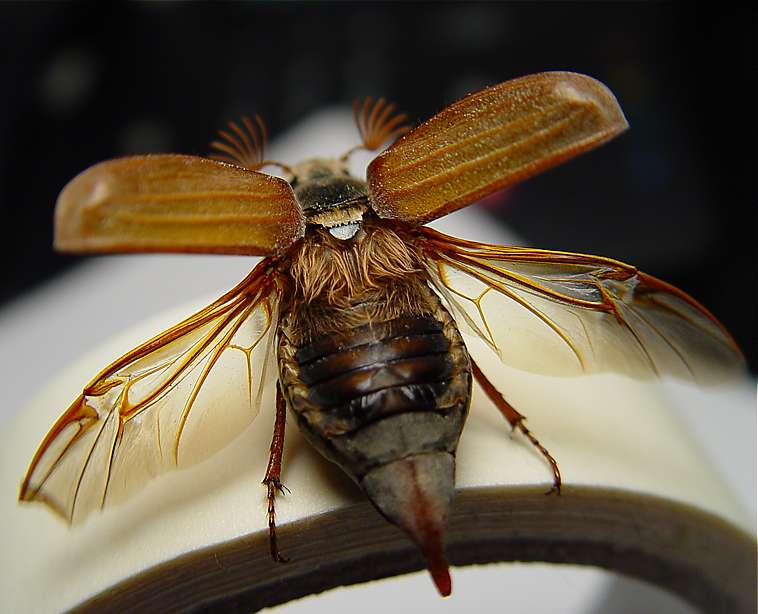
Cockchafer

Cockchafer

Melolontha melolontha

Unknown author, CC BY-SA 3.0, via Wikimedia Commons

Side by side

Metascelis flexilisCockchafer
Scientific nameMetascelis flexilis Westwood, 1842Melolontha melolontha (Linnaeus, 1758)
English nameNot recordedCockchafer
GroupInsectsInsects
ClassInsecta InsectInsecta Insect
OrderColeoptera BeetleColeoptera Beetle
FamilyScarabaeidae Dung BeetlesScarabaeidae Dung Beetles
GenusMetascelisMelolontha May Bugs
Named in18421758
Countries on record1 country41 countries
GBIF occurrence recordsNot recorded51,302 records

Rows where the two agree are shown in grey.

Where each is found

Only Metascelis flexilis (1)

Only Cockchafer (41)

From Catalogue of Life checklists and GBIF occurrence records. A country missing from a list means no record is held, which is not proof of absence.

Checked facts

Metascelis flexilisCockchafer
AppearanceNo checked fact yet
  • Male adults have seven flattened, leaf-shaped antenna extensions, whereas females have six. English Wikipedia
  • The male has larger, fan-shaped antennae than the female. English Wikipedia
  • The larva has a white body, a black abdominal extremity, and a curved C-shaped posture. English Wikipedia
  • The larva has a large brown head, strong mandibles, and well-developed hairy legs. English Wikipedia
SizeNo checked fact yet
  • Adult cockchafers measure between 25 and 30 mm in length. English Wikipedia
  • First-stage larvae measure 10–20 mm, second-stage larvae 30–35 mm, and final-stage larvae 40–46 mm. English Wikipedia
HabitatNo checked fact yet
  • The species occurs particularly in temperate European regions with soil conditions suitable for larval development. English Wikipedia
DietNo checked fact yet
  • Adult cockchafers feed on leaves of oak, sycamore, maple, hornbeam, beech, and plum trees. English Wikipedia
  • Adults also feed on chestnut leaves occasionally. English Wikipedia
  • Adult cockchafers consume leaves from deciduous trees and shrubs, including hazelnut. English Wikipedia
  • Larvae feed on plant roots, including potato roots. English Wikipedia
  • Larvae particularly consume roots of grasses, cereals, and other crops. English Wikipedia
  • Cockchafer larvae feed on strawberry roots and can damage strawberry crops. English Wikipedia
BehaviourNo checked fact yet
  • Male cockchafers generally swarm during mating season, while females remain stationary and feed on leaves. English Wikipedia
  • Male cockchafers use plant-released green leaf volatiles to locate females feeding on leaves. English Wikipedia
  • Larvae use plant volatiles and carbon dioxide to locate plant roots. English Wikipedia
  • Male cockchafers emerge from the soil when temperatures become favourable in April or May. English Wikipedia
  • Adult cockchafers typically disperse no more than 2–3 km from their emergence location. English Wikipedia
  • Cockchafer larvae can move horizontally through soil by as much as 30 cm per day. English Wikipedia
  • Cockchafer larvae undergo winter hibernation by burrowing deep into the soil. English Wikipedia
ReproductionNo checked fact yet
  • Females begin laying eggs approximately two to three weeks after adult emergence. English Wikipedia
  • Females deposit their eggs in fields approximately 15–25 cm below the soil surface. English Wikipedia
  • Each female can lay between 60 and 80 eggs. English Wikipedia
  • Mating between cockchafers lasts several hours. English Wikipedia
  • Female cockchafers lay eggs in batches containing 10–38 eggs. English Wikipedia
  • Egg maturation takes approximately 5–8 days at 27 °C and 23–32 days at 15 °C. English Wikipedia
  • Cockchafers develop through egg, larval, pupal, and adult stages. English Wikipedia
  • Eggs hatch approximately four to six weeks after being laid. English Wikipedia
  • The larva pupates underground during summer and develops into an adult over approximately six weeks. English Wikipedia
Distribution
  • Metascelis flexilis is thought to originate from the border region between Nepal and India. English Wikipedia
ConservationNo checked fact yet
  • Cockchafer populations in Europe declined between the 1940s and 1970s following the use of toxic pesticides and expansion of agricultural land. English Wikipedia
  • Cockchafer populations began recovering in some European areas after highly toxic pesticides were banned. English Wikipedia
UsesNo checked fact yet
  • Cockchafers were consumed in parts of Europe during the nineteenth century, including raw, sugared, candied, and in soup. English Wikipedia
Similar species
  • Sharp treated Metascelis flexilis as a synonym of Chilodiplus albertisii in 1877. English Wikipedia
  • Melolontha hippocastani is a closely related and morphologically similar species that shares physical and behavioural characteristics with M. melolontha. English Wikipedia
  • Melolontha hippocastani has a brown pronotum, whereas M. melolontha has a black pronotum. English Wikipedia
Name originNo checked fact yet
  • The name cockchafer combines the word cock, referring to size or vigour, with chafer, referring to an insect of this type. English Wikipedia
  • The scientific name Melolontha derives from the Ancient Greek word mēlolónthē, meaning cockchafer. English Wikipedia
Other
  • Metascelis flexilis was described by Westwood in 1842. English Wikipedia
  • The original type specimen of Metascelis flexilis was held in the collection of the Linnaean Society of London but is no longer there. English Wikipedia
  • A specimen identified as Metascelis flexilis is held in the collection of the ZMHU. English Wikipedia
  • Allsopp disputed the synonymy of Metascelis flexilis with Chilodiplus albertisii in a 1989 revision of the Systellopini tribe. English Wikipedia
  • Allsopp concluded that Metascelis flexilis does not belong to the Systellopini tribe, although it has not been formally reclassified. English Wikipedia
No checked fact yet

In brief

Metascelis flexilis

Metascelis flexilis was described by Westwood in 1842. It is thought to originate from the border region between Nepal and India. Its taxonomic placement has been disputed, including its synonymy with Chilodiplus albertisii and its assignment to the Systellopini tribe. Full profile

Cockchafer

The species is native to Europe and has also been reported in Turkey and the Caucasus region. Adult males have seven flattened, leaf-shaped antenna extensions, while females have six. Full profile

Compare something else

Page built on 30 November 2026 from the data on the two species pages, where every source is listed.

Cite this page

ScientificNames.org. (2026). Metascelis flexilis vs Cockchafer. Retrieved November 30, 2026, from https://scientificnames.org/compare/metascelis-flexilis-vs-cockchafer