Comparison

Starry Cup Coral vs Lord Coral

Starry Cup Coral (Micromussa regularis) and Lord Coral (Micromussa lordhowensis) both belong to the genus Micromussa and part ways below it. Both are recorded in 1 country.

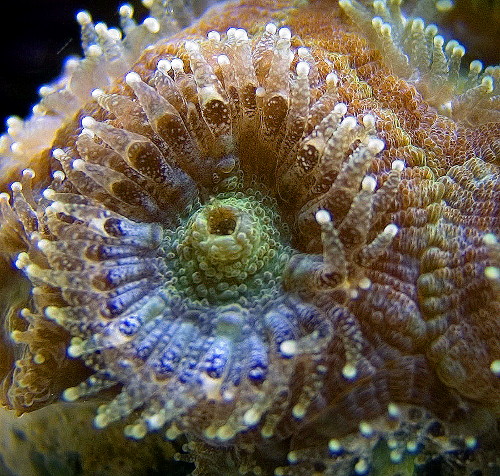
Starry Cup Coral

Starry Cup Coral

Micromussa regularis

Kate Osborne, CC BY 4.0, via Wikimedia Commons

Lord Coral

Lord Coral

Micromussa lordhowensis

Haplochromis, CC BY 2.5, via Wikimedia Commons

Side by side

Starry Cup CoralLord Coral
Scientific nameMicromussa regularis (Veron, 2000)Micromussa lordhowensis (Veron & Pichon, 1982)
English nameStarry Cup CoralLord Coral
GroupOther invertebratesOther invertebrates
ClassAnthozoaAnthozoa
OrderScleractiniaScleractinia
FamilyLobophylliidaeLobophylliidae
GenusMicromussaMicromussa
Named in20001982
Red List categoryLeast ConcernEndangered
Environmentmarinemarine
Countries on record3 countries4 countries
GBIF occurrence records66 records399 records

Rows where the two agree are shown in grey.

Where each is found

Both recorded in 1 country

Only Starry Cup Coral (2)

Only Lord Coral (3)

From Catalogue of Life checklists and GBIF occurrence records. A country missing from a list means no record is held, which is not proof of absence.

Checked facts

Starry Cup CoralLord Coral
Appearance
  • Colonies of Micromussa regularis have a massive growth form. English Wikipedia
  • Its corallites are subplacoid and arranged irregularly. English Wikipedia
  • The teeth on adjacent septa often align to form concentric rings. English Wikipedia
  • Its skeleton lacks a covering of fleshy tissue. English Wikipedia
  • Its colonies are brownish or yellowish-brown, sometimes with contrasting colours between the corallite floors and walls. English Wikipedia
SizeNo checked fact yet
Habitat
Diet
  • Micromussa regularis obtains most of its nutritional requirements from symbiotic dinoflagellates living in its soft tissues. English Wikipedia
  • Its symbiotic photosynthetic organisms supply organic carbon and nitrogen to the coral. English Wikipedia
  • Symbiotic dinoflagellates can provide up to 90% of the coral's energy requirements for metabolism and growth. English Wikipedia
  • The coral meets its remaining nutritional requirements by capturing planktonic organisms with its polyp tentacles. English Wikipedia
  • Its extended tentacles capture zooplankton and small invertebrates for consumption. English Wikipedia
  • The coral obtains additional energy from symbiotic dinoflagellates living within its tissues. English Wikipedia
  • Its symbiotic algae produce nutrients through photosynthesis. English Wikipedia
BehaviourNo checked fact yet
  • This coral aggressively defends itself against being overshadowed by other organisms. English Wikipedia
  • Some polyps extend long filaments at night that secrete enzymes capable of digesting cells of organisms they contact. English Wikipedia
ReproductionNo checked fact yet
  • This coral is hermaphroditic and reproduces through broadcast spawning. English Wikipedia
  • Its larvae become part of the plankton and drift with ocean currents before settling on the seabed. English Wikipedia
  • In aquarium experiments, fully developed larvae survived in the water for up to another 78 days before settling. English Wikipedia
Distribution
  • Micromussa regularis occurs in Indo-Pacific waters extending from Australia to the western Pacific Ocean. English Wikipedia
  • Micromussa regularis is uncommon across most of its geographical range, although it can be locally common. English Wikipedia
  • Its geographical range covers the western Indo-Pacific. English Wikipedia
  • Its range extends from the Red Sea, Gulf of Aqaba and eastern African coast to the East China Sea, Japan and Australia. English Wikipedia
Conservation
  • The population trend of Micromussa regularis is unknown but is considered likely to be declining. English Wikipedia
  • The species is particularly susceptible to coral bleaching and coral diseases. English Wikipedia
  • Climate change and physical destruction of coral reef habitats are identified as major threats to corals. English Wikipedia
  • Extreme weather events, rising seawater temperatures and ocean acidification contribute to increasing damage to coral habitats. English Wikipedia
  • The International Union for Conservation of Nature has assessed Micromussa regularis as vulnerable. English Wikipedia
  • Micromussa regularis receives protection through its inclusion in CITES Appendix II. English Wikipedia
  • The species is described as common and widely distributed. English Wikipedia
  • The species appears more resilient than some other coral species. English Wikipedia
  • Predation by parrotfish and starfish is identified as a likely major threat in the wild. English Wikipedia
  • Degradation of its reef habitat is identified as another likely threat. English Wikipedia
  • The species may disappear completely from some degraded reefs. English Wikipedia
  • Ocean acidification and climate change are expected to adversely affect this coral. English Wikipedia
UsesNo checked fact yet
Other
  • The species was originally classified in the genus Acanthastrea. English Wikipedia
  • The species was reclassified into the genus Micromussa in 2016. English Wikipedia
  • Phylogenetic research found this species to be unrelated to Acanthastrea echinata and closely related to other Micromussa species. English Wikipedia
  • Morphological analyses found that its septal size, shape and granulation match characteristics of Micromussa species. English Wikipedia
  • The species can thrive under lighting and water-flow conditions that some other Mussidae corals cannot tolerate. English Wikipedia
  • The species is commercially known as a trend coral and can command high prices unrelated to its rarity or accessibility. English Wikipedia

In brief

Starry Cup Coral

The starry cup coral is a zooxanthellate coral. It occurs in Indo-Pacific waters extending from Australia to the western Pacific Ocean. Its massive colonies have irregularly arranged subplacoid corallites and brownish or yellowish-brown colours. Full profile

Lord Coral

Micromussa lordhowensis lives on shallow reefs in the Indo-Pacific Ocean at depths reaching approximately 30 metres. It forms low colonial clumps with variable coloration and corallites reaching 15 mm in diameter. Full profile

Compare something else

Page built on 27 November 2026 from the data on the two species pages, where every source is listed.

Cite this page

ScientificNames.org. (2026). Starry Cup Coral vs Lord Coral. Retrieved November 27, 2026, from https://scientificnames.org/compare/micromussa-regularis-vs-lord-coral