Species · Other invertebrates
Lord Coral Micromussa lordhowensis
The scientific name of the Lord Coral is Micromussa lordhowensis. It is a species of animal in the family Lobophylliidae, order Scleractinia. The name dates from 1982.
- Scientific name
- Micromussa lordhowensis (Veron & Pichon, 1982)
- Common name
- Lord Coral
- Genus
- Micromussa
- Family
- Lobophylliidae
- Order
- Scleractinia
- Class
- Anthozoa
- Red List category
- EN Endangered
- Environment
- marine
- Recorded in
- 4 countries
- Name status
- accepted in the Catalogue of Life
Overview
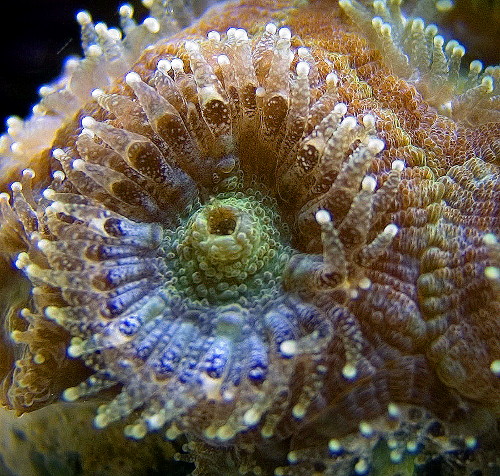
Micromussa lordhowensis lives on shallow reefs in the Indo-Pacific Ocean at depths reaching approximately 30 metres. It forms low colonial clumps with variable coloration and corallites reaching 15 mm in diameter.
Written 26 November 2026 from the sources listed below. Each statement was checked against the passage it cites; statements that could not be supported were removed.
Appearance
Lord Coral forms colonial growths consisting of low clumps. Its colonies can reach two metres across.[1][2]
Its corallites can reach 15 mm in diameter. Their walls consist of closely packed septa bearing fine teeth, and the columella is well developed.[3][4][5]
Its coloration varies and can include contrasting shades of red, orange, purple, blue or green.[6]
Habitat
Lord Coral occurs on shallow reefs in the Indo-Pacific Ocean. It inhabits reefs at depths reaching approximately 30 metres.[7][8]
Its geographical range covers the western Indo-Pacific, extending from the Red Sea, Gulf of Aqaba and eastern African coast to the East China Sea, Japan and Australia.[9][10]
Diet
Its extended tentacles capture zooplankton and small invertebrates for consumption.[11]
Lord Coral obtains additional energy from symbiotic dinoflagellates living within its tissues. These algae produce nutrients through photosynthesis.[12][13]
Behaviour
Lord Coral aggressively defends itself against being overshadowed by other organisms. Some polyps extend long filaments at night that secrete enzymes capable of digesting cells of organisms they contact.[14][15]
Reproduction and life cycle
Lord Coral is hermaphroditic and reproduces through broadcast spawning. Its larvae become part of the plankton and drift with ocean currents before settling on the seabed.[16][17]
In aquarium experiments, fully developed larvae survived in the water for up to another 78 days before settling.[18]
Conservation
Lord Coral is described as common and widely distributed. It appears more resilient than some other coral species.[19][20]
Predation by parrotfish and starfish is identified as a likely major threat in the wild. Degradation of its reef habitat is another likely threat, and the species may disappear completely from some degraded reefs.[21][22][23]
Ocean acidification and climate change are expected to adversely affect Lord Coral.[24]
Uses
Colorful specimens of Lord Coral are popular in the aquarium trade. The coral propagates rapidly in captive reef environments.[25][26]
The species is commercially known as a trend coral and can command high prices unrelated to its rarity or accessibility.[27]
Similar species
Lord Coral was originally classified in the genus Acanthastrea and was reclassified into the genus Micromussa in 2016. Phylogenetic research found it to be unrelated to Acanthastrea echinata and closely related to other Micromussa species.[28][29][30]
Morphological analyses found that its septal size, shape and granulation match characteristics of Micromussa species.[31]
The species can thrive under lighting and water-flow conditions that some other Mussidae corals cannot tolerate.[32]
Classification of the Lord Coral
| Kingdom | Animalia |
|---|---|
| Phylum | Cnidaria |
| Class | Anthozoa |
| Subclass | Hexacorallia |
| Order | Scleractinia |
| Suborder | Vacatina |
| Family | Lobophylliidae |
| Genus | Micromussa |
| Species | Micromussa lordhowensis (Veron & Pichon, 1982) |
Where the Lord Coral is found
Checklists and occurrence records place Micromussa lordhowensis in 4 countries. GBIF holds 399 georeferenced records of it.
Countries
Regions and cities with the most records
- Kingston, Norfolk Island 109
- Caloundra, Australia 27
- Queensland, Australia 26
- Sunshine Coast, Australia 24
- New South Wales, Australia 23
- Capalaba, Australia 13
- Coffs Harbour, Australia 13
- Ushibukamachi, Japan 5
- Nagasaki, Japan 4
- Gladstone, Australia 3
- Gold Coast, Australia 3
- Karratha, Australia 3
- Kushimoto, Japan 3
- Northern Territory, Australia 3
- Western Australia, Australia 3
A number beside a place is its count of GBIF occurrence records. A place without a number comes from a checklist alone. Records show where a species has been observed or collected, which can include escapes and vagrants.
Common names
English
- Lord Coral
- Acan Lord
- Starry Cup Coral
Names in 3 other languages
- Czech
- riflovník lordhowensijský
- Japanese
- カクオオトゲキクメイシ
- Portuguese
- Coral-cérebro-de-Lord-Howe
Synonyms
One other scientific name has been used for this species and is now treated as a synonym of Micromussa lordhowensis.
- Acanthastrea lordhowensis Veron & Pichon, 1982
Related species
-
 Starry Cup CoralMicromussa regularis
- Micromussa CoralMicromussa amakusensis
- False Knob CoralMicromussa multipunctata
- Micromussa indiana
- Micromussa pacifica
-
 Starry Cup CoralAcanthastrea echinata
-
 Lobed Cactus CoralLobophyllia hemprichii
-
 Button CoralCynarina lacrymalis
Compare
Questions and answers
What is the scientific name of the Lord Coral?
The scientific name of the Lord Coral is Micromussa lordhowensis. Written with its author, the full name is Micromussa lordhowensis (Veron & Pichon, 1982).
Which family does the Lord Coral belong to?
Micromussa lordhowensis belongs to the family Lobophylliidae, in the order Scleractinia and the class Anthozoa.
Where is the Lord Coral found?
Checklists and occurrence records place Micromussa lordhowensis in 4 countries: Australia, Norfolk Island, Japan and New Caledonia.
What is the conservation status of the Lord Coral?
The IUCN Red List category recorded for Micromussa lordhowensis is Endangered (EN).
What other names does the Lord Coral have?
Micromussa lordhowensis is also known in English as Acan Lord and Starry Cup Coral.
Sources
Passages the profile rests on
- This species forms colonial growths consisting of low clumps. Source passage: “Micromussa lordhowensis is a colonial coral forming low clumps” — English Wikipedia
- Its colonies can reach two metres across. Source passage: “that can be two metres (yards) across.” — English Wikipedia
- Its corallites can reach 15 mm in diameter. Source passage: “The corallites are large, up to 15 mm (0.6 in) in diameter” — English Wikipedia
- Its corallite walls consist of closely packed septa bearing fine teeth. Source passage: “with walls composed of closely packed septa with fine teeth.” — English Wikipedia
- Its columella is well developed. Source passage: “The columella is well-developed.” — English Wikipedia
- Its coloration varies and can include contrasting shades of red, orange, purple, blue or green. Source passage: “The colour varies widely and is often formed of two contrasting shades of red, orange, purple, blue or green.” — English Wikipedia
- This coral occurs on shallow reefs in the Indo-Pacific Ocean. Source passage: “occurring on shallow reefs in the Indo-Pacific Ocean.” — English Wikipedia
- It inhabits reefs at depths reaching approximately 30 metres. Source passage: “on reefs at depths down to about 30 metres (98 ft).” — English Wikipedia
- Its geographical range covers the western Indo-Pacific. Source passage: “Micromussa lordhowensis occurs in the western Indo-Pacific” — English Wikipedia
- Its range extends from the Red Sea, Gulf of Aqaba and eastern African coast to the East China Sea, Japan and Australia. Source passage: “Its range extends from the Red Sea, the Gulf of Aqaba and the eastern coast of Africa to the East China Sea, Japan and Australia.” — English Wikipedia
- Its extended tentacles capture zooplankton and small invertebrates for consumption. Source passage: “they search for zooplankton and small invertebrates which are transferred to the mouth when caught.” — English Wikipedia
- The coral obtains additional energy from symbiotic dinoflagellates living within its tissues. Source passage: “Another source of energy is the symbiotic dinoflagellates, microscopic algae that live within the coral's tissues” — English Wikipedia
- Its symbiotic algae produce nutrients through photosynthesis. Source passage: “which produce nutrients by photosynthesis.” — English Wikipedia
- This coral aggressively defends itself against being overshadowed by other organisms. Source passage: “Micromussa lordhowensis is an aggressive species of coral and defends itself against the possibility of being overshadowed.” — English Wikipedia
- Some polyps extend long filaments at night that secrete enzymes capable of digesting cells of organisms they contact. Source passage: “At night some polyps extend long filaments which secrete enzymes which digest the cells of other organisms with which they come in contact.” — English Wikipedia
- This coral is hermaphroditic and reproduces through broadcast spawning. Source passage: “Micromussa lordhowensis is a hermaphrodite and a broadcast spawner.” — English Wikipedia
- Its larvae become part of the plankton and drift with ocean currents before settling on the seabed. Source passage: “The larvae form part of the plankton and drift with the ocean currents, eventually settling on the seabed.” — English Wikipedia
- In aquarium experiments, fully developed larvae survived in the water for up to another 78 days before settling. Source passage: “the larvae could remain alive in the water after they were fully developed for up to a further 78 days before settling.” — English Wikipedia
- The species is described as common and widely distributed. Source passage: “In the main however it is a common species that is widely distributed” — English Wikipedia
- The species appears more resilient than some other coral species. Source passage: “seems to be more resilient than some other species.” — English Wikipedia
- Predation by parrotfish and starfish is identified as a likely major threat in the wild. Source passage: “the chief threat it is likely to face is from predation by coral eating organisms such as parrot fish and starfish” — English Wikipedia
- Degradation of its reef habitat is identified as another likely threat. Source passage: “and the degradation of its reef habitat.” — English Wikipedia
- The species may disappear completely from some degraded reefs. Source passage: “It may disappear entirely from some degraded reefs” — English Wikipedia
- Ocean acidification and climate change are expected to adversely affect this coral. Source passage: “is likely to be adversely affected by ocean acidification and climate change.” — English Wikipedia
- Colorful specimens of this species are popular in the aquarium trade. Source passage: “Many colorful species of this coral are popular in the aquarium trade” — English Wikipedia
- This coral propagates rapidly in captive reef environments. Source passage: “The coral grows and propagates rapidly in captive reef environments” — English Wikipedia
- The species is commercially known as a trend coral and can command high prices unrelated to its rarity or accessibility. Source passage: “best known recently as a "trend coral" that commands high prices in the reef trade that are not related to its rarity, population or accessibility.” — English Wikipedia
- The species was originally classified in the genus Acanthastrea. Source passage: “It was originally classified under the genus Acanthastrea” — English Wikipedia
- The species was reclassified into the genus Micromussa in 2016. Source passage: “and reclassified under the genus Micromussa in 2016.” — English Wikipedia
- Phylogenetic research found this species to be unrelated to Acanthastrea echinata and closely related to other Micromussa species. Source passage: “it was found to be unrelated to the genus type, A. echinata, but closely related to the other species in Micromussa.” — English Wikipedia
- Morphological analyses found that its septal size, shape and granulation match characteristics of Micromussa species. Source passage: “Micromussa lordhowensis displays the septal size, shape, and granulation typical of all Micromussa species” — English Wikipedia
- The species can thrive under lighting and water-flow conditions that some other Mussidae corals cannot tolerate. Source passage: “thrives under lighting and flow conditions that other Mussidae would not survive.” — English Wikipedia
Data
- Catalogue of Life, 2026-10-16 XR cc by
- Global Biodiversity Information Facility CC BY 4.0
- Wikidata CC0
- GeoNames CC BY 4.0
- Wikimedia Commons per image; credit shown with each image
- Within the Catalogue of Life, this name comes from World List of Scleractinia cc by
References
- Arrigoni R, Benzoni F, Huang D, Fukami H, Chen CA, Berumen ML, Hoogenboom M, Thomson DP, Hoeksema BW, Budd AF, Zayasu Y, Terraneo TI, Kitano YF, & Baird AH. (2016). When forms meet genes: revision of the scleractinian genera Micromussa and Homophyllia (Lobophylliidae) with a description of two new species and one new genus. Contributions to Zoology, 85 (4): 387–422. https://doi.org/10.1163/18759866-08504002 Link where the name was published
This species in other databases
- Catalogue of Life 42ZLM
- Wikidata Q61656516
- iNaturalist 519616
- WoRMS urn:lsid:marinespecies.org:taxname:886929
Page built on 28 November 2026. See how the catalog is made and all sources and licences.
Cite this page
ScientificNames.org. (2026). Micromussa lordhowensis (Lord Coral). Retrieved November 28, 2026, from https://scientificnames.org/species/micromussa-lordhowensis
“Micromussa lordhowensis (Lord Coral).” ScientificNames.org, 2026, scientificnames.org/species/micromussa-lordhowensis. Accessed 28 Nov. 2026.
ScientificNames.org. “Micromussa lordhowensis (Lord Coral).” Accessed November 28, 2026. https://scientificnames.org/species/micromussa-lordhowensis.
@misc{scientificnames_micromussa_lordhowensis_lord_coral,
  author = {{ScientificNames.org}},
  title = {Micromussa lordhowensis (Lord Coral)},
  year = {2026},
  url = {https://scientificnames.org/species/micromussa-lordhowensis},
  note = {Accessed 2026-11-28}
}