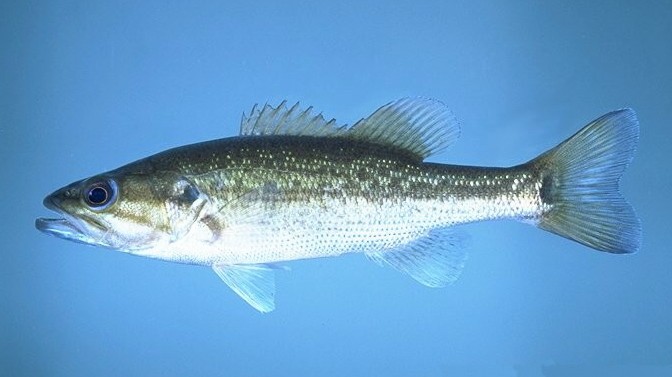
| Appearance | | - The spotted bass has prominent rows of dark spots below its lateral line. English Wikipedia
- The spotted bass has scales on the base portion of its second dorsal fin. English Wikipedia
- Its first and second dorsal fins are clearly connected. English Wikipedia
- Its upper jaw bone does not extend back to or beyond the rear edge of the eyes. English Wikipedia
- The spotted bass lacks the vertical body bars characteristic of smallmouth bass. English Wikipedia
- The spotted bass has small black spots below the lateral line that are absent in largemouth and smallmouth bass. English Wikipedia
- Juvenile spotted bass can have an orange band at the base of the tail followed by a black band and a white edge. English Wikipedia
- The spotted bass has a smaller mouth than the largemouth bass. English Wikipedia
- The maxilla does not extend beyond the eye when the mouth is fully closed. dwr.virginia.gov
- The spotted bass has a small patch of teeth on its tongue. dwr.virginia.gov
- Dark blotches, often connected, extend across the midline of the body. dwr.virginia.gov
|
|---|
| Size | No checked fact yet | |
|---|
| Habitat | - The species inhabits clear lakes and ponds with abundant aquatic vegetation. fws.gov
- The species also occupies swamps and backwaters of creeks and rivers. fws.gov
- The species primarily inhabits lakes and rivers. animaldiversity.org
- Its optimal habitat consists of slow-moving, quiet, clear water with soft, shallow substrates. animaldiversity.org
- Dense aquatic vegetation provides habitat for both avoiding predators and capturing prey. animaldiversity.org
- The species typically occupies shallow water at depths of 0.3–4 metres. animaldiversity.org
- During winter, individuals migrate to deeper water at depths of 5–15 metres. animaldiversity.org
- In its introduced European range, the species has been reported in estuaries with salinities up to 13 parts per thousand. animaldiversity.org
| - The spotted bass prefers cool and warm mountain streams and reservoirs with rocky bottoms. English Wikipedia
- The spotted bass commonly occupies flowing streams, rivers, and reservoirs with aquatic vegetation, submerged logs, and rocky or riprap walls. English Wikipedia
- The spotted bass generally inhabits waters with more current than those preferred by largemouth bass. English Wikipedia
- The spotted bass can inhabit water as deep as 30 metres. English Wikipedia
- The spotted bass occupies water that is too warm for smallmouth bass but generally swifter-moving than water preferred by largemouth bass. dwr.virginia.gov
- The spotted bass prefers cover provided by large woody debris, undercut banks, trees, rocks, and submerged aquatic vegetation. dwr.virginia.gov
|
|---|
| Diet | No checked fact yet | - The spotted bass feeds on insects, crustaceans, frogs, annelid worms, and smaller fish. English Wikipedia
- The spotted bass commonly consumes small fishes, crayfish, and aquatic insects. English Wikipedia
- Young spotted bass initially consume copepods and other small crustaceans before beginning to eat insects. English Wikipedia
- The spotted bass consumes approximately half as much fish as the largemouth bass. English Wikipedia
- Spotted bass in Virginia feed heavily on other fish, amphibians, crayfish, and insects. dwr.virginia.gov
|
|---|
| Behaviour | | - The spotted bass captures prey by opening its mouth and generating negative pressure to draw prey inside. English Wikipedia
- Spotted bass are described as aggressive feeders that opportunistically consume catchable prey that fits in their mouths. dwr.virginia.gov
|
|---|
| Reproduction | - The species is polyandrous, with one female mating with multiple males during a breeding season. animaldiversity.org
- In southern regions, reproduction generally occurs between January and March. animaldiversity.org
- In northern regions, reproduction generally occurs during May and June. animaldiversity.org
- Spawning can begin when water temperatures reach approximately 15 degrees Celsius. animaldiversity.org
- Males construct nests using hard-packed sand, pea gravel, clay, or marl. animaldiversity.org
- Spawning generally takes place in water 0.6–2 metres deep. animaldiversity.org
- The male externally fertilizes the eggs after the female deposits them in the nest. animaldiversity.org
- A female can produce between 3,000 and 45,000 offspring in one spawning event. animaldiversity.org
- The average number of offspring produced by a female is approximately 4,000. animaldiversity.org
| |
|---|
| Distribution | - The species is native to much of eastern North America. animaldiversity.org
- Its native range extends north to Quebec, Canada, and south to northern Mexico. animaldiversity.org
- Its native range extends east to the Atlantic coast and west to Texas and North Dakota. animaldiversity.org
- The species is native to the St. Lawrence-Great Lakes, Hudson Bay, and Mississippi River basins. animaldiversity.org
- Its native range includes Atlantic drainages from North Carolina to Florida. animaldiversity.org
- Its native range includes Gulf drainages from southern Florida to northern Mexico. animaldiversity.org
- The species has also been observed in an isolated range extending from western Montana to southern British Columbia. animaldiversity.org
- Outside its native range, the species has been introduced to Europe, Asia, Africa, and South America. animaldiversity.org
| - The spotted bass is native to the Mississippi River basin and Gulf states from central Texas to the Florida panhandle. English Wikipedia
- The native range of the spotted bass extends into the western Mid-Atlantic states. English Wikipedia
- The spotted bass has been introduced into western North Carolina and Virginia. English Wikipedia
|
|---|
| Conservation | No checked fact yet | - The spotted bass has become established as an invasive species in some isolated waters of southern Africa. English Wikipedia
- The spotted bass was held responsible for declines in native fiery redfin and Cape galaxias abundance in South Africa. English Wikipedia
|
|---|
| Uses | No checked fact yet | |
|---|
| Similar species | No checked fact yet | - The spotted bass is frequently mistaken for the largemouth bass because of their similar coloration. English Wikipedia
- The spotted bass is also frequently confused with the smallmouth bass. English Wikipedia
- The spotted bass is known to hybridize with the smallmouth bass. English Wikipedia
|
|---|