Comparison
Mimic Octopus vs Southern Blue-ringed Octopus
Mimic Octopus (Thaumoctopus mimicus) and Southern Blue-ringed Octopus (Hapalochlaena maculosa) both belong to the family Octopodidae (scuttles) and part ways below it. Both are recorded in 1 country.
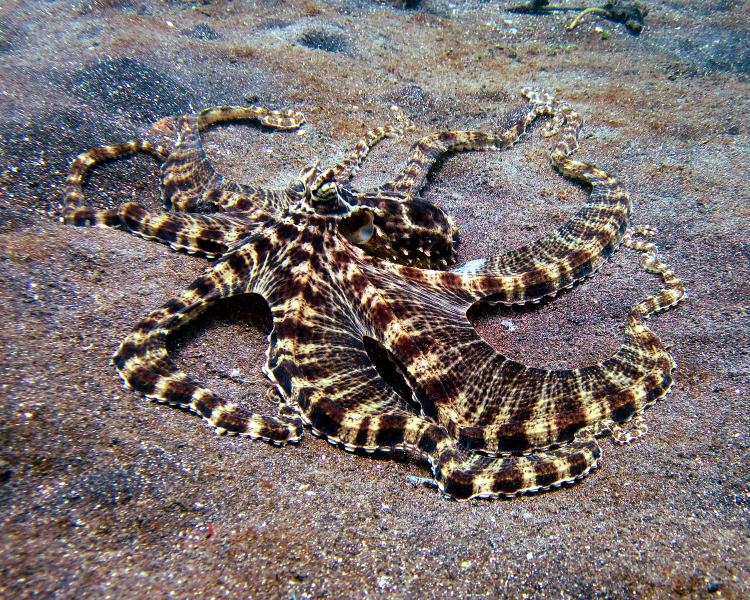


Side by side
| Mimic Octopus | Southern Blue-ringed Octopus | |
|---|---|---|
| Scientific name | Thaumoctopus mimicus M. Norman & Hochberg, 2005 | Hapalochlaena maculosa (Hoyle, 1883) |
| English name | Mimic Octopus | Southern Blue-ringed Octopus |
| Group | Molluscs | Molluscs |
| Class | Cephalopoda Cephalopod | Cephalopoda Cephalopod |
| Family | Octopodidae Scuttles | Octopodidae Scuttles |
| Genus | Thaumoctopus Mimic Octopus | Hapalochlaena Blue-ringed Octopus |
| Named in | 2005 | 1883 |
| Red List category | Least Concern | Least Concern |
| Environment | marine | marine |
| Countries on record | 6 countries | 1 country |
| GBIF occurrence records | 220 records | 795 records |
Rows where the two agree are shown in grey.
Where each is found
Both recorded in 1 country
Only Mimic Octopus (5)
From Catalogue of Life checklists and GBIF occurrence records. A country missing from a list means no record is held, which is not proof of absence.
Checked facts
| Mimic Octopus | Southern Blue-ringed Octopus | |
|---|---|---|
| Appearance |
|
|
| Size |
|
|
| Habitat |
|
|
| Diet |
|
|
| Behaviour |
|
|
| Reproduction | No checked fact yet |
|
| Distribution | No checked fact yet |
|
| Conservation | No checked fact yet |
|
| Uses | No checked fact yet |
|
| Other | No checked fact yet |
|
In brief
Mimic Octopus
Thaumoctopus mimicus inhabits muddy river-mouth bottoms, estuaries, and shallow offshore waters, primarily on sandy or silty seabeds at depths below 15 meters. Full profile
Southern Blue-ringed Octopus
Hapalochlaena maculosa occurs along the southern coasts of Australia. It has iridescent blue rings within its eye spots that become visibly luminous when aggravated. Full profile
Compare something else
Page built on 27 November 2026 from the data on the two species pages, where every source is listed.
Cite this page
ScientificNames.org. (2026). Mimic Octopus vs Southern Blue-ringed Octopus. Retrieved November 27, 2026, from https://scientificnames.org/compare/mimic-octopus-vs-southern-blue-ringed-octopus
“Mimic Octopus vs Southern Blue-ringed Octopus.” ScientificNames.org, 2026, scientificnames.org/compare/mimic-octopus-vs-southern-blue-ringed-octopus. Accessed 27 Nov. 2026.
ScientificNames.org. “Mimic Octopus vs Southern Blue-ringed Octopus.” Accessed November 27, 2026. https://scientificnames.org/compare/mimic-octopus-vs-southern-blue-ringed-octopus.
@misc{scientificnames_mimic_octopus_vs_southern_blue_ringed_octopus,
  author = {{ScientificNames.org}},
  title = {Mimic Octopus vs Southern Blue-ringed Octopus},
  year = {2026},
  url = {https://scientificnames.org/compare/mimic-octopus-vs-southern-blue-ringed-octopus},
  note = {Accessed 2026-11-27}
}