Comparison

Hawaiʻi ʻōʻō vs Oʻahu ʻōʻō

Hawaiʻi ʻōʻō (Moho nobilis) and Oʻahu ʻōʻō (Moho apicalis) both belong to the genus Moho ('o'os) and part ways below it.

Hawaiʻi ʻōʻō

Hawaiʻi ʻōʻō

Moho nobilis

Vassil, CC0, via Wikimedia Commons

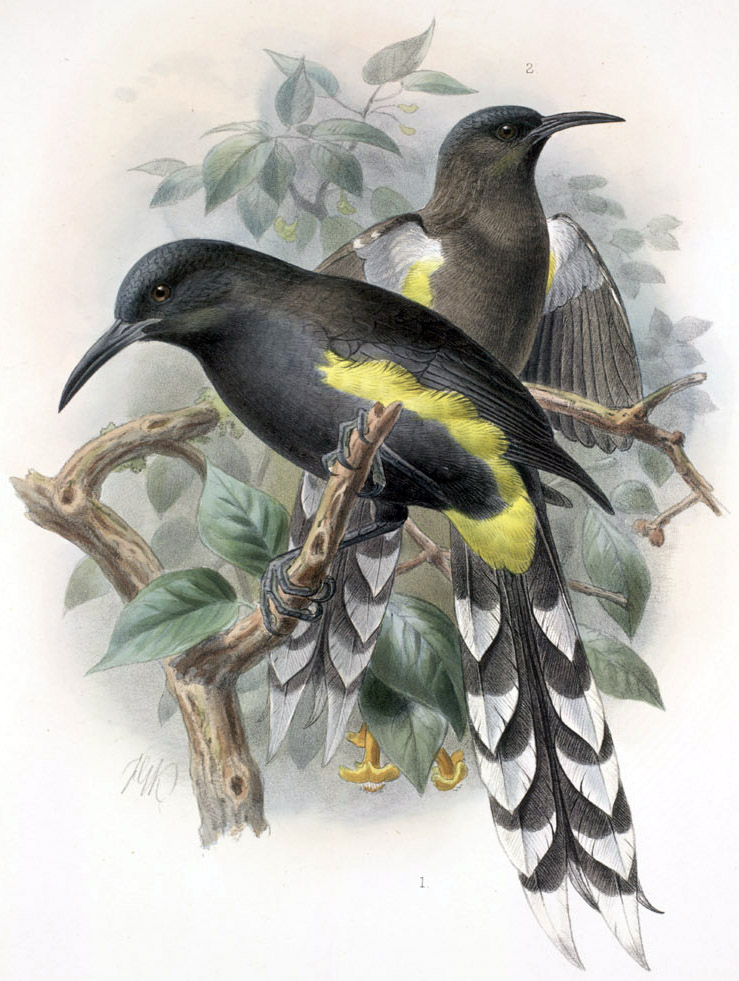
Oʻahu ʻōʻō

Oʻahu ʻōʻō

Moho apicalis

John Gerrard Keulemans, Public domain, via Wikimedia Commons

Side by side

Hawaiʻi ʻōʻōOʻahu ʻōʻō
Scientific nameMoho nobilis (Merrem, 1786)Moho apicalis Gould, 1861
English nameHawaiʻi ʻōʻōOʻahu ʻōʻō
GroupBirdsBirds
ClassAves BirdAves Bird
OrderPasseriformes PasserinePasseriformes Passerine
FamilyMohoidae Hawaiian HoneyeatersMohoidae Hawaiian Honeyeaters
GenusMoho 'O'osMoho 'O'os
Named in17861861
Red List categoryExtinctExtinct

Rows where the two agree are shown in grey.

Checked facts

Hawaiʻi ʻōʻōOʻahu ʻōʻō
Appearance
  • The Hawaiʻi ʻōʻō had glossy black plumage with brown shading on its belly. English Wikipedia
  • The species had yellowish tufts at its axillaries, which were absent in juveniles. English Wikipedia
  • The species had yellowish plumes on its rump. English Wikipedia
  • Its wings had the largest yellow plumes among all ʻōʻō species. English Wikipedia
  • Males and females had similar appearances, although females were smaller and had less twisted tail-feather tips. English Wikipedia
Size
HabitatNo checked fact yet
DietNo checked fact yet
  • The species used a specialized tongue to extract floral nectar from different flower species. English Wikipedia
Behaviour
  • The species had a dipping flight pattern compared to that of the Eurasian magpie. English Wikipedia
  • Its wings could produce a buzzing sound during rapid flapping. English Wikipedia
  • Its call was harsh and consisted of two syllables. English Wikipedia
  • The species was typically shy and timid. English Wikipedia
  • It aggressively defended its territory against approaching birds. English Wikipedia
  • During territorial displays, the bird raised its wings, erected its tail feathers, and displayed its yellowish plumes while attacking intruders. English Wikipedia
ReproductionNo checked fact yet
Distribution
  • The Hawaiʻi ʻōʻō was relatively common on the Big Island when Europeans first arrived. English Wikipedia
  • The last known sighting of the species occurred on the slopes of Mauna Loa in 1934. English Wikipedia
  • The species was endemic to the Hawaiian island of Oʻahu. English Wikipedia
  • Specimens were collected at scattered locations throughout the Koʻolau Range. English Wikipedia
  • Subfossils discovered at Barber's Point suggest that the species' historical range may have extended across the entire island of Oʻahu. English Wikipedia
  • The last reliable evidence consisted of three specimens collected from Nuʻuanu Valley between 11 and 15 January 1837. English Wikipedia
  • The species was restricted to forests on Oʻahu, Hawaiʻi, USA. datazone.birdlife.org
Conservation
  • The Hawaiʻi ʻōʻō is extinct. English Wikipedia
  • The species experienced a rapid population decline after Europeans arrived. English Wikipedia
  • Mosquito-borne diseases and deforestation were considered probable major causes of its extinction. English Wikipedia
  • The introduction of muskets accelerated the species' decline by enabling hunters and collectors to shoot birds from great distances and heights and in large numbers. English Wikipedia
  • Hunters reportedly killed more than one thousand individuals in a single hunt as late as 1898. English Wikipedia
  • The species remained present for nearly 30 years after becoming too rare for large-scale shooting. English Wikipedia
  • Captured individuals kept in cages survived for only a few days or weeks before succumbing to mosquito-borne diseases. English Wikipedia
  • The species was already considered extinct by the time Gould described it in 1860. English Wikipedia
  • Surveys conducted between 1880 and 1890 failed to find the species, after which it was described as extinct. English Wikipedia
Uses
  • Native Hawaiians used the species' striking plumage to make robes, capes, and feathered staffs for Hawaiian nobility. English Wikipedia
  • Some individuals were captured and kept in cages for sale as songbirds. English Wikipedia
  • Early Hawaiians used feathers from the species for clothing, including royal capes and headdresses. English Wikipedia
  • Feathers were gathered into small tied bunches by common people for tax payments to the ruling class. English Wikipedia
OtherNo checked fact yet
  • John Gould scientifically named and described the species in 1860. English Wikipedia
  • Seven specimens of the species are held in museum collections in Berlin, London, New York City, and Cambridge, Massachusetts. English Wikipedia
  • The species is known from approximately seven specimens. datazone.birdlife.org

In brief

Hawaiʻi ʻōʻō

The species was relatively common on the Big Island when Europeans first arrived, and its last known sighting occurred on the slopes of Mauna Loa in 1934. It was distinguished by glossy black plumage, yellowish plumes, and wings with the largest yellow plumes among all ʻōʻō species. Full profile

Oʻahu ʻōʻō

The species was endemic to the Hawaiian island of Oʻahu. It had predominantly sooty-black plumage, deeply yellow flanks and undertail coverts, and brown tail feathers with white tips on all except the two central feathers. Full profile

Compare something else

Page built on 28 November 2026 from the data on the two species pages, where every source is listed.

Cite this page

ScientificNames.org. (2026). Hawaiʻi ʻōʻō vs Oʻahu ʻōʻō. Retrieved November 28, 2026, from https://scientificnames.org/compare/moho-nobilis-vs-moho-apicalis