Species · Birds · Extinct
Hawaiʻi ʻōʻō Moho nobilis
The scientific name of the Hawaiʻi ʻōʻō is Moho nobilis. It is an extinct species of bird in the family Mohoidae (hawaiian honeyeaters), order Passeriformes. The name dates from 1786.
- Scientific name
- Moho nobilis (Merrem, 1786)
- Common name
- Hawaiʻi ʻōʻō
- Genus
- Moho
- Family
- Mohoidae (Hawaiian Honeyeaters)
- Order
- Passeriformes
- Class
- Aves
- Red List category
- EX Extinct
- Name status
- accepted in the Catalogue of Life

Overview
The species was relatively common on the Big Island when Europeans first arrived, and its last known sighting occurred on the slopes of Mauna Loa in 1934. It was distinguished by glossy black plumage, yellowish plumes, and wings with the largest yellow plumes among all ʻōʻō species.
Written 26 November 2026 from the sources listed below. Each statement was checked against the passage it cites; statements that could not be supported were removed.
Appearance
The Hawaiʻi ʻōʻō had glossy black plumage with brown shading on its belly. It had yellowish tufts at its axillaries and yellowish plumes on its rump, while juveniles lacked the axillary tufts.[1][2][3]
Its wings had the largest yellow plumes among all ʻōʻō species. The species measured approximately 32 centimetres in overall length, with a wing length ranging from 11 to 11.5 centimetres and a tail that could reach 19 centimetres.[4][5][6][7]
Males and females had similar appearances, although females were smaller and had less twisted tail-feather tips.[8]
Behaviour
The Hawaiʻi ʻōʻō had a dipping flight pattern compared to that of the Eurasian magpie. Its wings could produce a buzzing sound during rapid flapping.[9][10]
Its call was harsh and consisted of two syllables. The species was typically shy and timid.[11][12]
The species aggressively defended its territory against approaching birds. During territorial displays, it raised its wings, erected its tail feathers, and displayed its yellowish plumes while attacking intruders.[13][14]
Reproduction and life cycle
The nests and eggs of the Hawaiʻi ʻōʻō have never been discovered. The species preferred settling in the highest branches.[15][16]
Conservation
The Hawaiʻi ʻōʻō is extinct. It experienced a rapid population decline after Europeans arrived, and its last known sighting occurred on the slopes of Mauna Loa in 1934.[17][18][19]
Mosquito-borne diseases and deforestation were considered probable major causes of its extinction. Captured individuals kept in cages survived for only a few days or weeks before succumbing to mosquito-borne diseases.[20][21]
The introduction of muskets accelerated the species' decline by enabling hunters and collectors to shoot birds from great distances and heights and in large numbers. Hunters reportedly killed more than one thousand individuals in a single hunt as late as 1898.[22][23]
The species remained present for nearly 30 years after becoming too rare for large-scale shooting.[24]
Uses
Native Hawaiians used the species' striking plumage to make robes, capes, and feathered staffs for Hawaiian nobility.[25]
Some individuals were captured and kept in cages for sale as songbirds.[26]
Classification of the Hawaiʻi ʻōʻō
| Kingdom | Animalia |
|---|---|
| Phylum | Chordata |
| Subphylum | Vertebrata |
| Infraphylum | Gnathostomata |
| Parvphylum | Osteichthyes |
| Megaclass | Tetrapoda |
| Class | Aves (Bird) |
| Order | Passeriformes (Passerine) |
| Family | Mohoidae (Hawaiian Honeyeaters) |
| Genus | Moho ('O'os) |
| Species | Moho nobilis (Merrem, 1786) |
Where the Hawaiʻi ʻōʻō is found
Checklists place Moho nobilis in Oceania.
Range as the checklists state it
Oceania
A number beside a place is its count of GBIF occurrence records. A place without a number comes from a checklist alone. Records show where a species has been observed or collected, which can include escapes and vagrants.
Common names
English
- Hawai'i 'O'o
- Hawai Oo
- Hawaii 'O'o
- Hawaii Oo
Names in 17 other languages
- Croatian
- žutorameni havajski medosas
- Czech
- moho ozdobný
- Dutch
- Hawaii-o'o
- Finnish
- havaijinkiharapyrstö
- French
- Moho d'Hawaï
- German
- Hawaiimoho, Prachtmoho
- Hungarian
- Hawaii mohó
- Italian
- Oo delle Hawaii
- Japanese
- ムネフサミツスイ
- Norwegian Bokmål
- hawaiihonningeter
- Polish
- reliktowiec górski
- Portuguese
- oo-do-havai, oó-de-havai, oó-de-havaí, ’o’o-de-hawaii
- Russian
- Благородный мохо
- Slovak
- moho lesklý
- Spanish
- Oo de Hawai, Oo de Hawái
- Swedish
- hawaii-oo
- Ukrainian
- мого гірський
Synonyms
2 other scientific names have been used for this species and are now treated as synonyms of Moho nobilis.
- Gracula nobilis Merrem, 1786
- Merops fasciculatus Latham, J, 1790
Related species
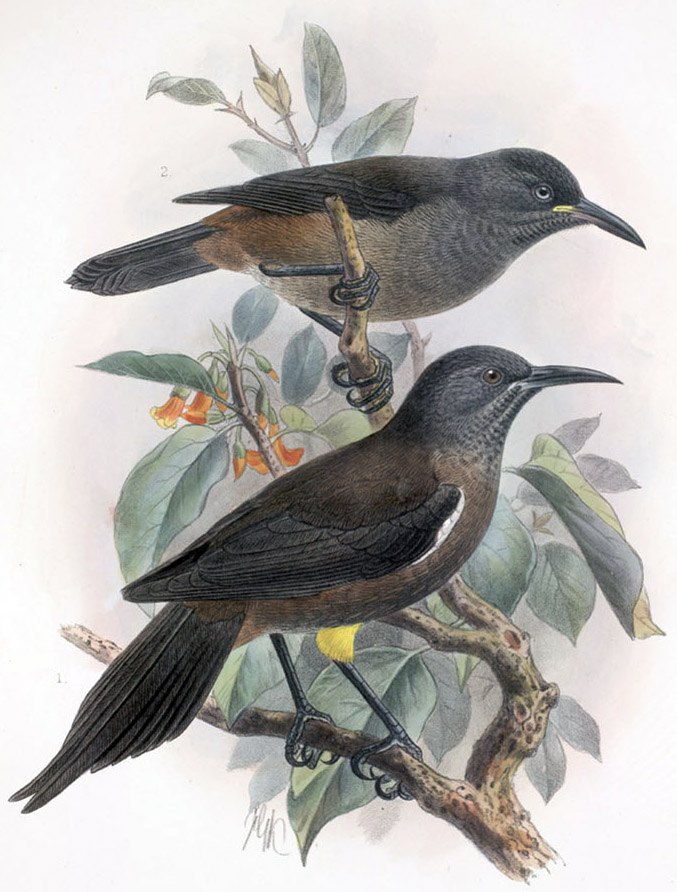

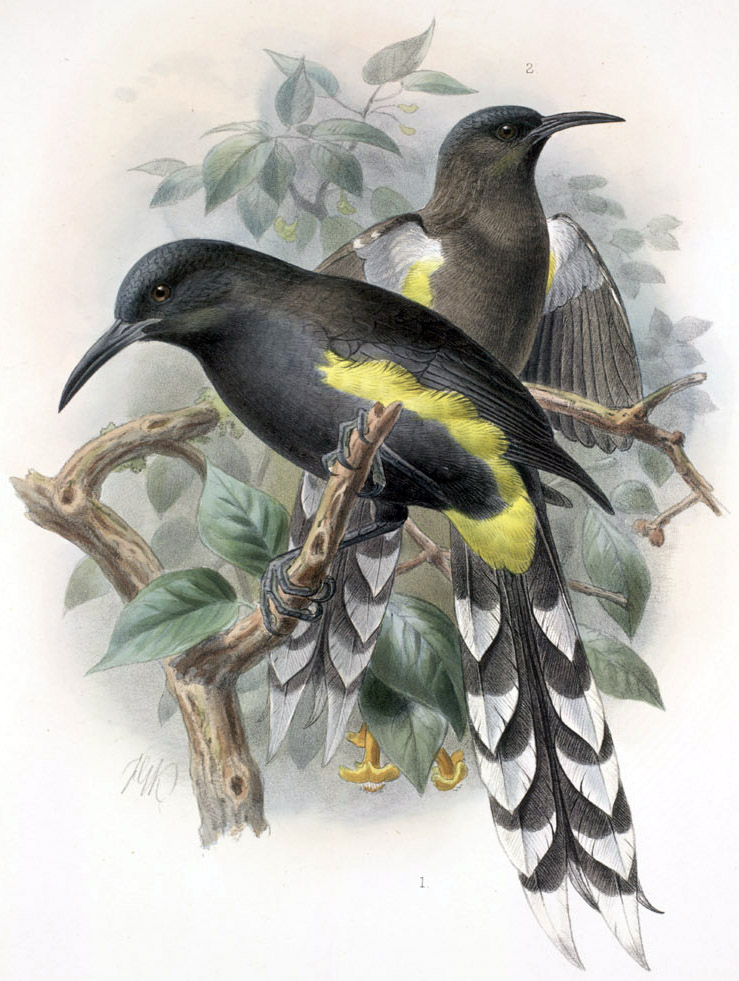
Compare
Questions and answers
What is the scientific name of the Hawaiʻi ʻōʻō?
The scientific name of the Hawaiʻi ʻōʻō is Moho nobilis. Written with its author, the full name is Moho nobilis (Merrem, 1786).
Which family does the Hawaiʻi ʻōʻō belong to?
Moho nobilis belongs to the family Mohoidae, in the order Passeriformes and the class Aves.
What is the conservation status of the Hawaiʻi ʻōʻō?
The IUCN Red List category recorded for Moho nobilis is Extinct (EX).
What other names does the Hawaiʻi ʻōʻō have?
Moho nobilis is also known in English as Hawai'i 'O'o, Hawai Oo, Hawaii 'O'o and Hawaii Oo.
Sources
Passages the profile rests on
- The Hawaiʻi ʻōʻō had glossy black plumage with brown shading on its belly. Source passage: “The colour of its plumage was glossy black with a brown shading at the belly.” — English Wikipedia
- The species had yellowish tufts at its axillaries, which were absent in juveniles. Source passage: “It also had yellowish tufts at the axillaries, which juveniles lacked.” — English Wikipedia
- The species had yellowish plumes on its rump. Source passage: “It had some yellowish plumes on its rump” — English Wikipedia
- Its wings had the largest yellow plumes among all ʻōʻō species. Source passage: “It had the largest yellow plumes on its wings out of all the species of ʻōʻō.” — English Wikipedia
- The Hawaiʻi ʻōʻō measured approximately 32 centimetres in overall length. Source passage: “It had an overall length of 32 centimetres (13 in)” — English Wikipedia
- Its wing length ranged from 11 to 11.5 centimetres. Source passage: “wing length of 11–11.5 centimetres (4.3–4.5 in)” — English Wikipedia
- Its tail could reach 19 centimetres in length. Source passage: “tail length of up to 19 centimetres (7.5 in).” — English Wikipedia
- Males and females had similar appearances, although females were smaller and had less twisted tail-feather tips. Source passage: “The sexes were similar in appearance, but females were smaller and the end of their tail feathers was not as twisted as that of males.” — English Wikipedia
- The species had a dipping flight pattern compared to that of the Eurasian magpie. Source passage: “The Hawaiʻi ʻōʻō had a dipping flight which was compared to that of the Eurasian magpie.” — English Wikipedia
- Its wings could produce a buzzing sound during rapid flapping. Source passage: “George C. Munro noted that its wings could produce a buzzing sound while flapping quickly” — English Wikipedia
- Its call was harsh and consisted of two syllables. Source passage: “Its call was harsh and disyllabic” — English Wikipedia
- The species was typically shy and timid. Source passage: “It was typically shy and timid” — English Wikipedia
- It aggressively defended its territory against approaching birds. Source passage: “it was highly aggressive towards other birds when they approached its territory” — English Wikipedia
- During territorial displays, the bird raised its wings, erected its tail feathers, and displayed its yellowish plumes while attacking intruders. Source passage: “in which it would raise its wings, erect its tail feathers and display its yellowish plumes while attacking them.” — English Wikipedia
- The nests and eggs of the Hawaiʻi ʻōʻō have never been discovered. Source passage: “Nests and eggs of the Hawaiʻi ʻōʻō have never been discovered” — English Wikipedia
- The species preferred settling in the highest branches. Source passage: “mainly because the species preferred to settle in the highest of branches.” — English Wikipedia
- The last known sighting of the species occurred on the slopes of Mauna Loa in 1934. Source passage: “The last known sighting was in 1934 on the slopes of Mauna Loa.” — English Wikipedia
- The Hawaiʻi ʻōʻō is extinct. Source passage: “The Hawaiʻi ʻōʻō (Moho nobilis) is an extinct Hawaiian honeyeater in the genus Moho.” — English Wikipedia
- The species experienced a rapid population decline after Europeans arrived. Source passage: “but its decline followed rapidly afterwards.” — English Wikipedia
- Mosquito-borne diseases and deforestation were considered probable major causes of its extinction. Source passage: “mosquito-borne diseases and deforestation probably were the major reasons for its extinction” — English Wikipedia
- Captured individuals kept in cages survived for only a few days or weeks before succumbing to mosquito-borne diseases. Source passage: “only to live for a few days or weeks before diseases from mosquitoes befell them.” — English Wikipedia
- The introduction of muskets accelerated the species' decline by enabling hunters and collectors to shoot birds from great distances and heights and in large numbers. Source passage: “The decline of this bird was hastened by the introduction of the musket, which allowed hunters and collectors to shoot birds down from a distance, from great heights, and in great numbers.” — English Wikipedia
- Hunters reportedly killed more than one thousand individuals in a single hunt as late as 1898. Source passage: “As late as 1898, hunters were still able to kill over a thousand individuals in one hunt” — English Wikipedia
- The species remained present for nearly 30 years after becoming too rare for large-scale shooting. Source passage: “The birds became too rare to be shot in any great quantities, but continued to be found for nearly 30 years.” — English Wikipedia
- Native Hawaiians used the species' striking plumage to make robes, capes, and feathered staffs for Hawaiian nobility. Source passage: “Its striking plumage was already used for ʻaʻahu aliʻi (robes), ʻahu ʻula (capes), and kāhili (feathered staffs) of aliʻi (Hawaiian nobility)” — English Wikipedia
- Some individuals were captured and kept in cages for sale as songbirds. Source passage: “Some were even caught and put in cages to be sold as songbirds” — English Wikipedia
Data
- Catalogue of Life, 2026-10-16 XR cc by
- Wikidata CC0
- Wikimedia Commons per image; credit shown with each image
- iNaturalist per image; credit shown with each image
- Within the Catalogue of Life, this name comes from The Integrated Taxonomic Information System cc0
References
- Banks, R. C., R. W. McDiarmid, and A. L. Gardner. (1987). Checklist of Vertebrates of the United States, the U.S. Territories, and Canada. Resource Publication, No. 166.
This species in other databases
Page built on 28 November 2026. See how the catalog is made and all sources and licences.
Cite this page
ScientificNames.org. (2026). Moho nobilis (Hawaiʻi ʻōʻō). Retrieved November 28, 2026, from https://scientificnames.org/species/moho-nobilis
“Moho nobilis (Hawaiʻi ʻōʻō).” ScientificNames.org, 2026, scientificnames.org/species/moho-nobilis. Accessed 28 Nov. 2026.
ScientificNames.org. “Moho nobilis (Hawaiʻi ʻōʻō).” Accessed November 28, 2026. https://scientificnames.org/species/moho-nobilis.
@misc{scientificnames_moho_nobilis_hawai_i_o_o,
  author = {{ScientificNames.org}},
  title = {Moho nobilis (Hawaiʻi ʻōʻō)},
  year = {2026},
  url = {https://scientificnames.org/species/moho-nobilis},
  note = {Accessed 2026-11-28}
}