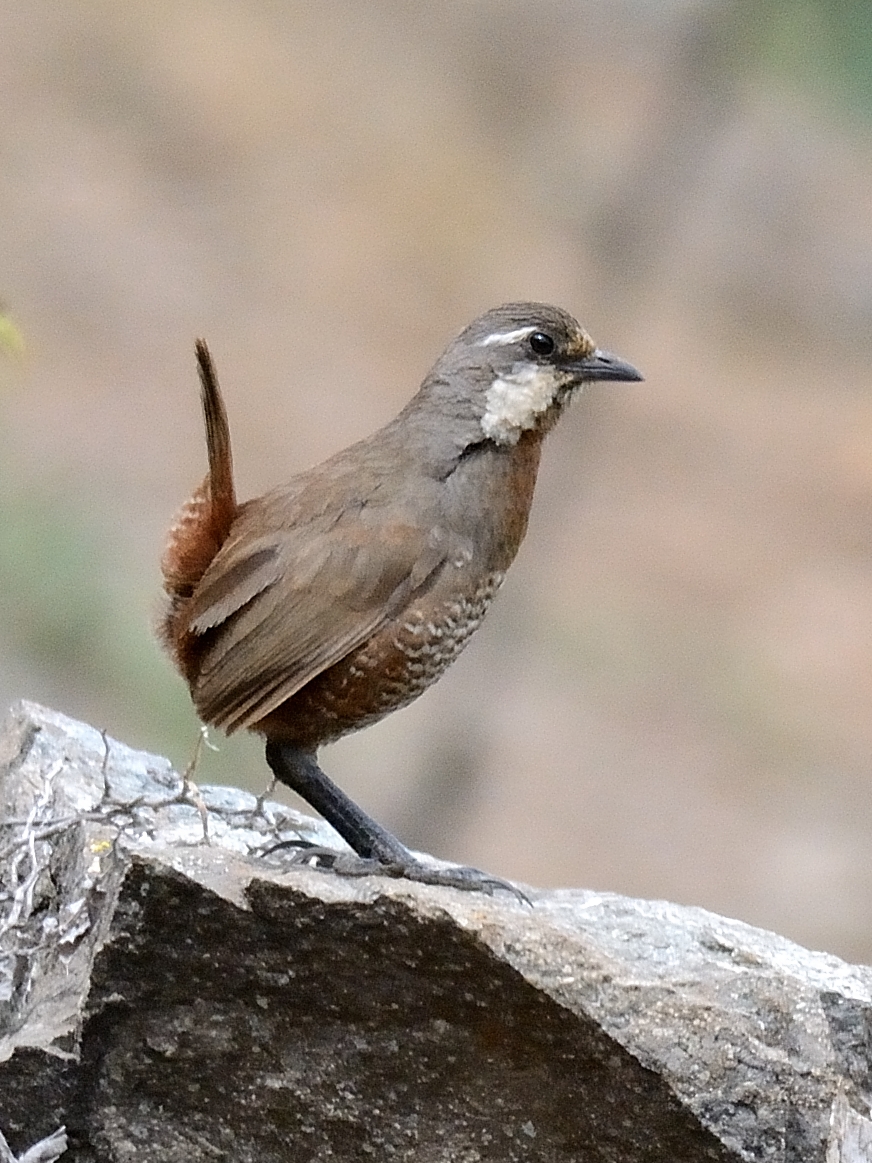
| Appearance | - The adult plumage is predominantly cinnamon brown, with white barring on the breast, belly and undertail-coverts. English Wikipedia
- The species has a heavy bill, a cocked tail and disproportionately large feet. English Wikipedia
- Adult birds have a dark eyestripe, a white eyebrow and a broad white stripe along each side of the throat. English Wikipedia
- The bill and legs are black in adult birds. English Wikipedia
- Males and females have similar plumage, although females are usually smaller. English Wikipedia
- Juveniles have an unbarred rump and fainter barring on the flanks compared with adults. English Wikipedia
- The atacamae subspecies is smaller and paler than the nominate subspecies, with whiter underparts. English Wikipedia
- The species is characterized by a large, stocky body shape, prominent white moustaches and a boldly barred belly. ebird.org
| - Male Slaty Bristlefronts are predominantly dark blue-gray, with a dark brown lower back and black flanks, vent, and tail. English Wikipedia
- Female Slaty Bristlefronts have brown plumage that is lighter on the throat and breast. English Wikipedia
- Both sexes have a crest of short, stiff, erect feathers at the base of the bill and forehead. English Wikipedia
|
|---|
| Size | | |
|---|
| Habitat | - The species inhabits hillsides with some shrubs and low tree cover. English Wikipedia
- The species prefers habitats with low water content in the soil. English Wikipedia
- The atacamae subspecies occurs in semi-desert habitat containing scattered rocks and boulders. English Wikipedia
| - The Slaty Bristlefront inhabits humid forests in both lowland and mountainous environments. English Wikipedia
- The species occurs at elevations as low as 100 m in some locations, although its more typical lower elevation limit is 400 m. English Wikipedia
- In the northern part of its range, the Slaty Bristlefront occurs exclusively in mountains at elevations reaching 1,800 m. English Wikipedia
|
|---|
| Diet | - The species feeds mainly on invertebrates, including insects and earthworms. English Wikipedia
- The species also consumes seeds and fruits. English Wikipedia
- The Moustached Turca displaces rocks and forages near plants when searching for seeds and fruits. English Wikipedia
| |
|---|
| Behaviour | - The Moustached Turca is primarily ground-dwelling and can run quickly. English Wikipedia
- The species rarely flies and uses flight only for short distances. English Wikipedia
- The species vocalizes mainly in the morning and at dusk, although calls and songs can occur throughout the day. English Wikipedia
- Its song consists of low hooting notes lasting between five and ten seconds. English Wikipedia
- The species commonly sings and produces bubbling calls while perched on exposed rocks or high boulders. English Wikipedia
| - Slaty Bristlefronts forage in pairs while maintaining some distance from one another. English Wikipedia
- The species forages on the ground and in low vegetation. English Wikipedia
- The Slaty Bristlefront begins its song with a sequence of clicks followed by a trill. English Wikipedia
- The species' trill has been described as resembling hysterical laughter. English Wikipedia
- Recorded calls of the Slaty Bristlefront include "tsewk-tsewk, pit", "keekick", and "he-he-heeheeheehee". English Wikipedia
|
|---|
| Reproduction | - Nesting begins in July, and chicks hatch between August and December. English Wikipedia
- Adults have been observed beginning nest construction at the end of July. English Wikipedia
- Adults have been observed carrying food to nests until January. English Wikipedia
- The species excavates nesting tunnels measuring between 0.4 and 2.2 metres deep in earth banks on steep rocky hillsides. English Wikipedia
- The nesting burrow ends in a cavity approximately 25 centimetres wide. English Wikipedia
- The megapodius subspecies usually lays two eggs, with an occasional third egg. English Wikipedia
- The atacamae subspecies typically lays three eggs. English Wikipedia
- Eggs of the atacamae subspecies average 32.1 millimetres in length and 24.6 millimetres in width. English Wikipedia
| - A documented Slaty Bristlefront nest was recorded in Rio de Janeiro state. English Wikipedia
- Both members of a breeding pair construct the nest. English Wikipedia
- Nest construction materials include twigs, narrow leaves, and leaf stems, with a lichen lining. English Wikipedia
- The nest is placed inside a roughly horizontal burrow in an earthen bank that is at least 1.24 m long. English Wikipedia
|
|---|
| Distribution | - The Moustached Turca is endemic to Chile. English Wikipedia
- The nominate megapodius subspecies occurs in central Chile. English Wikipedia
- The atacamae subspecies occurs in the Atacama Region of Chile. English Wikipedia
- Reproductive individuals have been recorded at elevations between sea level and 2,000 metres in the Andean foothills. English Wikipedia
- Non-reproductive individuals have been recorded at elevations reaching 3,200 metres. English Wikipedia
| |
|---|
| Conservation | | - The Slaty Bristlefront is assessed as Least Concern by the IUCN. English Wikipedia
- Habitat loss threatens the Slaty Bristlefront, particularly in lowland areas. English Wikipedia
|
|---|
| Similar species | - The White-throated Tapaculo is a potential identification confusion because it shares the Moustached Turca's environment. English Wikipedia
- The White-throated Tapaculo is smaller and lacks the Moustached Turca's distinctive white moustache. English Wikipedia
| - The Slaty Bristlefront and Stresemann's Bristlefront form a superspecies. English Wikipedia
- The Slaty Bristlefront and Stresemann's Bristlefront may actually represent a single species. English Wikipedia
|
|---|
| Name origin | - The specific name megapodius derives from ancient Greek words meaning big feet. English Wikipedia
| No checked fact yet |
|---|
| Other | - The species was first described by Heinrich von Kittlitz in 1830. English Wikipedia
- Two subspecies are recognized: Pteroptochos megapodius megapodius and Pteroptochos megapodius atacamae. English Wikipedia
| - The Slaty Bristlefront belongs to the Neotropical bird family Rhinocryptidae, commonly known as the tapaculos. inaturalist.org
- The IUCN assessment of the Slaty Bristlefront was dated 5 November 2021. iucnredlist.org
|
|---|