Species · Birds
Moustached Turca Pteroptochos megapodius
The scientific name of the Moustached Turca is Pteroptochos megapodius. It is a species of bird in the family Rhinocryptidae (tapaculo), order Passeriformes. The name dates from 1830.
- Scientific name
- Pteroptochos megapodius Kittlitz, 1830
- Common name
- Moustached Turca
- Genus
- Pteroptochos
- Family
- Rhinocryptidae (Tapaculo)
- Order
- Passeriformes
- Class
- Aves
- Red List category
- LC Least Concern
- Recorded in
- 1 country
- Name status
- accepted in the Catalogue of Life
Overview
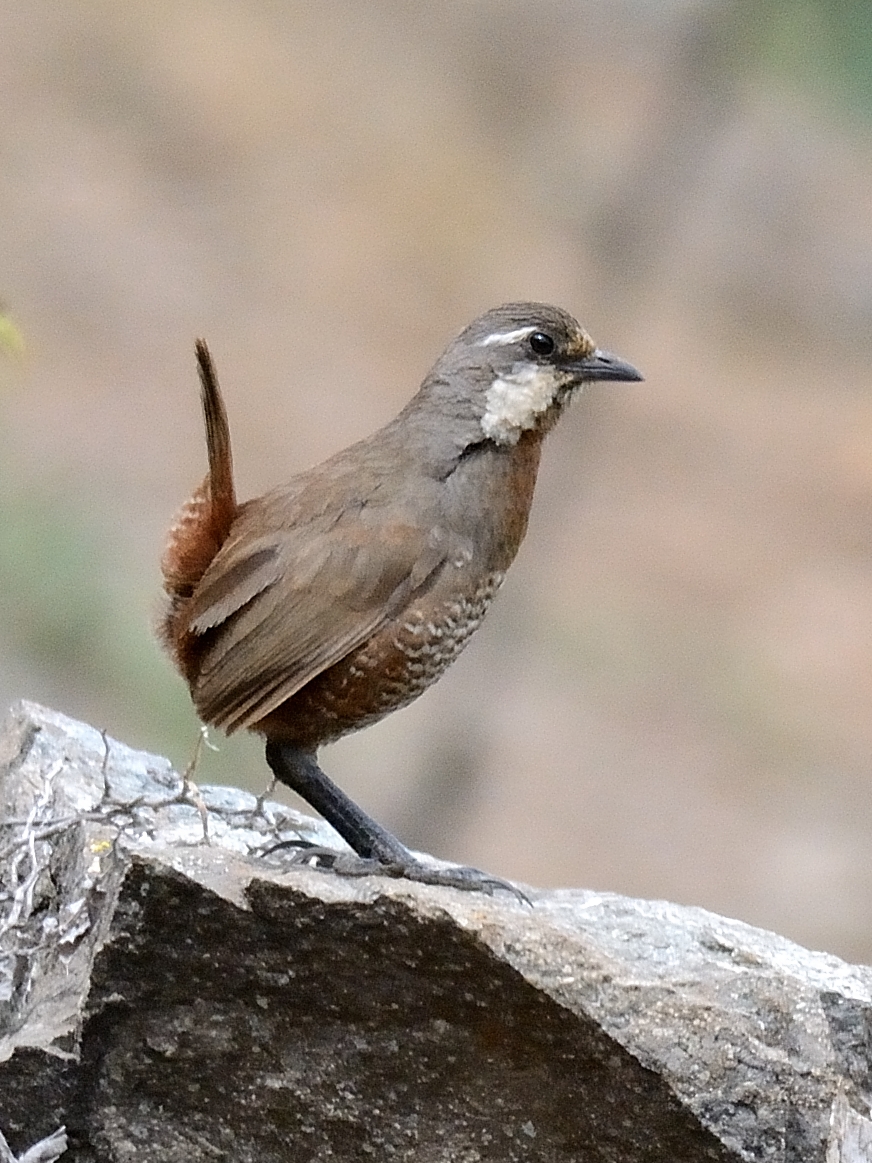
The Moustached Turca (Pteroptochos megapodius Kittlitz, 1830) is a bird in the family Rhinocryptidae, order Passeriformes and class Aves. The species is endemic to Chile. It is characterized by a large, stocky body, prominent white moustaches and a boldly barred belly.
Written 26 November 2026 from the sources listed below. Each statement was checked against the passage it cites; statements that could not be supported were removed.
Appearance
Adult plumage is predominantly cinnamon brown, with white barring on the breast, belly and undertail-coverts. Adults have a dark eyestripe, a white eyebrow and a broad white stripe along each side of the throat.[1][2]
The species has a heavy bill, a cocked tail and disproportionately large feet. The bill and legs are black in adult birds.[3][4]
Adults measure approximately 22.5 centimetres in length and weigh between 95 and 125 grams. Males and females have similar plumage, although females are usually smaller.[5][6][7]
Juveniles have an unbarred rump and fainter barring on the flanks compared with adults. The atacamae subspecies is smaller and paler than the nominate subspecies, with whiter underparts.[8][9]
Habitat
The species inhabits hillsides with some shrubs and low tree cover and prefers habitats with low water content in the soil.[10][11]
The atacamae subspecies occurs in semi-desert habitat containing scattered rocks and boulders.[12]
Diet
The Moustached Turca feeds mainly on invertebrates, including insects and earthworms. It also consumes seeds and fruits.[13][14]
When searching for seeds and fruits, the species displaces rocks and forages near plants.[15]
Behaviour
The Moustached Turca is primarily ground-dwelling and can run quickly. It rarely flies and uses flight only for short distances.[16][17]
The species vocalizes mainly in the morning and at dusk, although calls and songs can occur throughout the day. Its song consists of low hooting notes lasting between five and ten seconds.[18][19]
The species commonly sings and produces bubbling calls while perched on exposed rocks or high boulders.[20]
Reproduction and life cycle
Nesting begins in July, and chicks hatch between August and December. Adults have been observed beginning nest construction at the end of July and carrying food to nests until January.[21][22][23]
The species excavates nesting tunnels measuring between 0.4 and 2.2 metres deep in earth banks on steep rocky hillsides. Each nesting burrow ends in a cavity approximately 25 centimetres wide.[24][25]
The megapodius subspecies usually lays two eggs, with an occasional third egg. The atacamae subspecies typically lays three eggs.[26][27]
Eggs of the atacamae subspecies average 32.1 millimetres in length and 24.6 millimetres in width.[28]
Conservation
The Moustached Turca was assessed as Least Concern on the IUCN Red List in 2022. Its population trend is considered stable.[29][30]
Habitat destruction and fragmentation are identified as the main threats to the species. Hunting the Moustached Turca is illegal in Chile.[31][32]
Similar species
The White-throated Tapaculo is a potential identification confusion because it shares the Moustached Turca's environment. It is smaller and lacks the Moustached Turca's distinctive white moustache.[33][34]
Classification of the Moustached Turca
| Kingdom | Animalia |
|---|---|
| Phylum | Chordata |
| Subphylum | Vertebrata |
| Infraphylum | Gnathostomata |
| Parvphylum | Osteichthyes |
| Megaclass | Tetrapoda |
| Class | Aves (Bird) |
| Order | Passeriformes (Passerine) |
| Family | Rhinocryptidae (Tapaculo) |
| Genus | Pteroptochos (Huet-huets) |
| Species | Pteroptochos megapodius Kittlitz, 1830 |
Where the Moustached Turca is found
Checklists and occurrence records place Pteroptochos megapodius in 1 country across South America. GBIF holds 23,961 georeferenced records of it.
Countries
Regions and cities with the most records
- Santiago Metropolitan, Chile 12,580
- Valparaiso, Chile 5,282
- Peñalolén, Chile 4,195
- Coquimbo Region, Chile 4,079
- Santiago, Chile 4,054
- Renca, Chile 2,754
- Puente Alto, Chile 1,931
- Limache, Chile 1,927
- La Pintana, Chile 1,738
- Lampa, Chile 1,504
- Colina, Chile 1,495
- Lo Prado, Chile 1,461
- Quillota, Chile 1,400
- Quilicura, Chile 1,351
- San Bernardo, Chile 1,114
- Peñaflor, Chile 977
- Maipú, Chile 973
- Padre Hurtado, Chile 955
- La Cruz, Chile 914
- Llaillay, Chile 875
- El Quisco, Chile 845
- Villa Alemana, Chile 802
- Quilpué, Chile 757
- Viña del Mar, Chile 755
- La Calera, Chile 634
- Talagante, Chile 594
- El Monte, Chile 564
- San Esteban, Chile 537
- Los Andes, Chile 529
- Valparaíso, Chile 506
- Illapel, Chile 412
- Concón, Chile 386
- San Felipe, Chile 376
- Putaendo, Chile 368
- Curacaví, Chile 357
- Graneros, Chile 338
1 more country has a few records outside this range
These countries hold a few records of Pteroptochos megapodius but lie outside the range the checklists give for it. Such records are often zoo or garden specimens, museum material or vagrants, so the species is not counted as occurring there.
Range as the checklists state it
South America
A number beside a place is its count of GBIF occurrence records. A place without a number comes from a checklist alone. Records show where a species has been observed or collected, which can include escapes and vagrants.
Common names
English
- Moustached Turca
Names in 23 other languages
- Catalan
- tapacul gros mostatxut
- Chinese
- 须隐窜鸟, 鬚特卡雀
- Croatian
- krupnonoga strmorepka
- Czech
- štidlák kníratý
- Dutch
- Chileense Turco
- Esperanto
- liphara tapakulo
- Finnish
- viiksivetvetti
- French
- Tourco à moustaches
- German
- Bartturko, Großfuß-Rallenschlüpfer, Weißbart-Bürzelstelzer, Weißbarttapaculo
- Hungarian
- nagylábú törökmadár
- Japanese
- シラヒゲオタテドリ
- Lithuanian
- ūsuotasis turkas
- Norwegian
- skjeggturka
- Polish
- turko wąsaty
- Portuguese
- huet-huet-de-bigodes, turca
- Russian
- Пастушковый тюрко, Усатый гид-гид
- Serbian
- Brkati turko
- Slovak
- turko veľkonohý
- Spanish
- Huet-huet turca
- Swedish
- mustaschtapakul
- Turkish
- Bıyıklı Hütleyen
- Ukrainian
- турко вусатий
- Welsh
- hwet-hwet mwstasiog
Synonyms
One other scientific name has been used for this species and is now treated as a synonym of Pteroptochos megapodius.
- Leptonyx macropus Swainson, WJ, 1832
Subspecies and varieties
- Pteroptochos megapodius atacamae subspecies
- Pteroptochos megapodius megapodius subspecies
Related species
-
 Black-throated Huet-huetPteroptochos tarnii
-
 Chestnut-throated Huet-huetPteroptochos castaneus
-
 Chucao TapaculoScelorchilus rubecula
-
 Magellanic TapaculoScytalopus magellanicus
-
 Slaty BristlefrontMerulaxis ater
-
 Ocellated TapaculoAcropternis orthonyx
-
 Crested GallitoRhinocrypta lanceolata
-
 Blackish TapaculoScytalopus latrans
Compare
Questions and answers
What is the scientific name of the Moustached Turca?
The scientific name of the Moustached Turca is Pteroptochos megapodius. Written with its author, the full name is Pteroptochos megapodius Kittlitz, 1830.
Which family does the Moustached Turca belong to?
Pteroptochos megapodius belongs to the family Rhinocryptidae, in the order Passeriformes and the class Aves.
Where is the Moustached Turca found?
Checklists and occurrence records place Pteroptochos megapodius in 1 country: Chile.
What is the conservation status of the Moustached Turca?
The IUCN Red List category recorded for Pteroptochos megapodius is Least Concern (LC).
Where does the Moustached Turca occur?
The Moustached Turca is endemic to Chile. The nominate megapodius subspecies occurs in central Chile, while the atacamae subspecies occurs in the Atacama Region of Chile.[35][36][37]
At what elevations does the Moustached Turca occur?
Reproductive individuals have been recorded at elevations between sea level and 2,000 metres in the Andean foothills. Non-reproductive individuals have been recorded at elevations reaching 3,200 metres.[38][39]
How many subspecies are recognized?
Two subspecies are recognized: Pteroptochos megapodius megapodius and Pteroptochos megapodius atacamae.[40]
How does the Moustached Turca differ from the White-throated Tapaculo?
The White-throated Tapaculo is smaller and lacks the Moustached Turca's distinctive white moustache.[34]
What is the origin of the scientific name megapodius?
The specific name megapodius derives from ancient Greek words meaning big feet.[41]
Who first described the Moustached Turca and when?
Heinrich von Kittlitz first described the species in 1830.[42]
Sources
Passages the profile rests on
- The adult plumage is predominantly cinnamon brown, with white barring on the breast, belly and undertail-coverts. Source passage: “The adult plumage is mostly cinnamon brown with white barring on the breast, belly and undertail-coverts.” — English Wikipedia
- Adult birds have a dark eyestripe, a white eyebrow and a broad white stripe along each side of the throat. Source passage: “They have a dark eyestripe, white eyebrow and a white broad stripe on the sides of the throat.” — English Wikipedia
- The species has a heavy bill, a cocked tail and disproportionately large feet. Source passage: “It has a heavy bill, cocked tail and disproportionately big feet” — English Wikipedia
- The bill and legs are black in adult birds. Source passage: “The bill and legs are black in adults.” — English Wikipedia
- Adults measure approximately 22.5 centimetres in length. Source passage: “approximately 22.5 cm (8.9 inches) long” — English Wikipedia
- Adults weigh between 95 and 125 grams. Source passage: “a mass between 95–125 grams (3.4–4.4 oz).” — English Wikipedia
- Males and females have similar plumage, although females are usually smaller. Source passage: “The plumage of females and males are alike, but size-wise the female is usually smaller.” — English Wikipedia
- Juveniles have an unbarred rump and fainter barring on the flanks compared with adults. Source passage: “juveniles have an unbarred rump and more fainted barring on the flanks.” — English Wikipedia
- The atacamae subspecies is smaller and paler than the nominate subspecies, with whiter underparts. Source passage: “The atacamae subspecies is smaller, overall much paler and has whiter underparts in comparison to its sister subspecies.” — English Wikipedia
- The species inhabits hillsides with some shrubs and low tree cover. Source passage: “Overall, the species can be found on hillsides with some shrubs and low tree cover.” — English Wikipedia
- The species prefers habitats with low water content in the soil. Source passage: “It prefers areas with low water content in the soil” — English Wikipedia
- The atacamae subspecies occurs in semi-desert habitat containing scattered rocks and boulders. Source passage: “in the case of the atacamae subspecies is only found in a semi-desert region with scattered rocks and boulders.” — English Wikipedia
- The species feeds mainly on invertebrates, including insects and earthworms. Source passage: “The moustached turca feeds mostly on invertebrates such as insects and earthworms.” — English Wikipedia
- The species also consumes seeds and fruits. Source passage: “They can also feed on seeds and fruits” — English Wikipedia
- The Moustached Turca displaces rocks and forages near plants when searching for seeds and fruits. Source passage: “by displacing rocks and foraging near plants.” — English Wikipedia
- The Moustached Turca is primarily ground-dwelling and can run quickly. Source passage: “It is a mainly ground-dwelling bird and can run quickly.” — English Wikipedia
- The species rarely flies and uses flight only for short distances. Source passage: “It seldom uses its wings and only does so for short distance flights.” — English Wikipedia
- The species vocalizes mainly in the morning and at dusk, although calls and songs can occur throughout the day. Source passage: “The turca will mostly vocalize during the morning and at dusk, however song and calls can also be heard throughout the day.” — English Wikipedia
- Its song consists of low hooting notes lasting between five and ten seconds. Source passage: “Its song is a series of low, hooting notes lasting for 5 to 10 seconds.” — English Wikipedia
- The species commonly sings and produces bubbling calls while perched on exposed rocks or high boulders. Source passage: “Typically, it will vocalize its song and bubbling call when perched on exposed rock, such as on top of high boulder” — English Wikipedia
- Nesting begins in July, and chicks hatch between August and December. Source passage: “They will start their nesting process in July and chicks will hatch between August and December.” — English Wikipedia
- Adults have been observed beginning nest construction at the end of July. Source passage: “Adults have been observed to start their nests at the end of July.” — English Wikipedia
- Adults have been observed carrying food to nests until January. Source passage: “Some observations have been made of adults carrying food in the nest up until January” — English Wikipedia
- The species excavates nesting tunnels measuring between 0.4 and 2.2 metres deep in earth banks on steep rocky hillsides. Source passage: “The moustached turca creates tunnels between 0.4–2.2 metres (16–87 in) deep in an earth bank on steep rocky hillsides” — English Wikipedia
- The nesting burrow ends in a cavity approximately 25 centimetres wide. Source passage: “At the end of this burrow is a cavity of approximately 25 centimetres (9.8 in) of width” — English Wikipedia
- The megapodius subspecies usually lays two eggs, with an occasional third egg. Source passage: “the megapodius usually having 2 eggs with an occasional third” — English Wikipedia
- The atacamae subspecies typically lays three eggs. Source passage: “the atacamae having 3 eggs.” — English Wikipedia
- Eggs of the atacamae subspecies average 32.1 millimetres in length and 24.6 millimetres in width. Source passage: “the atacamae, with respectively 32.1 millimetres (1.26 in) and 24.6 millimetres (0.97 in).” — English Wikipedia
- The Moustached Turca was assessed as Least Concern on the IUCN Red List in 2022. Source passage: “This species has been assessed by the IUCN Red List of Threatened Species in 2022 and categorized as Least Concern (LC).” — English Wikipedia
- The species' population trend is considered stable. Source passage: “and a population trend/size that is also stable.” — English Wikipedia
- Habitat destruction and fragmentation are identified as the main threats to the species. Source passage: “the main threat to this species is habitat destruction and fragmentation.” — English Wikipedia
- Hunting the Moustached Turca is illegal in Chile. Source passage: “it is illegal to hunt it in Chile.” — English Wikipedia
- The White-throated Tapaculo is a potential identification confusion because it shares the Moustached Turca's environment. Source passage: “The only species it could be confused with is the white-throated tapaculo (Scelorchilus albicollis) which shares a similar environment.” — English Wikipedia
- The White-throated Tapaculo is smaller and lacks the Moustached Turca's distinctive white moustache. Source passage: “However, the tapaculo is smaller and does not have the distinctive white moustache of the turca.” — English Wikipedia
- The Moustached Turca is endemic to Chile. Source passage: “This species is endemic to Chile.” — English Wikipedia
- The nominate megapodius subspecies occurs in central Chile. Source passage: “The nominate subspecies, megapodius, is found in central Chile” — English Wikipedia
- The atacamae subspecies occurs in the Atacama Region of Chile. Source passage: “The isolated form, atacamae, occurs in the Atacama Region.” — English Wikipedia
- Reproductive individuals have been recorded at elevations between sea level and 2,000 metres in the Andean foothills. Source passage: “All observations regarding reproductive individuals were found between the sea level and 2,000 metres (6,600 ft) in the foothills of the Andes.” — English Wikipedia
- Non-reproductive individuals have been recorded at elevations reaching 3,200 metres. Source passage: “some non-reproductive individuals have been found at altitudes up to 3,200 metres (10,500 ft).” — English Wikipedia
- Two subspecies are recognized: Pteroptochos megapodius megapodius and Pteroptochos megapodius atacamae. Source passage: “two subspecies have been recognized, the Pteroptochos megapodius megapodius (von Kittlitz, 1830) and the Pteroptochos megapodius atacamae (R. A Philippi-B, 1946).” — English Wikipedia
- The specific name megapodius derives from ancient Greek words meaning big feet. Source passage: “which translates to "big feet".” — English Wikipedia
- The species was first described by Heinrich von Kittlitz in 1830. Source passage: “The species was first described by Heinrich von Kittlitz during his voyage in 1830” — English Wikipedia
- The IUCN Red List assessed the Moustached Turca in 2016. Source passage: “Moustached Turca Pteroptochos megapodius has most recently been assessed for The IUCN Red List of Threatened Species in 2016.” — iucnredlist.org
Data
- Catalogue of Life, 2026-10-16 XR cc by
- Global Biodiversity Information Facility CC BY 4.0
- Wikidata CC0
- GeoNames CC BY 4.0
- Wikimedia Commons per image; credit shown with each image
- Within the Catalogue of Life, this name comes from The Integrated Taxonomic Information System cc0
References
- von Kittlitz, & Friedrich Heinrich. (1830). Über Einige Vögel von Chili, Beobachtet im März und Anfang April 1827. Mémoires Presentés À l’Académie Impériale Des Sciences de St. Pétersbourg Par Divers Savants et Lus Dans Ses Assemblées, Vol. 1, No. 2. where the name was published
- Gill, Frank, & and Minturn Wright. (2006). Birds of the World: Recommended English Names.
This species in other databases
Page built on 27 November 2026. See how the catalog is made and all sources and licences.
Cite this page
ScientificNames.org. (2026). Pteroptochos megapodius (Moustached Turca). Retrieved November 27, 2026, from https://scientificnames.org/species/pteroptochos-megapodius
“Pteroptochos megapodius (Moustached Turca).” ScientificNames.org, 2026, scientificnames.org/species/pteroptochos-megapodius. Accessed 27 Nov. 2026.
ScientificNames.org. “Pteroptochos megapodius (Moustached Turca).” Accessed November 27, 2026. https://scientificnames.org/species/pteroptochos-megapodius.
@misc{scientificnames_pteroptochos_megapodius_moustached_turca,
  author = {{ScientificNames.org}},
  title = {Pteroptochos megapodius (Moustached Turca)},
  year = {2026},
  url = {https://scientificnames.org/species/pteroptochos-megapodius},
  note = {Accessed 2026-11-27}
}