Comparison
Myliobatis episcopus vs Common Eagle Ray
Myliobatis episcopus (Myliobatis episcopus) and Common Eagle Ray (Myliobatis aquila) both belong to the genus Myliobatis (eagle rays) and part ways below it.
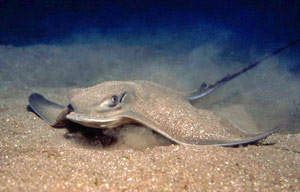

Side by side
| Myliobatis episcopus | Common Eagle Ray | |
|---|---|---|
| Scientific name | Myliobatis episcopus Ninni & Chiereghini, 1872 | Myliobatis aquila (Linnaeus, 1758) |
| English name | Not recorded | Common Eagle Ray |
| Group | Fishes | Fishes |
| Class | Elasmobranchii | Elasmobranchii |
| Order | Myliobatiformes | Myliobatiformes |
| Family | Myliobatidae Eagle Ray | Myliobatidae Eagle Ray |
| Genus | Myliobatis Eagle Rays | Myliobatis Eagle Rays |
| Named in | 1872 | 1758 |
| Red List category | Not recorded | Critically Endangered |
| Environment | Not recorded | brackish, marine |
| Countries on record | Not recorded | 34 countries |
| GBIF occurrence records | Not recorded | 3,891 records |
Rows where the two agree are shown in grey.
Where each is found
Only Common Eagle Ray (34)
- Albania
- Algeria
- Angola
- Benin
- Cameroon
- Croatia
- Democratic Republic of the Congo
- Egypt
- Equatorial Guinea
- France
- Gabon
- Ghana
- Greece
- Guinea
- Guinea-Bissau
- Ireland
- Italy
- Ivory Coast
- Liberia
- Malta
- Mozambique
- Namibia
- Nigeria
- Portugal
- Republic of the Congo
- Reunion
- Seychelles
- Sierra Leone
- South Africa
- Spain
- Togo
- Tunisia
- United Kingdom
- Western Sahara
From Catalogue of Life checklists and GBIF occurrence records. A country missing from a list means no record is held, which is not proof of absence.
Checked facts
| Myliobatis episcopus | Common Eagle Ray | |
|---|---|---|
| Appearance | No checked fact yet |
|
| Size | No checked fact yet |
|
| Habitat | No checked fact yet |
|
| Diet | No checked fact yet |
|
| Behaviour | No checked fact yet |
|
| Reproduction | No checked fact yet |
|
| Distribution | No checked fact yet |
|
| Conservation | No checked fact yet |
|
| Uses | No checked fact yet |
|
In brief
Common Eagle Ray
Myliobatis aquila occurs in the eastern Atlantic Ocean, the Mediterranean Sea and the south-western Indian Ocean. It has a rhomboidal pectoral disc, a long slender tail with one or rarely two spines near its base, and flattened hexagonal tooth plates arranged in a mosaic pattern. Full profile
Compare something else
Page built on 28 November 2026 from the data on the two species pages, where every source is listed.
Cite this page
ScientificNames.org. (2026). Myliobatis episcopus vs Common Eagle Ray. Retrieved November 28, 2026, from https://scientificnames.org/compare/myliobatis-episcopus-vs-common-eagle-ray
“Myliobatis episcopus vs Common Eagle Ray.” ScientificNames.org, 2026, scientificnames.org/compare/myliobatis-episcopus-vs-common-eagle-ray. Accessed 28 Nov. 2026.
ScientificNames.org. “Myliobatis episcopus vs Common Eagle Ray.” Accessed November 28, 2026. https://scientificnames.org/compare/myliobatis-episcopus-vs-common-eagle-ray.
@misc{scientificnames_myliobatis_episcopus_vs_common_eagle_ray,
  author = {{ScientificNames.org}},
  title = {Myliobatis episcopus vs Common Eagle Ray},
  year = {2026},
  url = {https://scientificnames.org/compare/myliobatis-episcopus-vs-common-eagle-ray},
  note = {Accessed 2026-11-28}
}