Species · Fishes
Common Eagle Ray Myliobatis aquila
The scientific name of the Common Eagle Ray is Myliobatis aquila. It is a species of fish in the family Myliobatidae (eagle ray), order Myliobatiformes. The name dates from 1758.
- Scientific name
- Myliobatis aquila (Linnaeus, 1758)
- Common name
- Common Eagle Ray
- Genus
- Myliobatis
- Family
- Myliobatidae (Eagle Ray)
- Order
- Myliobatiformes
- Class
- Elasmobranchii
- Red List category
- CR Critically Endangered
- Environment
- brackish, marine
- Recorded in
- 34 countries
- Name status
- accepted in the Catalogue of Life
Overview
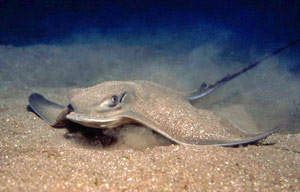
Myliobatis aquila occurs in the eastern Atlantic Ocean, the Mediterranean Sea and the south-western Indian Ocean. It has a rhomboidal pectoral disc, a long slender tail with one or rarely two spines near its base, and flattened hexagonal tooth plates arranged in a mosaic pattern.
Written 26 November 2026 from the sources listed below. Each statement was checked against the passage it cites; statements that could not be supported were removed.
Appearance
The Common Eagle Ray has a rhomboidal pectoral disc with large triangular fins extending from both sides. Its dorsal surface ranges from dusky bronze to blackish, sometimes with olive to violet shading, while its ventral surface is white with a brownish margin.[1][2][3][4]
Its tail is long and slender, approximately two to two and a half times longer than the disc, with one or, rarely, two spines near its base and no tail fin. Its jaws have flattened hexagonal tooth bars and plates arranged in a mosaic pattern.[5][6][7][8]
The skin is generally smooth, although large adults may have prickly areas along the midbody and tail base. The maximum recorded total length is 183 cm, the maximum recorded disc width is 80 cm and the maximum reported body weight is 14.5 kg; females grow larger than males.[9][10][11][12][13]
Habitat
The Common Eagle Ray inhabits open sandy areas, shallow lagoons, bays and estuaries. It spends much of its time in water shallower than 50 m, although it occurs at depths reaching approximately 800 m.[14][15][16][17]
The species has been recorded in a semi-enclosed lagoon on Gran Canaria Island, where it prefers rocky and mixed seabeds.[18][19]
Diet
The Common Eagle Ray primarily feeds on crustaceans and bivalve molluscs excavated from the seabed. Other recorded food items include polychaete worms, gastropod molluscs, sea pens and small fish.[20][21]
It dislodges benthic crustaceans and molluscs from sediment using its pectoral fin tips and subrostral lobe. Larger individuals consume more fish than smaller individuals.[22][23][24]
Behaviour
The Common Eagle Ray often schools in small groups in bays, shallow lagoons and estuaries. It also swims in groups close to soft-bottom habitats.[25][26]
During its reproductive period, the species gathers in groups of dozens.[27]
Reproduction and life cycle
The Common Eagle Ray is ovoviviparous. Embryos initially receive nourishment from their egg yolks and subsequently from fluids secreted by the mother, and gestation lasts approximately six to eight months.[28][29][30]
Females produce between three and seven live young per pregnancy. Newborn individuals closely resemble adults in morphology.[31][32]
Males reach sexual maturity at a total length of approximately 40–50 cm, while females reach sexual maturity at approximately 60–70 cm.[33][34]
Conservation
The Common Eagle Ray has been assessed as critically endangered by the IUCN according to document 1. Populations in the Gulf of Lion declined during the 1970s, and intensive fishing threatens the species in the Mediterranean Sea.[35][36][37]
Uses
The Common Eagle Ray is caught as bycatch in pelagic trawl fisheries and is sought by recreational fishers as a game fish. Its flesh is marketed smoked and dry salted in tropical regions where the species occurs.[38][39][40]
The species is also used to produce fish meal and oil.[41]
Classification of the Common Eagle Ray
| Kingdom | Animalia |
|---|---|
| Phylum | Chordata |
| Subphylum | Vertebrata |
| Infraphylum | Gnathostomata |
| Parvphylum | Chondrichthyes |
| Class | Elasmobranchii |
| Subclass | Neoselachii |
| Infraclass | Batoidea |
| Order | Myliobatiformes |
| Family | Myliobatidae (Eagle Ray) |
| Genus | Myliobatis (Eagle Rays) |
| Species | Myliobatis aquila (Linnaeus, 1758) |
Where the Common Eagle Ray is found
Checklists and occurrence records place Myliobatis aquila in 34 countries. GBIF holds 3,891 georeferenced records of it.
Countries
- Albania 3
- Algeria 3
- Angola 8
- Benin 11
- Cameroon 27
- Croatia 76
- Democratic Republic of the Congo 8
- Egypt 19
- Equatorial Guinea 13
- France 368
- Gabon 56
- Ghana 51
- Greece 5
- Guinea 23
- Guinea-Bissau 15
- Ireland 3
- Italy 323
- Ivory Coast 46
- Liberia 47
- Malta 6
- Mozambique 6
- Namibia 13
- Nigeria 78
- Portugal 952
- Republic of the Congo 8
- Reunion 6
- Seychelles 7
- Sierra Leone 26
- South Africa 216
- Spain 1,439
- Togo 8
- Tunisia 5
- United Kingdom 13
- Western Sahara 3
Regions and cities with the most records
- Azeitão, Portugal 895
- Quinta Do Conde, Portugal 895
- Sesimbra, Portugal 895
- Setúbal, Portugal 861
- Palmela, Portugal 670
- Javea, Spain 237
- Altea, Spain 227
- Denia, Spain 191
- Calp, Spain 187
- l'Alfàs del Pi, Spain 186
- la Nucia, Spain 179
- Benidorm, Spain 166
- Villajoyosa, Spain 128
- Cangas do Morrazo, Spain 123
- Vigo, Spain 122
- Moaña, Spain 119
- Redondela, Spain 114
- Marín, Spain 111
- Alicante, Spain 110
- Torrevieja, Spain 110
- Sant Joan d'Alacant, Spain 104
- El Campello, Spain 103
- Mutxamel, Spain 103
- Sanxenxo, Spain 103
- San Vicent del Raspeig, Spain 102
- Sueca, Spain 100
- Galicia, Spain 94
- Alfafar, Spain 86
- Benetússer, Spain 86
- Guardamar del Segura, Spain 86
- Paiporta, Spain 84
- Rojales, Spain 83
- Valencia, Spain 83
- La Teste-de-Buch, France 81
- Pontevedra, Spain 81
- Cullera, Spain 80
16 more countries have a few records outside this range
These countries hold a few records of Myliobatis aquila but lie outside the range the checklists give for it. Such records are often zoo or garden specimens, museum material or vagrants, so the species is not counted as occurring there.
A number beside a place is its count of GBIF occurrence records. A place without a number comes from a checklist alone. Records show where a species has been observed or collected, which can include escapes and vagrants.
Common names
English
- Common Eagle Ray
- Sea Eagle
- Eagle Ray
- Spotted Eagle Ray
Names in 30 other languages
- Afrikaans
- Arendrog, Pylstert
- Albanian
- shqiponja e detit
- Asturian
- estíngola
- Basque
- Tramana
- Breton
- Garvleiz boutin, rea bri
- Catalan
- Milana, milana comuna
- Croatian
- Golub kosir
- Czech
- siba deskozubá
- Danish
- Almindelig ørnerokke, Ørnerokke
- Dutch
- adelaarsrog
- Finnish
- kotkarausku
- French
- Aigle commun, Hirondelle, aigle de mer, mourine, raie aigle
- Galician
- chucho
- German
- Atlantischer Adlerrochen, gewöhnlicher Adlerrochen
- Greek
- Αετός, Αετόψαρο, Χελιδόνι
- Hebrew
- טחן עיטי
- Hungarian
- sasrája
- Italian
- aquila di mare
- Lithuanian
- paprastoji erelinė raja
- Norwegian Bokmål
- ørneskate
- Norwegian Nynorsk
- ørneskate
- Polish
- orleń pospolity, skrzydlak pospolity
- Portuguese
- Ratão-águia
- Russian
- Обыкновенный морской орёл, Обыкновенный скат-орляк, орляк
- Slovenian
- morski golob, navadni morski golob
- Spanish
- Aguila de mar, Aguila marina, Ratón, gallarón, águila marina
- Swedish
- örnrocka
- Turkish
- Folya, cicuna, çiçuna
- Ukrainian
- Звичайний орляк, Скат-орляк звичайний
- Welsh
- Morgathod Adeiniog, morgath adeiniog
Synonyms
8 other scientific names have been used for this species and are now treated as synonyms of Myliobatis aquila.
- Holorhinus aquila Fowler, 1941
- Leiobatus aquila (Linnaeus, 1758)
- Myliobatis cervus Smith, 1935
- Myliobatis equila (Linnaeus, 1758)
- Myliobatis noctula Bonaparte, 1833
- Myliobatus aquila (Linnaeus, 1758)
- Raia rhombus Larrañaga, 1923
- Raja aquila Linnaeus, 1758
Related species
-
 Bat RayMyliobatis californica
-
 New Zealand Eagle RayMyliobatis tenuicaudatus
-
 Southern Eagle RayMyliobatis goodei
-
 Purple Eagle RayMyliobatis hamlyni
-
 Bullnose Eagle RayMyliobatis freminvillei
-
 Japanese Eagle RayMyliobatis tobijei
-
 Chilean Eagle RayMyliobatis chilensis
-
 Longnose Eagle RayMyliobatis longirostris
Compare
Questions and answers
What is the scientific name of the Common Eagle Ray?
The scientific name of the Common Eagle Ray is Myliobatis aquila. Written with its author, the full name is Myliobatis aquila (Linnaeus, 1758).
Which family does the Common Eagle Ray belong to?
Myliobatis aquila belongs to the family Myliobatidae, in the order Myliobatiformes and the class Elasmobranchii.
Where is the Common Eagle Ray found?
Checklists and occurrence records place Myliobatis aquila in 34 countries, including Spain, Portugal, France, Italy, South Africa and Nigeria.
What is the conservation status of the Common Eagle Ray?
The IUCN Red List category recorded for Myliobatis aquila is Critically Endangered (CR).
What other names does the Common Eagle Ray have?
Myliobatis aquila is also known in English as Sea Eagle, Eagle Ray and Spotted Eagle Ray.
What is a group of eagle rays called?
The Common Eagle Ray gathers in groups of dozens during its reproductive period and often schools in small groups in bays, shallow lagoons and estuaries.[27][25]
What do eagle rays eat?
The Common Eagle Ray primarily eats crustaceans and bivalve molluscs excavated from the seabed. Its diet also includes polychaete worms, gastropod molluscs, sea pens and small fish.[20][21]
Is eagle ray good eating?
The flesh is marketed smoked and dry salted in tropical regions where the species occurs.[40]
Sources
Passages the profile rests on
- The species has a rhomboidal pectoral disc with large triangular fins extending from both sides. Source passage: “It has a rhomboidal disc with a pair of large, triangular pectoral fins projecting on either side” — English Wikipedia
- The dorsal surface is brown or black, while the ventral surface is white. Source passage: “The dorsal surface is brown or black while the ventral surface is white.” — English Wikipedia
- The dorsal surface can be dusky bronze or blackish with olive to violet shading. Source passage: “The dorsal surface of this ray is dusky bronze or blackish with olive to violet shading” — floridamuseum.ufl.edu
- The ventral surface is white with a brownish margin. Source passage: “the ventral surface is white with a brownish margin.” — floridamuseum.ufl.edu
- The tail is long and slender, with a large spine at its base and no tail fin. Source passage: “the tail is long and slender, with a large spine at its base but no tail fin.” — English Wikipedia
- The species has flattened hexagonal tooth bars and plates arranged in a mosaic pattern on its jaws. Source passage: “it has flattened hexagonal bars and plates arranged in a mosaic pattern on its jaws” — English Wikipedia
- The tail is approximately two to two and a half times longer than the disc. Source passage: “The tail is distinct from the disc and is 2-2.5 times longer than the disc.” — floridamuseum.ufl.edu
- The tail has one or, rarely, two spines near its base. Source passage: “with one or rarely two spines on the top of the tail close to the body.” — floridamuseum.ufl.edu
- The skin is generally smooth, although large adults may have prickly areas along the midbody and tail base. Source passage: “The skin is smooth on the dorsal and ventral sides of the body however large adults may be somewhat prickly along the midbody region and the base of the tail.” — floridamuseum.ufl.edu
- The maximum recorded total length is 183 cm. Source passage: “The common eagle ray reaches up to 183 cm (6.0 ft) in total length” — English Wikipedia
- The maximum recorded disc width is 80 cm. Source passage: “with a disc width up to 80 cm (2.6 ft)” — English Wikipedia
- Females grow larger than males. Source passage: “Females grow to be larger than males.” — English Wikipedia
- The maximum reported body weight is 14.5 kg. Source passage: “the maximum reported weight is 32 pounds (14.5 kg).” — floridamuseum.ufl.edu
- The species inhabits open sandy areas. Source passage: “It typically prefers more open sandy areas.” — English Wikipedia
- The species occurs at depths reaching approximately 800 m. Source passage: “at depths down to about 800 m (2,600 ft)” — English Wikipedia
- Much of its time is spent in water shallower than 50 m. Source passage: “but much of its time is spent in shallower water at less than 50 m (160 ft).” — English Wikipedia
- The species inhabits shallow lagoons, bays and estuaries. Source passage: “resides in tropical to warm temperate waters along coastlines in shallow lagoons, bays and estuaries.” — floridamuseum.ufl.edu
- The species has been recorded in a semi-enclosed lagoon on Gran Canaria Island. Source passage: “It has also been found in a semi-enclosed lagoon on Gran Canaria Island” — English Wikipedia
- In the Gran Canaria lagoon, the species prefers rocky and mixed seabeds. Source passage: “where it was founded to prefer rocky and mixed bottoms.” — English Wikipedia
- The species primarily feeds on crustaceans and bivalve molluscs excavated from the seabed. Source passage: “The species largely feeds on crustaceans and bivalve molluscs that it excavates from the seabed.” — English Wikipedia
- Other recorded food items include polychaete worms, gastropod molluscs, sea pens and small fish. Source passage: “Other items in its diet include polychaete worms, gastropod molluscs, sea pens and small fish.” — English Wikipedia
- Larger individuals consume more fish than smaller individuals. Source passage: “Larger individuals consume more fish than smaller individuals.” — English Wikipedia
- The species feeds on benthic crustaceans and molluscs by dislodging them from sediment with its pectoral fin tips and subrostral lobe. Source passage: “Common eagle rays feed on benthic crustaceans and mollusks by dislodging them from the sediments with their pectoral fins tips and subrostral lobe.” — floridamuseum.ufl.edu
- Fish are also part of the species' diet. Source passage: “They are also known to feed on fishes.” — floridamuseum.ufl.edu
- The species often schools in small groups in bays, shallow lagoons and estuaries. Source passage: “This ray often schools in small groups in bays, shallow lagoons, and estuaries” — floridamuseum.ufl.edu
- The species often swims in groups close to soft-bottom habitats. Source passage: “The common eagle ray often swims in groups close to soft bottom habitats.” — floridamuseum.ufl.edu
- The species gathers in groups of dozens during its reproductive period. Source passage: “This species is known to gather in groups of dozens of individuals during the reproductive period.” — English Wikipedia
- The species has an ovoviviparous reproductive mode. Source passage: “The reproductive mode of the common eagle ray is ovoviviparous.” — floridamuseum.ufl.edu
- Embryos initially receive nourishment from their egg yolks and subsequently from fluids secreted by the mother. Source passage: “receiving nourishment at first from their egg yolks, but later from fluids secreted by their mother into her uterus.” — English Wikipedia
- The gestation period lasts approximately six to eight months. Source passage: “The gestation period is 6–8 months long” — English Wikipedia
- Females produce between three and seven live young per pregnancy. Source passage: “after which the female gives birth to between three and seven live pups.” — English Wikipedia
- Newborn individuals closely resemble adults in morphology. Source passage: “Newly born eagle rays closely resemble the adults in morphology.” — floridamuseum.ufl.edu
- Males reach sexual maturity at a total length of approximately 40–50 cm. Source passage: “Male common eagle rays reach sexual maturity at 15.7-19.7 inches (40-50 cm) total length” — floridamuseum.ufl.edu
- Females reach sexual maturity at a total length of approximately 60–70 cm. Source passage: “females mature at 23.6-27.6 inches (60-70 cm) total length.” — floridamuseum.ufl.edu
- The species has been assessed as critically endangered by the IUCN according to document 1. Source passage: “The International Union for Conservation of Nature to rate it as "critically endangered".” — English Wikipedia
- Populations in the Gulf of Lion declined during the 1970s. Source passage: “In the Gulf of Lion in the northwestern Mediterranean Sea, populations declined in the 1970s” — English Wikipedia
- The species is threatened by intensive fishing in the Mediterranean Sea. Source passage: “there and elsewhere in the Mediterranean, the fish is under threat from intensive fishing.” — English Wikipedia
- The species is caught as bycatch in pelagic trawl fisheries. Source passage: “This species is sometimes caught as bycatch, including in the pelagic trawl fishery.” — English Wikipedia
- The species is sought by recreational fishers as a game fish. Source passage: “However it is sought as a game fish by recreational fishers” — floridamuseum.ufl.edu
- The flesh is marketed smoked and dry salted in tropical regions where the species occurs. Source passage: “The flesh is highly esteemed and is marketed smoked and dry salted in the tropics where this species occurs.” — floridamuseum.ufl.edu
- The species is also used to produce fish meal and oil. Source passage: “It is also utilized for fish meal and oil on foreign trailers.” — floridamuseum.ufl.edu
- The species occurs in the eastern Atlantic Ocean from the North Sea to South Africa. Source passage: “It inhabits the eastern Atlantic Ocean (North Sea to South Africa)” — English Wikipedia
- The species occurs in the Mediterranean Sea. Source passage: “the Mediterranean Sea” — English Wikipedia
- The species is also distributed in the south-western Indian Ocean. Source passage: “and the south-western Indian Ocean.” — English Wikipedia
- The species is absent from the Black Sea. Source passage: “but is absent in the Black Sea.” — floridamuseum.ufl.edu
Data
- Catalogue of Life, 2026-10-16 XR cc by
- Global Biodiversity Information Facility CC BY 4.0
- Wikidata CC0
- GeoNames CC BY 4.0
- Wikimedia Commons per image; credit shown with each image
- Within the Catalogue of Life, this name comes from World Register of Marine Species cc by
References
- Linnaeus, C. (1758) Systema Naturae, Ed. X. (Systema naturae per regna tria naturae, secundum classes, ordines, genera, species, cum characteribus, differentiis, synonymis, locis. Tomus I. Editio decima, reformata. Impensis Direct. Laurentii Salvii, Holmiae, 824 pp. https: // doi. org / 10.5962 / bhl. title. 542 where the name was published
This species in other databases
- Catalogue of Life 453C6
- Wikidata Q926676
- iNaturalist 49311
- WoRMS urn:lsid:marinespecies.org:taxname:105860
- ITIS 160983
Page built on 26 November 2026. See how the catalog is made and all sources and licences.
Cite this page
ScientificNames.org. (2026). Myliobatis aquila (Common Eagle Ray). Retrieved November 26, 2026, from https://scientificnames.org/species/myliobatis-aquila
“Myliobatis aquila (Common Eagle Ray).” ScientificNames.org, 2026, scientificnames.org/species/myliobatis-aquila. Accessed 26 Nov. 2026.
ScientificNames.org. “Myliobatis aquila (Common Eagle Ray).” Accessed November 26, 2026. https://scientificnames.org/species/myliobatis-aquila.
@misc{scientificnames_myliobatis_aquila_common_eagle_ray,
  author = {{ScientificNames.org}},
  title = {Myliobatis aquila (Common Eagle Ray)},
  year = {2026},
  url = {https://scientificnames.org/species/myliobatis-aquila},
  note = {Accessed 2026-11-26}
}