Comparison
Javan Spitting Cobra vs Egyptian Cobra
Javan Spitting Cobra (Naja sputatrix) and Egyptian Cobra (Naja haje) both belong to the genus Naja (cobras) and part ways below it.
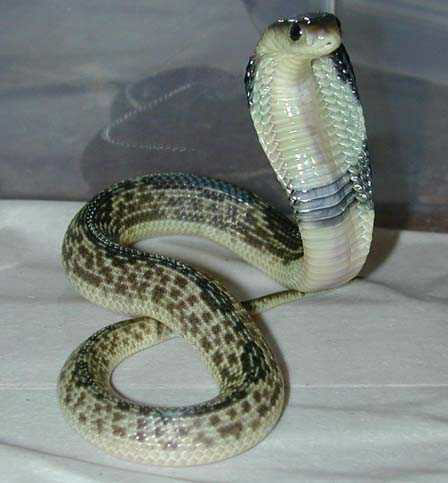
Javan Spitting Cobra
Naja sputatrix
Department of Sustainability & Environment, CC BY 2.0, via Wikimedia Commons


Side by side
| Javan Spitting Cobra | Egyptian Cobra | |
|---|---|---|
| Scientific name | Naja sputatrix Boie, 1827 | Naja haje (Linnaeus, 1758) |
| English name | Javan Spitting Cobra | Egyptian Cobra |
| Group | Reptiles | Reptiles |
| Class | Reptilia Reptile | Reptilia Reptile |
| Order | Squamata Snakes | Squamata Snakes |
| Family | Elapidae Cobras | Elapidae Cobras |
| Genus | Naja Cobras | Naja Cobras |
| Named in | 1827 | 1758 |
| Red List category | Least Concern | Least Concern |
| Environment | Not recorded | marine, terrestrial |
| Countries on record | 2 countries | 33 countries |
| GBIF occurrence records | 333 records | 478 records |
Rows where the two agree are shown in grey.
Where each is found
Only Javan Spitting Cobra (2)
Only Egyptian Cobra (33)
- Algeria
- Benin
- Botswana
- Burkina Faso
- Cameroon
- Central African Republic
- Chad
- Democratic Republic of the Congo
- Egypt
- Eritrea
- Ethiopia
- Guinea
- Guinea-Bissau
- Kenya
- Libya
- Mali
- Mauritania
- Morocco
- Mozambique
- Namibia
- Niger
- Nigeria
- Senegal
- Somalia
- South Africa
- South Sudan
- Sudan
- Tanzania
- Tunisia
- Uganda
- Western Sahara
- Zambia
- Zimbabwe
From Catalogue of Life checklists and GBIF occurrence records. A country missing from a list means no record is held, which is not proof of absence.
Checked facts
| Javan Spitting Cobra | Egyptian Cobra | |
|---|---|---|
| Appearance |
|
|
| Size |
|
|
| Habitat |
|
|
| Diet |
|
|
| Behaviour |
|
|
| Reproduction |
| No checked fact yet |
| Distribution |
|
|
| Conservation |
|
|
| Uses |
|
|
| Other |
| No checked fact yet |
In brief
Javan Spitting Cobra
Naja sputatrix is native to Java and the Indonesian islands of Bali, Lombok, Sumbawa, Komodo, Flores, Lomblen, and Alor. It is terrestrial and nocturnal, and readily spits venom when threatened. Full profile
Egyptian Cobra
Naja haje occurs across most of North Africa north of the Sahara, the savannas of West Africa south of the Sahara, the Congo Basin, Kenya, and Tanzania. It has elongated cervical ribs that allow its neck to expand into a hood, and its coloration varies from brown and copper-red to grey-brown and black. Full profile
Compare something else
Page built on 27 November 2026 from the data on the two species pages, where every source is listed.
Cite this page
ScientificNames.org. (2026). Javan Spitting Cobra vs Egyptian Cobra. Retrieved November 27, 2026, from https://scientificnames.org/compare/javan-spitting-cobra-vs-egyptian-cobra
“Javan Spitting Cobra vs Egyptian Cobra.” ScientificNames.org, 2026, scientificnames.org/compare/javan-spitting-cobra-vs-egyptian-cobra. Accessed 27 Nov. 2026.
ScientificNames.org. “Javan Spitting Cobra vs Egyptian Cobra.” Accessed November 27, 2026. https://scientificnames.org/compare/javan-spitting-cobra-vs-egyptian-cobra.
@misc{scientificnames_javan_spitting_cobra_vs_egyptian_cobra,
  author = {{ScientificNames.org}},
  title = {Javan Spitting Cobra vs Egyptian Cobra},
  year = {2026},
  url = {https://scientificnames.org/compare/javan-spitting-cobra-vs-egyptian-cobra},
  note = {Accessed 2026-11-27}
}