Species · Reptiles
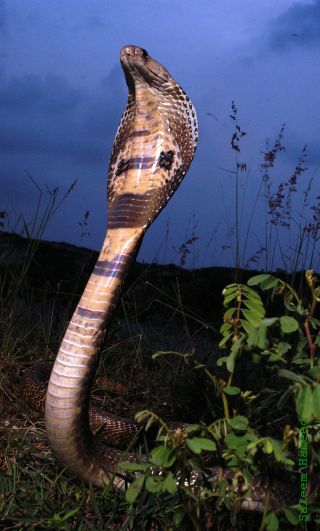
Egyptian Cobra Naja haje
The scientific name of the Egyptian Cobra is Naja haje. It is a species of reptile in the family Elapidae (cobras), order Squamata. The name dates from 1758.
- Scientific name
- Naja haje (Linnaeus, 1758)
- Common name
- Egyptian Cobra
- Genus
- Naja
- Family
- Elapidae (Cobras)
- Order
- Squamata
- Class
- Reptilia
- Red List category
- LC Least Concern
- Environment
- marine, terrestrial
- Recorded in
- 33 countries
- Name status
- accepted in the Catalogue of Life

Overview
The Egyptian cobra (Naja haje) is an elapid venomous snake species in the genus Naja. It is one of the most venomous species of snakes inhabiting Northern Africa. The venom of the Egyptian cobra can be lethal to humans and consists mostly of neurotoxins and cytotoxins. Unlike most other cobras, the species does not spit venom.
Classification of the Egyptian Cobra
| Kingdom | Animalia |
|---|---|
| Phylum | Chordata |
| Subphylum | Vertebrata |
| Infraphylum | Gnathostomata |
| Parvphylum | Osteichthyes |
| Megaclass | Tetrapoda |
| Class | Reptilia (Reptile) |
| Order | Squamata (Snakes) |
| Suborder | Serpentes (Snakes) |
| Infraorder | Alethinophidia |
| Family | Elapidae (Cobras) |
| Genus | Naja (Cobras) |
| Species | Naja haje (Linnaeus, 1758) |
Where the Egyptian Cobra is found
Checklists and occurrence records place Naja haje in 33 countries across Africa. GBIF holds 478 georeferenced records of it.
Countries
- Algeria 5
- Benin 77
- Botswana 4
- Burkina Faso 2
- Cameroon 4
- Central African Republic 3
- Chad 4
- Democratic Republic of the Congo 9
- Egypt 86
- Eritrea
- Ethiopia 8
- Guinea
- Guinea-Bissau 1
- Kenya 43
- Libya 3
- Mali 2
- Mauritania
- Morocco 94
- Mozambique 3
- Namibia 9
- Niger 3
- Nigeria 14
- Senegal 2
- Somalia
- South Africa 13
- South Sudan 4
- Sudan 9
- Tanzania 22
- Tunisia 26
- Uganda 16
- Western Sahara
- Zambia 6
- Zimbabwe 6
Regions and cities with the most records
- Kajiado County, Kenya 18
- Tan-Tan, Morocco 11
- Machakos County, Kenya 10
- Zou, Benin 10
- Arusha, Tanzania 9
- Atakora, Benin 9
- Atlantique, Benin 9
- Ouémé, Benin 9
- Borgou, Benin 8
- Machakos, Kenya 8
- Guelmim, Morocco 7
- Porto-Novo, Benin 7
- Alibori, Benin 6
- Athi River, Kenya 6
- Collines, Benin 6
- Ekpé, Benin 6
- Haut-Uele, Democratic Republic of the Congo 6
- Jigawa State, Nigeria 6
- Kitengela, Kenya 6
- Kouffo, Benin 6
- Naivasha, Kenya 6
- Nakuru County, Kenya 6
- Abomey, Benin 5
- Bauchi, Nigeria 4
- Bohicon, Benin 4
- Cotonou, Benin 4
- Donga, Benin 4
- Mono, Benin 4
- Ouidah, Benin 4
- Plateau, Benin 4
- Abomey-Calavi, Benin 3
- Central Equatoria, South Sudan 3
- Gilgil, Kenya 3
- Godomè, Benin 3
- Kassala, Sudan 3
- Kassala, Sudan 3
Range as the checklists state it
Algeria, Burkina Faso, Cameroon, Central African Republic ?, N Democratic Republic of the Congo (Zaire), Chad, Egypt (?), Eritrea, Ethiopia, Guinea-Bissau (?), Guinea (Conakry), Kenya, Libya, Mali, Western Sahara, Mauritania ?, Morocco, Niger, Nigeria, Senegal, Somalia, Sudan (Jumhūriyyat), Republic of South Sudan (RSS), Tanzania, Uganda, Zimbabwe
A number beside a place is its count of GBIF occurrence records. A place without a number comes from a checklist alone. Records show where a species has been observed or collected, which can include escapes and vagrants.
Common names
English
- Egyptian Cobra
- Obscure Cobra [obscura]
Names in 1 other language
- German
- Uräusschlange
Synonyms
7 other scientific names have been used for this species and are now treated as synonyms of Naja haje.
- Cerastes candidus Laurenti, 1768
- Coluber candidissimus Lacépède, 1789
- Coluber haje Linnaeus, 1758
- Naja haje haje (Linnaeus, 1758)
- Naja haje legionis Valverde, 1989
- Naja haje var. viridis Peters, 1873
- Naja obscura Saleh & Trape ex Trape, 2023
Related species
-
 Indian CobraNaja naja
-
 Monocled CobraNaja kaouthia
-
 Caspian CobraNaja oxiana
-
 Forest CobraNaja melanoleuca
-
 Cape CobraNaja nivea
-
 Philippine CobraNaja philippinensis
-
 Red Spitting CobraNaja pallida
-
 Black-necked Spitting CobraNaja nigricollis
Compare
Questions and answers
What is the scientific name of the Egyptian Cobra?
The scientific name of the Egyptian Cobra is Naja haje. Written with its author, the full name is Naja haje (Linnaeus, 1758).
Which family does the Egyptian Cobra belong to?
Naja haje belongs to the family Elapidae, in the order Squamata and the class Reptilia.
Where is the Egyptian Cobra found?
Checklists and occurrence records place Naja haje in 33 countries, including Morocco, Egypt, Benin, Kenya, Tunisia and Tanzania.
What is the conservation status of the Egyptian Cobra?
The IUCN Red List category recorded for Naja haje is Least Concern (LC).
What other names does the Egyptian Cobra have?
Naja haje is also known in English as Obscure Cobra [obscura].
Sources
Data
- Catalogue of Life, 2026-10-16 XR cc by
- Global Biodiversity Information Facility CC BY 4.0
- Wikidata CC0
- English Wikipedia CC BY-SA 4.0
- GeoNames CC BY 4.0
- Wikimedia Commons per image; credit shown with each image
- Within the Catalogue of Life, this name comes from The Reptile Database cc by
References
- Linné, C. [= Linnaeus, C.]. (1758). Systema naturæ per regna tria naturæ, secundum classes, ordines, genera, species, cum characteribus, differentiis, synonymis, locis. Tomus I. Editio decima, reformata. Laurentii Salvii, Holmiæ. 10th Edition: 824 Pp.
- Peters, & Wilhem Carl Hartwig. (1873). Über zwei Giftschlangen aus Afrika und über neue oder weniger bekannte Gattungen und Arten von Batrachiern. Monatsber. Königl. Akad. Wiss. Berlin. 1873 (Mai): 411-418.
- Boulenger, George A. (1891). Catalogue of the reptiles and batrachians of Barbary (Morocco, Algeria, Tunisia), based chiefly upon the notes and collections made in 1880-1884 by M. Fernand Lataste. Tr. Zool. Soc. 13: 93-164.
- Schmidt, K. P. (1923). Contributions to the herpetology of the Belgian Congo based on the collection of the American Museum Congo Expedition, 1909-1915. Part II. Snakes, with field notes by Herbert Lang and James P. Chapin. Bull. Amer. Mus. Nat. Hist. 49 (1): 1-146.
- Loveridge, & Arthur. (1929). East African reptiles and amphibians in the United States National Museum. Bull. US Natl. Mus. (151): 1-135.
- Scortecci, G. (1932). Rettili dello Yemen. Atti Soc. Ital. Sci.Nat. 71: 39-49.
- Mertens, R. (1937). The Type Designations of the Ophidian Genera Cerastes and Coronella, Established by Laurenti in 1768. Copeia 1937 (1): 70.
- Dickinson, W. H. (1948). Observations on Naja haje (Linnaeus) Feigning Death. Herpetologica 4 (4): 147.
- Loveridge, A. (1956). On snakes collected in the Anglo-Egyptian Sudan by J.S. Owen, Esq. Sudan Notes Rec. 36: 37-56 [1955].
- Haas, & Georg. (1957). Some amphibians and reptiles from Arabia. Proc. Cal. Acad. Sci. 29 (3): 47-86.
- Broadley, D. G. (1958). Snakes of Southern Rhodesia. 6. The Egyptian cobra (Naja haje haje). Afr. Wild Life 12: 125-128.
- Broadley, D. G. (1959). The herpetology of Southern Rhodesia. Part I--the snakes. Bull. Mus. Comp. Zool. Harvard 120 (1): 1-100 [Reprint 1972].
- Broadley, D. G. (1962). On some reptile collections from the North-Western and North-Eastern Districts of Southern Rhodesia 1958-1961, with descriptions of four new lizards. Occ. Pap. Nat. Mus. South. Rhodesia 26 (B): 787-843.
- Kramer, E. & H. SCHNURRENBERGER. (1963). Systematik, Verbreitung und Ökologie der Libyschen Schlangen. Rev. Sui. Zool. 70 (3): 453-568.
- Lambiris, A. J. I. (1967). Observations on the Feeding Behaviour of Naja haje and Naja nigricollis. J. Herp. Assoc. Africa (3): 36-36.
- Broadley, D. G. (1968). A review of the African cobras of the genus Naja (Serpentes: Elapinae). Arnoldia (Rhodesia) (Ser. 3) 29: 1-14.
- Pitman, C. R. S. (1974). A guide to the snakes of Uganda. Codicote, Wheldon & Wesley, L., 290 Pp.
- Pienaar, & Uys de Villiers. (1978). The Reptile Fauna of the Kruger National Park. Pretoria: National Parks Board of South Africa, I-Vii, 222 S.
- Arnold E N. (1980). The scientific results of the Oman flora and fauna survey 1977 (Dhofar). The reptiles and amphibians of Dhofar, southern Arabia. JOURNAL OF OMAN STUDIES SPECIAL REPORT (No. 2): 273-332.
- Schleich, H. H. (1987). Contributions to the herpetology of Kouf National Park (NE-Libya) and adjacent areas. Spixiana 10 (1): 37-80.
- Els, R. A. (1988). Venoms and Snakebite: Naja haje annulifera: Envenomation. J. Herp. Assoc. Africa (34): 52-52.
- Valverde, J. A. (1989). Notas sobre vertebrados. VII. Una nueva cobra del NW de Africa, Naja haje legionis, ssp. nov. (Elapidae, Serpentes). Acta IX Real Sociedad Española de Historia Natural 2: 214-230.
- Haagner, G. V. (1990). Life History Note: Naja haje annulifera: Ophiophagy. J. Herp. Assoc. Africa (37): 47-47.
- Lanza, B. (1990). Amphibians and reptiles of the Somali Democratic Republic: check list and biogeography. Biogeographia, 14: 407-465 [1988].
- Chifundera, K. (1990). Snakes of Zaire and their bites. Afr. Stud. Monogr. (Kyoto) 10(3): 137-157.
This species in other databases
Page built on 24 November 2026. See how the catalog is made and all sources and licences.
Cite this page
ScientificNames.org. (2026). Naja haje (Egyptian Cobra). Retrieved November 24, 2026, from https://scientificnames.org/species/naja-haje
“Naja haje (Egyptian Cobra).” ScientificNames.org, 2026, scientificnames.org/species/naja-haje. Accessed 24 Nov. 2026.
ScientificNames.org. “Naja haje (Egyptian Cobra).” Accessed November 24, 2026. https://scientificnames.org/species/naja-haje.
@misc{scientificnames_naja_haje_egyptian_cobra,
  author = {{ScientificNames.org}},
  title = {Naja haje (Egyptian Cobra)},
  year = {2026},
  url = {https://scientificnames.org/species/naja-haje},
  note = {Accessed 2026-11-24}
}