Comparison

Woodland Jumping Mouse vs Long-eared Jerboa

Woodland Jumping Mouse (Napaeozapus insignis) and Long-eared Jerboa (Euchoreutes naso) both belong to the family Dipodidae (jerboa) and part ways below it.

Woodland Jumping Mouse

Woodland Jumping Mouse

Napaeozapus insignis

D Gordon E. Robertson, CC BY-SA 3.0, via Wikimedia Commons
Long-eared Jerboa

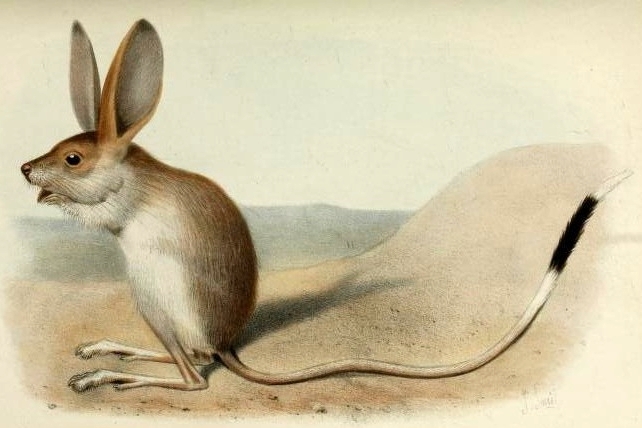
Long-eared Jerboa

Euchoreutes naso

Joseph Smit (1836–1929), Public domain, via Wikimedia Commons

Side by side

Woodland Jumping MouseLong-eared Jerboa
Scientific nameNapaeozapus insignis (Miller, 1891)Euchoreutes naso Sclater, 1891
English nameWoodland Jumping MouseLong-eared Jerboa
GroupMammalsMammals
ClassMammalia MammalMammalia Mammal
OrderRodentia RodentRodentia Rodent
FamilyDipodidae JerboaDipodidae Jerboa
GenusNapaeozapus Woodland Jumping MiceEuchoreutes
Named in18911891
Red List categoryLeast ConcernLeast Concern
Countries on record2 countries2 countries
GBIF occurrence records10,871 records111 records

Rows where the two agree are shown in grey.

Where each is found

Only Woodland Jumping Mouse (2)

Only Long-eared Jerboa (2)

From Catalogue of Life checklists and GBIF occurrence records. A country missing from a list means no record is held, which is not proof of absence.

Checked facts

Woodland Jumping MouseLong-eared Jerboa
Appearance
  • The species has white underparts, yellowish-orange sides, and a dark stripe running along its back from nose to tail. biokids.umich.edu
  • Its tail is thin, tapered, sparsely haired, scaly, and white-tipped. animaldiversity.org
  • The tops of its feet are white. biokids.umich.edu
  • The long-eared jerboa has reddish-yellow to light russet upperparts and a white belly. animaldiversity.org
  • The long-eared jerboa has ears approximately one-third longer than its head. animaldiversity.org
  • The long-eared jerboa has a tail with short hairs and a terminal tuft of black and white hairs. animaldiversity.org
  • The long-eared jerboa has five digits on each hind foot, with shorter lateral digits than central digits. animaldiversity.org
  • The central metatarsals of the long-eared jerboa are fused over a short distance. animaldiversity.org
  • The long-eared jerboa has tufts of bristly hairs covering its feet. animaldiversity.org
  • The long-eared jerboa has thin, white incisors. animaldiversity.org
  • The long-eared jerboa has a small premolar on each side of its upper jaw. animaldiversity.org
  • Female long-eared jerboas have eight mammary glands. animaldiversity.org
SizeNo checked fact yet
Habitat
  • The species prefers forested habitats with dense woody undergrowth. animaldiversity.org
  • It occurs in spruce-fir and hemlock-hardwood forests throughout its range. biokids.umich.edu
  • It also occupies forest edges with sufficient vegetation cover and access to water. biokids.umich.edu
  • It occurs at elevations ranging from sea level to 2,013 meters. animaldiversity.org
  • Boreal habitats support higher population densities than non-boreal habitats. animaldiversity.org
  • In some areas, populations are restricted to mountain tops, remnant forest patches, and cool, moist coves because suitable habitat is limited. animaldiversity.org
  • Long-eared jerboas have been collected in sandy valleys covered with low-growing bushes. animaldiversity.org
  • The long-eared jerboa inhabits arid desert and semi-desert environments in the Mengxin and Aerjin Mountain regions. animaldiversity.org
  • The long-eared jerboa also inhabits cold, high-elevation desert environments in the Qing-Zang Plateau region. animaldiversity.org
  • Haloxylon ammodendron has been documented at some long-eared jerboa capture sites. animaldiversity.org
Diet
Behaviour
  • The species undergoes deep seasonal hibernation. biokids.umich.edu
  • Males emerge from hibernation approximately two weeks before females. animaldiversity.org
  • Its peak activity period occurs during summer. English Wikipedia
  • Most individuals begin hibernation by late November, although some start as early as September. English Wikipedia
  • During hibernation, individuals periodically awaken approximately every two weeks to urinate or eat stored food. English Wikipedia
  • It constructs nests in hollow logs, beneath tree roots, or under rocks. English Wikipedia
  • Its burrows usually contain multiple chambers for sleeping, food storage, and nesting. English Wikipedia
  • Its nests are constructed from grasses, reeds, and leaves. English Wikipedia
  • Captive individuals generally show little aggression toward one another. English Wikipedia
  • Long-eared jerboas are presumed to be mainly nocturnal. animaldiversity.org
  • The long-eared jerboa locates flying insects using sound and captures them by leaping rapidly into the air. animaldiversity.org
  • The long-eared jerboa belongs to a species whose mating system has not been established. animaldiversity.org
  • The long-eared jerboa is gonochoric, with separate male and female sexes. animaldiversity.org
Reproduction
  • Females can produce one or two litters during a breeding season extending from May through September. biokids.umich.edu
  • The gestation period lasts between 23 and 29 days. animaldiversity.org
  • Litters contain between one and seven young, with an average of 4.5. animaldiversity.org
  • Newborns are blind, hairless, unpigmented, and weigh approximately one gram. animaldiversity.org
  • Both sexes reach reproductive maturity when they emerge from hibernation in the year following their birth. animaldiversity.org
  • Female long-eared jerboas nurse and care for their offspring at least until weaning. animaldiversity.org
Distribution
  • The species occurs throughout northeastern North America, from central Manitoba to northern Quebec and south to northern Georgia. biokids.umich.edu
  • The long-eared jerboa occurs from southernmost Mongolia into northwestern China. animaldiversity.org
Conservation
  • The species is classified as Least Concern on the IUCN Red List in document 1. English Wikipedia
  • Land development can reduce suitable habitat available for hibernation. English Wikipedia
  • Insufficient insulating snowfall may increase winter mortality. English Wikipedia
  • Rising temperatures threaten southern populations that are restricted to higher elevations. English Wikipedia
  • The long-eared jerboa was identified as one of the ten focal species of the EDGE project in 2007. English Wikipedia
  • Ongoing human disturbance is identified as a major threat to the long-eared jerboa. animaldiversity.org
  • The long-eared jerboa's population has experienced an observed or probable reduction of at least 80 percent over ten years. animaldiversity.org
Similar species
  • The meadow jumping mouse is a species with which the woodland jumping mouse can be confused. biokids.umich.edu
  • The woodland jumping mouse differs from the meadow jumping mouse by being larger, more brightly tricolored, and having a white-tipped tail. animaldiversity.org
No checked fact yet
OtherNo checked fact yet
  • The long-eared jerboa is the only recognized member of its genus, Euchoreutes. English Wikipedia
  • The long-eared jerboa is also the only recognized member of its subfamily, Euchoreutinae. English Wikipedia

In brief

Woodland Jumping Mouse

Napaeozapus insignis occurs throughout northeastern North America, from central Manitoba to northern Quebec and south to northern Georgia. It has white underparts, yellowish-orange sides, a dark stripe along its back, and a white-tipped tail. Full profile

Long-eared Jerboa

Euchoreutes naso occurs from southernmost Mongolia into northwestern China and inhabits arid desert, semi-desert, and cold, high-elevation desert environments. It is distinguished by ears approximately one-third longer than its head and a tail ending in a tuft of black and white hairs. Full profile

Compare something else

Page built on 29 November 2026 from the data on the two species pages, where every source is listed.

Cite this page

ScientificNames.org. (2026). Woodland Jumping Mouse vs Long-eared Jerboa. Retrieved November 29, 2026, from https://scientificnames.org/compare/woodland-jumping-mouse-vs-long-eared-jerboa