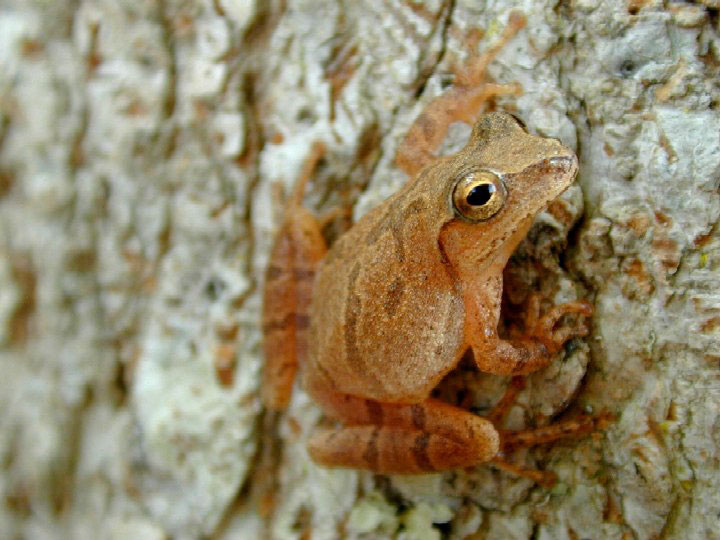
| Appearance | - The species typically has dark leg banding and a white marking extending from the eye to the base of the foreleg. English Wikipedia
- Females are slightly larger than males. English Wikipedia
- Males have a single vocal pouch. biokids.umich.edu
- Male northern cricket frogs develop a noticeable yellow coloration on their throat pouch during the breeding season. dwr.virginia.gov
| - The spring peeper typically has pink, tan, light brown, or gray skin and an X-shaped marking on its back. mdc.mo.gov
- The species has a cream-colored belly, a dark line across its head, and dark bars on its legs. mdc.mo.gov
- Spring peepers have adhesive pads on their fingertips and toe tips. mdc.mo.gov
- Females are generally lighter-colored and have bulkier abdomens than males. English Wikipedia
- The skin coloration of spring peepers can change within 15 to 45 minutes in response to temperature and light. English Wikipedia
|
|---|
| Size | - Adults typically measure 19–38 mm in length. English Wikipedia
- Females can reach a maximum snout-vent length of 38 mm. English Wikipedia
- Individuals in the eastern part of the range measure approximately 22–26 mm, compared with 24–29 mm in the western part. animaldiversity.org
| - Male spring peepers measure 18–30 mm in body length, while females measure 20–35 mm. English Wikipedia
|
|---|
| Habitat | - The species typically inhabits the edges of permanent ponds and lakes. animaldiversity.org
- Suitable habitat includes open, shallow water with abundant aquatic vegetation. English Wikipedia
- The species uses river backwaters and semi-permanent or permanent wetlands as breeding habitats. animaldiversity.org
- The species can inhabit arid regions, forests, and grasslands. animaldiversity.org
- The species prefers open grassy margins around ponds, ditches, and marshes. dwr.virginia.gov
| - Spring peepers inhabit marshy woodland and non-wooded lowlands near ponds and swamps. animaldiversity.org
- The species commonly inhabits forests and regenerating woodlands near temporary or semipermanent wetlands. English Wikipedia
- Spring peepers frequently breed in fishless ponds and temporary pools. mdc.mo.gov
- Spring peepers generally remain close to the ground or concealed in leaf litter despite their climbing ability. animaldiversity.org
|
|---|
| Diet | - The species primarily consumes insects and arachnids. dwr.virginia.gov
- Its diet includes mosquitoes. biokids.umich.edu
- Larger individuals consume relatively more leafhoppers, damselflies, butterflies, moths, grasshoppers, and crickets. English Wikipedia
- Tadpoles feed by filtering algae and phytoplankton from the water. dwr.virginia.gov
| - Adult spring peepers eat small insects and spiders, including ants, beetles, and flies. animaldiversity.org
- Spring peeper tadpoles feed on algae, detritus, and microorganisms. animaldiversity.org
- Adult spring peepers forage among leaf litter and surface debris for small insects and spiders. mdc.mo.gov
|
|---|
| Behaviour | | - Male spring peepers produce clear, high-pitched calls that rise slightly in pitch at the end. mdc.mo.gov
- Male spring peepers repeat their calls approximately once per second. mdc.mo.gov
- Spring peeper choruses can resemble the sound of hundreds of small jingle bells. mdc.mo.gov
- Spring peepers are usually concealed during daylight and become active around dusk. mdc.mo.gov
- Spring peepers may become active during daylight when heavy rain persists. mdc.mo.gov
- Spring peepers generally migrate at night. English Wikipedia
- Male spring peepers establish small territories around breeding pools and compete through frequent calling. animaldiversity.org
- Females preferentially select larger males as mates. animaldiversity.org
- Some males use a satellite strategy, remaining near calling males without calling themselves to intercept females. English Wikipedia
|
|---|
| Reproduction | - Breeding generally occurs from May through August. English Wikipedia
- Males attract females using high-pitched calls that resemble pebbles clicking together. English Wikipedia
- Females may lay eggs individually or in clusters containing up to seven eggs. animaldiversity.org
- Females can lay as many as 400 eggs in one reproductive event. animaldiversity.org
- Eggs may float on the water surface, attach to underwater aquatic plant stems, or sink to the bottom. animaldiversity.org
- Eggs generally hatch within a few days according to observations reported for the species. English Wikipedia
- Tadpoles generally undergo metamorphosis during July. dwr.virginia.gov
- Tadpoles exposed to dragonfly larvae may develop black tails as a defensive response. animaldiversity.org
| - Spring peepers in northern regions generally breed between March and June. English Wikipedia
- Spring peepers in southern regions breed between October and March, depending on local temperature. English Wikipedia
- Female spring peepers typically lay approximately 900 eggs per clutch, although clutches can contain up to 1,000 eggs. English Wikipedia
- Female spring peepers deposit their eggs individually or in groups of two or three. English Wikipedia
- Spring peeper eggs are attached individually to dead leaves, grasses, or sticks in shallow water. mdc.mo.gov
- Spring peeper eggs generally hatch within 6–12 days. animaldiversity.org
- Spring peeper tadpoles typically undergo metamorphosis after 45–90 days. animaldiversity.org
- Spring peepers generally reach sexual maturity at two years of age. mdc.mo.gov
- Male spring peepers provide no parental care after fertilization. animaldiversity.org
|
|---|
| Distribution | - The species occurs from southern Ontario, Canada, through the United States to northern Mexico. animaldiversity.org
- In the continental United States, the species occurs from Texas eastward to Virginia. animaldiversity.org
| No checked fact yet |
|---|
| Conservation | | - Spring peepers are listed as protected in New Jersey and threatened in Kansas. animaldiversity.org
- Spring peepers have become threatened in some states where wetland habitat has declined. mdc.mo.gov
- Spring peepers may help control populations of insects. animaldiversity.org
|
|---|
| Uses | - The species is used as an indicator of wetland health and environmental quality. English Wikipedia
- The species is used in research and in assessing water quality and ecological standards in ponds and streams. biokids.umich.edu
| |
|---|
| Similar species | - The southern cricket frog, Acris gryllus, is a similar species that can overlap geographically with the northern cricket frog. English Wikipedia
- The Striped Chorus Frog can be confused with the northern cricket frog. biokids.umich.edu
- The Northern Spring Peeper can be distinguished from the northern cricket frog by its smooth skin and X-shaped back marking. biokids.umich.edu
| - Spring peepers differ from some other Pseudacris species by lacking white lines on their lips. English Wikipedia
|
|---|