Comparison

Northern Hawk-owl vs Eurasian Eagle-owl

Northern Hawk-owl (Surnia ulula) and Eurasian Eagle-owl (Bubo bubo) both belong to the family Strigidae (owls) and part ways below it. Both are recorded in 21 countries.
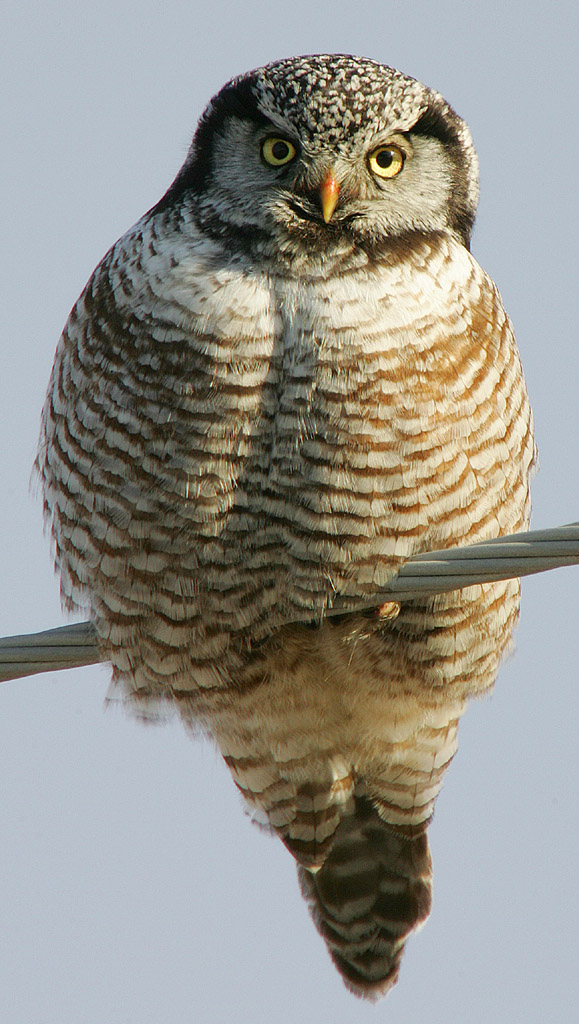
Northern Hawk-owl

Northern Hawk-owl

Surnia ulula

No machine-readable author provided. Krun assumed (based on copyright claims)., CC BY-SA 3.0, via Wikimedia Commons

Eurasian Eagle-owl

Eurasian Eagle-owl

Bubo bubo

Marton Berntsen, CC BY-SA 4.0, via Wikimedia Commons

Side by side

Northern Hawk-owlEurasian Eagle-owl
Scientific nameSurnia ulula (Linnaeus, 1758)Bubo bubo (Linnaeus, 1758)
English nameNorthern Hawk-owlEurasian Eagle-owl
GroupBirdsBirds
ClassAves BirdAves Bird
OrderStrigiformes OwlStrigiformes Owl
FamilyStrigidae OwlsStrigidae Owls
GenusSurnia Hawk-OwlsBubo Horned Owl
Named in17581758
Red List categoryLeast ConcernLeast Concern
Environmentterrestrialterrestrial
Countries on record22 countries68 countries
GBIF occurrence records97,805 records191,738 records

Rows where the two agree are shown in grey.

Where each is found

Both recorded in 21 countries

Only Northern Hawk-owl (1)

Only Eurasian Eagle-owl (47)

From Catalogue of Life checklists and GBIF occurrence records. A country missing from a list means no record is held, which is not proof of absence.

Checked facts

Northern Hawk-owlEurasian Eagle-owl
Appearance
  • The Northern Hawk-Owl has relatively dark brown upperparts with off-white spotting, except for a black V-shaped marking on the back of its neck. English Wikipedia
  • The Northern Hawk-Owl has a white face outlined in black, a rounded head, yellow eyes, and a curved yellow beak. English Wikipedia
  • Its underparts are generally white or off-white with brown barring across the breast and stomach. English Wikipedia
  • Adult Northern Hawk-Owls have rounded tail-feather tips, whereas first-year birds have pointed tips. English Wikipedia
  • The Northern Hawk-Owl has a long, brown-banded tail. English Wikipedia
  • The subspecies S. u. ulula has paler underparts with finer barring than the other subspecies. English Wikipedia
  • The subspecies S. u. caparoch has browner underparts with heavier barring. English Wikipedia
  • The subspecies S. u. tianschanica is slightly larger and darker above than the other subspecies. English Wikipedia
  • The Northern Hawk-Owl has narrowly pointed primary feathers. raptor.umn.edu
  • The species has distinctive ear tufts, mottled upperparts, barred wings and tail, and orange eyes. English Wikipedia
  • Its underparts are buff-coloured and streaked with darker markings. English Wikipedia
  • The species has a bulky, barrel-shaped body, erect ear tufts, and orange eyes. English Wikipedia
Size
Habitat
  • The Northern Hawk-Owl inhabits open coniferous forests and mixed coniferous-deciduous forests. English Wikipedia
  • The Northern Hawk-Owl occurs in muskegs, clearings, swamp valleys, meadows, and recently burned areas. English Wikipedia
  • The Northern Hawk-Owl generally avoids dense spruce-fir forests. English Wikipedia
  • Its winter habitat is usually the same as its breeding habitat. English Wikipedia
  • The Northern Hawk-Owl is associated with fields, meadows, grasslands, forests, woodlands, shrublands, and savannas. audubon.org
  • The species inhabits mountainous and rocky areas, often near woodland edges, shrubland openings, or wetlands. English Wikipedia
  • Its habitats include coniferous forests and steppes. English Wikipedia
  • The species occasionally occurs in farmland and park-like urban settings in Europe and Asia. English Wikipedia
Diet
  • In Eurasia, the Northern Hawk-Owl feeds primarily on Microtus voles. English Wikipedia
  • The North American subspecies S. u. caparoch feeds on microtine voles. English Wikipedia
  • During winter, ground-dwelling birds such as ptarmigan and grouse make up a larger proportion of its prey biomass. English Wikipedia
  • The species primarily hunts small mammals, including rodents and rabbits. English Wikipedia
  • Birds and larger mammals are also part of its diet. English Wikipedia
  • Secondary prey includes reptiles, amphibians, fish, large insects, and invertebrates. English Wikipedia
Behaviour
  • The Northern Hawk-Owl is non-migratory and usually remains within its breeding range. English Wikipedia
  • The Northern Hawk-Owl is active during the day as well as at other times. English Wikipedia
  • The Northern Hawk-Owl hunts at varying times without an apparent preferred hunting time. English Wikipedia
  • The Northern Hawk-Owl typically hunts by perching and scanning the surrounding area for prey. English Wikipedia
  • The Northern Hawk-Owl prefers spruce trees as hunting perches. English Wikipedia
  • The Northern Hawk-Owl can use its exceptional hearing to locate rodents beneath snow. English Wikipedia
  • The Northern Hawk-Owl sometimes moves southward during irruptions. English Wikipedia
  • The Northern Hawk-Owl can attack animals and people that approach its young too closely. English Wikipedia
  • The species is predominantly a nocturnal predator. English Wikipedia
  • Hunting by sight is more important than hunting by hearing in this species. English Wikipedia
  • Individuals may be most active during low-light periods around sunrise and sunset. English Wikipedia
Reproduction
  • Northern Hawk-Owl mating rituals generally begin in early March. English Wikipedia
  • A Northern Hawk-Owl brood typically contains between 3 and 11 eggs. English Wikipedia
  • Northern Hawk-Owls commonly nest in the tops of hollow stumps of old dead spruce trees. English Wikipedia
  • Northern Hawk-Owls also sometimes nest on cliffsides. English Wikipedia
  • North American S. u. caparoch nests are generally located 2–10 m above ground. English Wikipedia
  • Eurasian S. u. ulula nests are generally located 4–5 m above ground. English Wikipedia
Distribution
  • The North American subspecies S. u. caparoch occurs from eastern Alaska across Canada to Newfoundland. English Wikipedia
  • The subspecies S. u. tianschanica breeds in Central Asia and reaches Xinjiang in China. English Wikipedia
  • The subspecies S. u. ulula occurs across Siberia. English Wikipedia
  • The species has a geographic range covering approximately 51.4 million square kilometres across Europe and Asia. English Wikipedia
  • The largest concentrations of the species occur in Continental Europe, Scandinavia, Russia, and Central Asia. English Wikipedia
  • Additional populations occur in Anatolia, the northern Middle East, South Asia, China, Korea, and Japan. English Wikipedia
  • An estimated 12 to 40 breeding pairs were thought to reside in the United Kingdom in 2016. English Wikipedia
Conservation
  • The North American Northern Hawk-Owl population was estimated at 10,000–50,000 pairs. English Wikipedia
  • Northern Hawk-Owl populations fluctuate in association with small-rodent population cycles. English Wikipedia
  • Human fire suppression is believed to negatively affect Northern Hawk-Owl populations by reducing open hunting areas and dead nesting wood. English Wikipedia
  • The global population was estimated at between 100,000 and 500,000 individuals. English Wikipedia
  • The IUCN classifies the species as Least Concern, although its population trend is decreasing. English Wikipedia
Uses
  • The Northern Hawk-Owl may be used to hunt small game in Ontario under an appropriate falconry license. English Wikipedia
  • Tame individuals have occasionally been used to deter gulls from nesting as a form of pest control. English Wikipedia
Similar speciesNo checked fact yet
  • The species is larger than the snowy owl but smaller than the golden eagle. English Wikipedia
  • The long-eared owl is considerably smaller than the Eurasian eagle-owl. English Wikipedia
  • The Indian eagle-owl is smaller and has a more prominent blackish facial disc border than the Eurasian eagle-owl. English Wikipedia

In brief

Northern Hawk-owl

The Northern Hawk-owl is a medium-sized, slender bird in the family Strigidae and order Strigiformes. It occurs across eastern Alaska, Canada, Newfoundland, Siberia, and Central Asia, with the subspecies S. u. tianschanica reaching Xinjiang in China. It has a white face outlined in black, yellow eyes, a long brown-banded tail, and brown-barred underparts. Full profile

Eurasian Eagle-owl

Bubo bubo inhabits mountainous and rocky areas, coniferous forests, and steppes across Europe and Asia. It is distinguished by its bulky, barrel-shaped body, erect ear tufts, mottled upperparts, and orange eyes. Full profile

Compare something else

Page built on 26 November 2026 from the data on the two species pages, where every source is listed.

Cite this page

ScientificNames.org. (2026). Northern Hawk-owl vs Eurasian Eagle-owl. Retrieved November 26, 2026, from https://scientificnames.org/compare/northern-hawk-owl-vs-eurasian-eagle-owl