Comparison

Bangka Slow Loris vs Sunda Slow Loris

Bangka Slow Loris (Nycticebus bancanus) and Sunda Slow Loris (Nycticebus coucang) both belong to the genus Nycticebus (slow loris) and part ways below it.
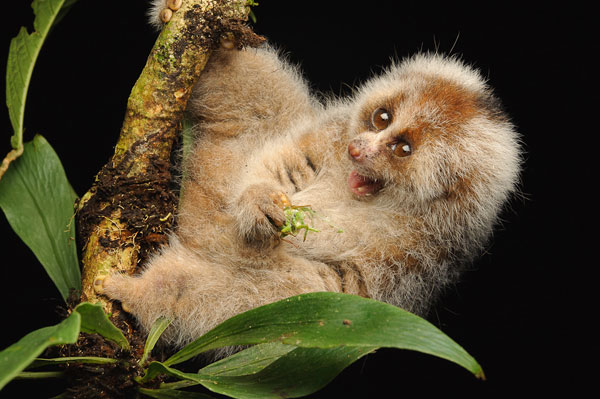
Bangka Slow Loris

Bangka Slow Loris

Nycticebus bancanus

Gunay M.E., CC BY-SA 4.0, via Wikimedia Commons

Sunda Slow Loris

Sunda Slow Loris

Nycticebus coucang

Lucie Čižmářová, The Kukang Rescue Program, CC BY-SA 4.0, via Wikimedia Commons

Side by side

Bangka Slow LorisSunda Slow Loris
Scientific nameNycticebus bancanus Lyon, 1906Nycticebus coucang (Boddaert, 1785)
English nameBangka Slow LorisSunda Slow Loris
GroupMammalsMammals
ClassMammalia MammalMammalia Mammal
OrderPrimates PrimatePrimates Primate
FamilyLorisidae PottosLorisidae Pottos
GenusNycticebus Slow LorisNycticebus Slow Loris
Named in19061785
Red List categoryCritically EndangeredEndangered
Countries on recordNot recorded8 countries
GBIF occurrence recordsNot recorded563 records

Rows where the two agree are shown in grey.

Where each is found

Only Sunda Slow Loris (8)

From Catalogue of Life checklists and GBIF occurrence records. A country missing from a list means no record is held, which is not proof of absence.

Checked facts

Bangka Slow LorisSunda Slow Loris
Appearance
  • The species has a wet nose, round head, small fur-covered ears, flat face, large eyes and a vestigial tail. English Wikipedia
  • Its fur is soft, thick and woolly, ranging from light brown to deep reddish brown with a lighter underside. English Wikipedia
  • It has dark rings around its eyes, a white nose with a pale stripe extending to the forehead, and a dark stripe running from the back of its head along its spine. English Wikipedia
  • Its vestigial tail is reduced to a stump concealed beneath its fur. English Wikipedia
  • Its second digit is shortened and its hands have a strong gripping ability. English Wikipedia
  • Its lower jaw has six forward-facing teeth forming a toothcomb. English Wikipedia
Size
  • The average body length of the Bangka slow loris is 258.05 mm (10.159 inches). English Wikipedia
Habitat
Diet
  • Floral nectar and nectar-producing plant parts account for approximately 31.7% of its feeding time. English Wikipedia
  • It obtains tree gum and sap by licking wounds in trees. English Wikipedia
Behaviour
  • The Bangka slow loris is nocturnal. English Wikipedia
  • The species uses its curved second hind-toe claw for scratching and grooming. English Wikipedia
  • The species uses its toothcomb for grooming. English Wikipedia
  • The Bangka slow loris uses secretions from its brachial gland defensively by wiping them onto its toothcomb. English Wikipedia
  • The species has a toxic bite, a distinctive characteristic among primates. English Wikipedia
  • The species activates its brachial gland toxin by mixing the secretion with saliva. English Wikipedia
  • The species applies toxin to its fur during grooming to protect its infants. English Wikipedia
  • The Sunda slow loris is nocturnal and arboreal. English Wikipedia
  • It generally spends the daytime sleeping in concealed locations in trees, often curled into a ball. English Wikipedia
  • It generally sleeps alone, although individuals have occasionally been observed sleeping with other members of their species. English Wikipedia
  • Individuals are predominantly solitary, spending approximately 8% of their active time near other individuals. animaldiversity.org
  • The species moves slowly through trees using all four limbs, generally keeping three limbs attached to a support. English Wikipedia
  • Its movements are quiet and involve little change in speed. animaldiversity.org
  • Individuals can remain suspended beneath branches using one or both feet for extended periods. animaldiversity.org
  • Adults produce eight distinct types of vocal calls divided into contact and aggressive or defensive categories. animaldiversity.org
  • The species generally avoids predators through crypsis rather than alarm calls. animaldiversity.org
  • Individuals use scent marking to communicate information about identity, physical condition and location. animaldiversity.org
  • Glands on the elbows produce oils that individuals lick and spread for communication. animaldiversity.org
  • Individuals use perineal rubbing to deposit urine and secretions from an anal gland. animaldiversity.org
ReproductionNo checked fact yet
Distribution
  • The Bangka slow loris occurs in southwestern Borneo and on Bangka Island. English Wikipedia
  • The species occurs in Indonesia, Malaysia, southern Thailand and Singapore. English Wikipedia
  • Its Indonesian distribution includes Sumatra, Batam, Galang, Tebing Tinggi and Great Natuna. English Wikipedia
  • In Malaysia, the species occurs on the Malay Peninsula and Pulau Tioman. English Wikipedia
  • The species is also recorded throughout Singapore. animaldiversity.org
Conservation
  • The Bangka slow loris was assessed by the IUCN in 2015 as Critically Endangered. iucnredlist.org
  • Habitat loss is one of the greatest threats to the survival of the Bangka slow loris. English Wikipedia
  • Illegal wildlife trade is a major threat to the species. English Wikipedia
  • The species is protected from commercial trade under Appendix I of CITES. English Wikipedia
  • Tin mining and oil palm plantations have caused extensive habitat destruction on Bangka Island. English Wikipedia
  • The Sunda slow loris was assessed as endangered on the IUCN Red List in 2020. English Wikipedia
  • International trade in the species was prohibited following its transfer to CITES Appendix I in June 2007. English Wikipedia
  • Habitat loss is a major threat to the species. English Wikipedia
  • Demand from the exotic pet trade threatens the species with extinction. English Wikipedia
  • The species is protected under Indonesian law, although enforcement is described as weak. English Wikipedia
  • Removing the teeth of individuals before selling them as pets can cause infection or death. English Wikipedia
  • Tooth removal makes individuals unsuitable for reintroduction into the wild. English Wikipedia
Similar species
  • The Bangka slow loris was formerly classified as a subspecies or synonym of the Bornean slow loris, Nycticebus menagensis. English Wikipedia
  • Nycticebus bancanus was elevated to full species status in 2013 following examination of museum specimens and photographs. English Wikipedia
No checked fact yet
Name originNo checked fact yet
OtherNo checked fact yet

In brief

Bangka Slow Loris

The Bangka Slow Loris belongs to the family Lorisidae. It occurs in southwestern Borneo and on Bangka Island. It has a toxic bite, a distinctive characteristic among primates. Full profile

Sunda Slow Loris

Nycticebus coucang occurs in Indonesia, Malaysia, southern Thailand and Singapore. It has a vestigial tail reduced to a stump concealed beneath its fur. Full profile

Compare something else

Page built on 29 November 2026 from the data on the two species pages, where every source is listed.

Cite this page

ScientificNames.org. (2026). Bangka Slow Loris vs Sunda Slow Loris. Retrieved November 29, 2026, from https://scientificnames.org/compare/bangka-slow-loris-vs-sunda-slow-loris