Species · Mammals
Sunda Slow Loris Nycticebus coucang
The scientific name of the Sunda Slow Loris is Nycticebus coucang. It is a species of mammal in the family Lorisidae (pottos), order Primates. The name dates from 1785.
- Scientific name
- Nycticebus coucang (Boddaert, 1785)
- Common name
- Sunda Slow Loris
- Genus
- Nycticebus
- Family
- Lorisidae (Pottos)
- Order
- Primates
- Class
- Mammalia
- Red List category
- EN Endangered
- Recorded in
- 8 countries
- Name status
- accepted in the Catalogue of Life

Overview
Nycticebus coucang occurs in Indonesia, Malaysia, southern Thailand and Singapore. It has a vestigial tail reduced to a stump concealed beneath its fur.
Written 26 November 2026 from the sources listed below. Each statement was checked against the passage it cites; statements that could not be supported were removed.
Appearance
Adults measure between 27 and 38 cm in length and weigh between 599 and 685 grams. Males and females do not exhibit sexual dimorphism in body weight.[1][2][3]
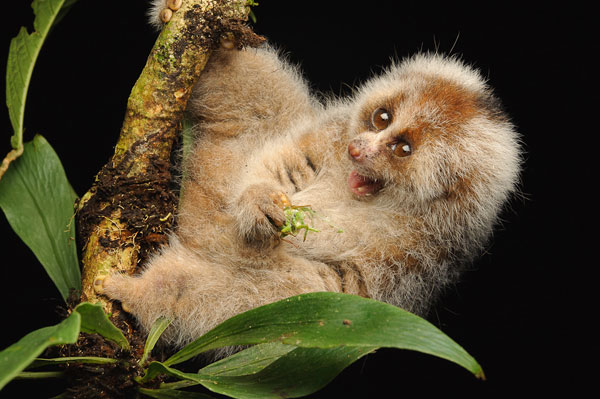
The Sunda Slow Loris has a wet nose, round head, small fur-covered ears, flat face, large eyes and a vestigial tail. Its fur is soft, thick and woolly, ranging from light brown to deep reddish brown with a lighter underside.[4][5]
It has dark rings around its eyes, a white nose with a pale stripe extending to the forehead, and a dark stripe running from the back of its head along its spine. Its second digit is shortened, and its hands have a strong gripping ability.[6][7]
Its lower jaw has six forward-facing teeth forming a toothcomb.[8]
Habitat
The Sunda Slow Loris inhabits continuous-canopy tropical rainforests and primarily occurs in primary and secondary tropical lowland forests. It can also inhabit degraded and logged forests.[9][10][11]
Its recorded habitats include swamp forests, peat swamps, savannahs, montane forests and shrub forests.[12]
The species occurs in Indonesia, Malaysia, southern Thailand and Singapore. Its Indonesian distribution includes Sumatra, Batam, Galang, Tebing Tinggi and Great Natuna.[13][14]
In Malaysia, it occurs on the Malay Peninsula and Pulau Tioman. It is also recorded throughout Singapore.[15][16]
Diet
Floral nectar and nectar-producing plant parts account for approximately 31.7% of its feeding time. It obtains tree gum and sap by licking wounds in trees.[17][18]
Behaviour
The Sunda Slow Loris is nocturnal and arboreal. It generally spends the daytime sleeping in concealed locations in trees, often curled into a ball.[19][20]
It generally sleeps alone, although individuals have occasionally been observed sleeping with other members of their species. Individuals are predominantly solitary, spending approximately 8% of their active time near other individuals.[21][22]
The species moves slowly through trees using all four limbs, generally keeping three limbs attached to a support. Its movements are quiet and involve little change in speed.[23][24]
Individuals can remain suspended beneath branches using one or both feet for extended periods.[25]
Adults produce eight distinct types of vocal calls divided into contact and aggressive or defensive categories. The species generally avoids predators through crypsis rather than alarm calls.[26][27]
Individuals use scent marking to communicate information about identity, physical condition and location. Glands on the elbows produce oils that individuals lick and spread for communication.[28][29]
Individuals use perineal rubbing to deposit urine and secretions from an anal gland.[30]
Reproduction and life cycle
Females reach sexual maturity between 18 and 24 months of age, while males can reach sexual maturity as early as 17 months. Females experience multiple periods of sexual receptivity during each year.[31][32][33]
The estrus cycle lasts between 29 and 45 days, and the average gestation period is 188 days. The female initiates copulation by hanging from a branch, sometimes vocalizing to attract the male.[34][35][36]
Females generally give birth to one offspring, although twins have been recorded. Offspring are weaned between three and six months of age.[37][38]
Females are responsible for caring for their offspring. They cover their young with toxic oil by licking them before and during weaning.[39][40]
Young individuals disperse between 16 and 27 months of age.[41]
Conservation
The Sunda Slow Loris was assessed as endangered on the IUCN Red List in 2020. International trade in the species was prohibited following its transfer to CITES Appendix I in June 2007.[42][43]
Habitat loss is a major threat to the species. Demand from the exotic pet trade also threatens it with extinction.[44][45]
The species is protected under Indonesian law, although enforcement is described as weak. Removing individuals' teeth before selling them as pets can cause infection or death and makes them unsuitable for reintroduction into the wild.[46][47][48]
Classification of the Sunda Slow Loris
| Kingdom | Animalia |
|---|---|
| Phylum | Chordata |
| Subphylum | Vertebrata |
| Infraphylum | Gnathostomata |
| Parvphylum | Osteichthyes |
| Megaclass | Tetrapoda |
| Class | Mammalia (Mammal) |
| Subclass | Theria |
| Infraclass | Eutheria |
| Order | Primates (Primate) |
| Suborder | Strepsirrhini |
| Infraorder | Lorisiformes |
| Family | Lorisidae (Pottos) |
| Subfamily | Lorisinae |
| Genus | Nycticebus (Slow Loris) |
| Species | Nycticebus coucang (Boddaert, 1785) |
Where the Sunda Slow Loris is found
Checklists and occurrence records place Nycticebus coucang in 8 countries across Asia. GBIF holds 563 georeferenced records of it.
Countries
Regions and cities with the most records
- Pahang, Malaysia 53
- Lampung, Indonesia 27
- Selangor, Malaysia 25
- Novena, Singapore 21
- Queenstown Estate, Singapore 20
- Singapore, Singapore 20
- Ang Mo Kio New Town, Singapore 19
- Bukit Timah, Singapore 19
- MacPherson, Singapore 19
- Anak Bukit, Singapore 18
- Eunos, Singapore 17
- Marine Parade, Singapore 17
- Yio Chu Kang, Singapore 17
- Jurong East, Singapore 16
- Sengkang New Town, Singapore 16
- Yishun New Town, Singapore 16
- Bedok New Town, Singapore 15
- Bukit Panjang New Town, Singapore 15
- Choa Chu Kang New Town, Singapore 15
- Keat Hong Village, Singapore 15
- Sungai Simpang, Singapore 15
- Teck Whye, Singapore 15
- Ulu Bedok, Singapore 15
- Jurong Town, Singapore 14
- Jurong West, Singapore 14
- Kampong Pasir Ris, Singapore 14
- Matilda Estate, Singapore 14
- Sembawang Estate, Singapore 14
- Yew Tee, Singapore 14
- Boon Lay, Singapore 13
- Kampong Loyang, Singapore 13
- Kuala Kubu Baharu, Malaysia 13
- Punggol, Singapore 13
- Raub, Malaysia 13
- Woodlands, Singapore 13
- Ara Damansara, Malaysia 11
3 more countries have a few records outside this range
These countries hold a few records of Nycticebus coucang but lie outside the range the checklists give for it. Such records are often zoo or garden specimens, museum material or vagrants, so the species is not counted as occurring there.
Range as the checklists state it
Southern Asia
A number beside a place is its count of GBIF occurrence records. A place without a number comes from a checklist alone. Records show where a species has been observed or collected, which can include escapes and vagrants.
Common names
English
- Sunda Slow Loris
- Bengal Slow Loris
- Greater Slow Loris
- Malayasian Slow Loris
- Slow Loris
Names in 21 other languages
- Arabic
- لوريس بطئ كبير
- Chinese
- 懶猴
- Czech
- outloň váhavý
- Dutch
- Grote Plompe Lori
- Finnish
- hidaslori
- French
- Loris lent
- Georgian
- ლორისებრნი
- German
- Sunda-Plumplori
- Greek
- Αργός Λόρις
- Hungarian
- szunda-szigeti lajhármaki
- Indonesian
- Kukang Sunda
- Italian
- Lori lento della Sonda
- Japanese
- スローロリス, スンダスローロリス
- Norwegian Bokmål
- Dovenlori
- Polish
- kukang większy
- Russian
- Медленный лори
- Spanish
- Loris Lento
- Tamil
- பெரிய தேவாங்கு
- Thai
- ลิงลมใต้
- Turkish
- Sunda Yavaş Lorisi
- asm
- লাজুকী বান্দৰ
Synonyms
13 other scientific names have been used for this species and are now treated as synonyms of Nycticebus coucang.
- Lemur tardigradus Raffles, 1821
- Loris tardigradus Boddaert, 1785
- Nycticebus brachycephalus Sody, 1949
- Nycticebus buku Robinson, 1917
- Nycticebus coucang brachycephalus Sody, 1949
- Nycticebus coucang buku Robinson, 1917
- Nycticebus coucang insularis Robinson, 1917
- Nycticebus insularis Robinson, 1917
- Nycticebus malaiana Anderson, 1881
- Nycticebus sumatrensis Ludeking, 1867
- Nycticebus tardigradus (Raffles, 1821)
- Nycticebus tardigradus malaiana Anderson, 1881
- Tardigradus coucang Boddaert, 1784
Subspecies and varieties
- Nycticebus coucang coucang subspecies
Related species
-
 Bangka Slow LorisNycticebus bancanus
-
 Bengal Slow LorisNycticebus bengalensis
-
 Bornean Slow LorisNycticebus borneanus
-
 Philippine Slow LorisNycticebus menagensis
-
 Javan Slow LorisNycticebus javanicus
-
 Sumatran Slow LorisNycticebus hilleri
-
 Kayan River Slow LorisNycticebus kayan
-
 Pygmy Slow LorisXanthonycticebus pygmaeus
Compare
Questions and answers
What is the scientific name of the Sunda Slow Loris?
The scientific name of the Sunda Slow Loris is Nycticebus coucang. Written with its author, the full name is Nycticebus coucang (Boddaert, 1785).
Which family does the Sunda Slow Loris belong to?
Nycticebus coucang belongs to the family Lorisidae, in the order Primates and the class Mammalia.
Where is the Sunda Slow Loris found?
Checklists and occurrence records place Nycticebus coucang in 8 countries, including Malaysia, Indonesia, Thailand, Singapore, Japan and India.
What is the conservation status of the Sunda Slow Loris?
The IUCN Red List category recorded for Nycticebus coucang is Endangered (EN).
What other names does the Sunda Slow Loris have?
Nycticebus coucang is also known in English as Bengal Slow Loris, Greater Slow Loris, Malayasian Slow Loris and Slow Loris.
Sources
Passages the profile rests on
- Adults measure between 27 and 38 cm in length. Source passage: “It measures 27 to 38 cm (11 to 15 in) from head to tail” — English Wikipedia
- Adults weigh between 599 and 685 grams. Source passage: “weighs between 599 and 685 g (21.1 and 24.2 oz).” — English Wikipedia
- Males and females do not exhibit sexual dimorphism in body weight. Source passage: “Unlike the Bengal slow loris, the Sunda slow loris does not show sexual dimorphism by weight.” — English Wikipedia
- The species has a wet nose, round head, small fur-covered ears, flat face, large eyes and a vestigial tail. Source passage: “it has a wet nose (rhinarium), a round head, small ears hidden in thick fur, a flat face, large eyes and a vestigial tail.” — English Wikipedia
- Its fur is soft, thick and woolly, ranging from light brown to deep reddish brown with a lighter underside. Source passage: “Its soft, thick, woolly fur ranges from light brown to deep reddish brown, with a lighter underside.” — English Wikipedia
- It has dark rings around its eyes, a white nose with a pale stripe extending to the forehead, and a dark stripe running from the back of its head along its spine. Source passage: “The Sunda slow loris has dark rings around its large eyes, a white nose with a whitish strip that extends to the forehead and a dark stripe that stretches from the back of the head along the spine.” — English Wikipedia
- Its second digit is shortened and its hands have a strong gripping ability. Source passage: “It has a shortened second digit, and the hands have a strong grip.” — English Wikipedia
- Its lower jaw has six forward-facing teeth forming a toothcomb. Source passage: “It has a toothcomb, six forward-facing teeth on the bottom jaw, which includes the lower incisors and the canine teeth.” — English Wikipedia
- The species inhabits continuous-canopy tropical rainforests. Source passage: “The Sunda slow loris is found in continuous canopy tropical rainforests.” — English Wikipedia
- It primarily inhabits primary and secondary tropical lowland forests. Source passage: “Sunda slow lorises mainly inhabit primary and secondary tropical lowland forests.” — animaldiversity.org
- The species can also inhabit degraded and logged forests. Source passage: “degraded habitats such as highly disturbed forests, secondary forests, disturbed primary forests and logged forests.” — animaldiversity.org
- Its recorded habitats include swamp forests, peat swamps, savannahs, montane forests and shrub forests. Source passage: “swamp forests, savannahs, montane and submontane forests, shrub forests, peat swamps and hardwood forests” — animaldiversity.org
- The species occurs in Indonesia, Malaysia, southern Thailand and Singapore. Source passage: “native to Indonesia, West Malaysia, southern Thailand and Singapore.” — English Wikipedia
- Its Indonesian distribution includes Sumatra, Batam, Galang, Tebing Tinggi and Great Natuna. Source passage: “in Indonesia, on the islands of Sumatra, Batam and Galang in the Riau Archipelago, and Tebing Tinggi Island and Great Natuna (Bunguran) in the Natuna Islands;” — English Wikipedia
- In Malaysia, the species occurs on the Malay Peninsula and Pulau Tioman. Source passage: “in Malaysia on the Malay Peninsula and Pulau Tioman;” — English Wikipedia
- The species is also recorded throughout Singapore. Source passage: “and throughout Singapore.” — animaldiversity.org
- Floral nectar and nectar-producing plant parts account for approximately 31.7% of its feeding time. Source passage: “floral nectar and nectar-producing plant parts (31.7%)” — English Wikipedia
- It obtains tree gum and sap by licking wounds in trees. Source passage: “Gum is taken by licking wounds on trees.” — English Wikipedia
- The Sunda slow loris is nocturnal and arboreal. Source passage: “The Sunda slow loris is nocturnal and arboreal, typically occurring in evergreen forests.” — English Wikipedia
- It generally spends the daytime sleeping in concealed locations in trees, often curled into a ball. Source passage: “It sleeps during the day, rolled up in a ball in hidden parts of trees above the ground” — English Wikipedia
- It generally sleeps alone, although individuals have occasionally been observed sleeping with other members of their species. Source passage: “It usually sleeps alone but has been observed to sleep with several conspecifics (individuals of the same species), including other adults.” — English Wikipedia
- Individuals are predominantly solitary, spending approximately 8% of their active time near other individuals. Source passage: “Sunda slow lorises are mainly solitary, spending only 8% of their active time near other individuals.” — animaldiversity.org
- The species moves slowly through trees using all four limbs, generally keeping three limbs attached to a support. Source passage: “the Sunda slow loris moves slowly through trees on all four limbs, typically with three limbs attached to a support at a time.” — English Wikipedia
- Its movements are quiet and involve little change in speed. Source passage: “They move with little noise or change in speed.” — animaldiversity.org
- Individuals can remain suspended beneath branches using one or both feet for extended periods. Source passage: “At times they may hang below a branch by one or both feet for long periods.” — animaldiversity.org
- Adults produce eight distinct types of vocal calls divided into contact and aggressive or defensive categories. Source passage: “Adults exhibit eight distinct calls of one of two types: contact calls (whistles, short keckers) and aggressive or defensive calls (long keckers, grunts, snarls, screams).” — animaldiversity.org
- The species generally avoids predators through crypsis rather than alarm calls. Source passage: “No alarm calls are used for signaling predators, as crypsis is the most common response for avoidance.” — animaldiversity.org
- Individuals use scent marking to communicate information about identity, physical condition and location. Source passage: “Olfactory senses play a central role in species interaction, with uses ranging from alerting others of identity, to physical state and even positioning of the individual.” — animaldiversity.org
- Glands on the elbows produce oils that individuals lick and spread for communication. Source passage: “Their elbows contain glands that exude oils, which are licked and spread by the individual to communicate position and status.” — animaldiversity.org
- Individuals use perineal rubbing to deposit urine and secretions from an anal gland. Source passage: “This species also uses perineal rubbing to deposit urine combined with the oil, from a separate gland on their anus.” — animaldiversity.org
- Females reach sexual maturity between 18 and 24 months of age. Source passage: “Sexual maturity is reached between 18 and 24 months of age in females” — animaldiversity.org
- Males can reach sexual maturity as early as 17 months. Source passage: “and can be reached as early as 17 months in males” — animaldiversity.org
- Females experience multiple periods of sexual receptivity during each year. Source passage: “Sunda slow lorises are polyestrous, having many periods of sexual receptivity during a year.” — animaldiversity.org
- The female initiates copulation by hanging from a branch, sometimes vocalizing to attract the male. Source passage: “To initiate, the female hangs from a branch within sight of the male, often vocalizing to draw further attention.” — animaldiversity.org
- The estrus cycle lasts between 29 and 45 days. Source passage: “Their estrus cycle lasts 29 to 45 days” — animaldiversity.org
- The average gestation period is 188 days. Source passage: “Their gestation period averages 188 days” — animaldiversity.org
- Females generally give birth to one offspring, although twins have been recorded. Source passage: “after which one offspring is born, although twinning has been observed.” — animaldiversity.org
- Offspring are weaned between three and six months of age. Source passage: “Offspring are weaned between three and six months of age.” — animaldiversity.org
- Females are responsible for caring for their offspring. Source passage: “Only females care for their young.” — animaldiversity.org
- Females cover their young with toxic oil by licking them before and during weaning. Source passage: “Before and during weaning, females lick their young, covering them in toxic oil” — animaldiversity.org
- Young individuals disperse between 16 and 27 months of age. Source passage: “The young disperses between 16 and 27 months, generally when it is sexually mature.” — English Wikipedia
- The Sunda slow loris was assessed as endangered on the IUCN Red List in 2020. Source passage: “According to the 2020 International Union for Conservation of Nature (IUCN) Red List assessment, the Sunda slow loris was evaluated as endangered.” — English Wikipedia
- International trade in the species was prohibited following its transfer to CITES Appendix I in June 2007. Source passage: “In June 2007 it was transferred from CITES Appendix II to Appendix I, indicating a true concern about the state of international trade in this species, an act now forbidden by international law.” — English Wikipedia
- Habitat loss is a major threat to the species. Source passage: “It also suffers from habitat loss, which has been severe in the areas in which it is found.” — English Wikipedia
- Demand from the exotic pet trade threatens the species with extinction. Source passage: “It is threatened with extinction due to a growing demand in the exotic pet trade” — English Wikipedia
- The species is protected under Indonesian law, although enforcement is described as weak. Source passage: “It is also protected by Indonesian law, though the law does not seem to be strictly enforced.” — English Wikipedia
- Removing the teeth of individuals before selling them as pets can cause infection or death. Source passage: “Its teeth are often pulled out before being sold as pets which can result in infection and/or death.” — English Wikipedia
- Tooth removal makes individuals unsuitable for reintroduction into the wild. Source passage: “Lack of teeth makes reintroduction to the wild impossible.” — English Wikipedia
Data
- Catalogue of Life, 2026-10-16 XR cc by
- Global Biodiversity Information Facility CC BY 4.0
- Wikidata CC0
- GeoNames CC BY 4.0
- Wikimedia Commons per image; credit shown with each image
- Within the Catalogue of Life, this name comes from The Integrated Taxonomic Information System cc0
References
- Elench. Anim. p.67 where the name was published
- Wilson, Don E., and DeeAnn M. Reeder, eds. (1993). Mammal Species of the World: A Taxonomic and Geographic Reference, 2nd Ed., 3rd Printing.
- Wilson, Don E., and F. Russell Cole. (2000). Common Names of Mammals of the World.
- Wilson, Don E., and DeeAnn M. Reeder, eds. (2005). Mammal Species of the World: A Taxonomic and Geographic Reference, 3rd Ed., Vol. 1.
- Mittermeier, Rusell A., Anthony B. Rylands, and Don E. Wilson, eds. (2013). Handbook of the Mammals of the World. Volume 3. Primates.
- Blair, Mary E., Giang T. H. Cao, Elora H. López-Nandam, Daniel A. Veronese-Paniagua, et al. (2023). Molecular Phylogenetic Relationships and Unveiling Novel Genetic Diversity among Slow and Pygmy Lorises, including Resurrection of Xanthonycticebus intermedius. Genes, Vol. 14, No. 3, Article 643.
This species in other databases
Page built on 27 November 2026. See how the catalog is made and all sources and licences.
Cite this page
ScientificNames.org. (2026). Nycticebus coucang (Sunda Slow Loris). Retrieved November 27, 2026, from https://scientificnames.org/species/nycticebus-coucang
“Nycticebus coucang (Sunda Slow Loris).” ScientificNames.org, 2026, scientificnames.org/species/nycticebus-coucang. Accessed 27 Nov. 2026.
ScientificNames.org. “Nycticebus coucang (Sunda Slow Loris).” Accessed November 27, 2026. https://scientificnames.org/species/nycticebus-coucang.
@misc{scientificnames_nycticebus_coucang_sunda_slow_loris,
  author = {{ScientificNames.org}},
  title = {Nycticebus coucang (Sunda Slow Loris)},
  year = {2026},
  url = {https://scientificnames.org/species/nycticebus-coucang},
  note = {Accessed 2026-11-27}
}