Comparison
Mossman Fairy Orchid vs Norfolk Island Oberonia
Mossman Fairy Orchid (Oberonia attenuata) and Norfolk Island Oberonia (Oberonia titania) both belong to the genus Oberonia (fairy orchids) and part ways below it. Both are recorded in 1 country.
Mossman Fairy Orchid
Oberonia attenuata

Side by side
| Mossman Fairy Orchid | Norfolk Island Oberonia | |
|---|---|---|
| Scientific name | Oberonia attenuata Dockrill | Oberonia titania Lindl. |
| English name | Mossman Fairy Orchid | Norfolk Island Oberonia |
| Group | Flowering plants | Flowering plants |
| Class | Liliopsida | Liliopsida |
| Order | Asparagales | Asparagales |
| Family | Orchidaceae Orchid | Orchidaceae Orchid |
| Genus | Oberonia Fairy Orchids | Oberonia Fairy Orchids |
| Red List category | Critically Endangered | Not recorded |
| Countries on record | 1 country | 5 countries |
| GBIF occurrence records | 14 records | 521 records |
Rows where the two agree are shown in grey.
Where each is found
Both recorded in 1 country
Only Norfolk Island Oberonia (4)
From Catalogue of Life checklists and GBIF occurrence records. A country missing from a list means no record is held, which is not proof of absence.
Checked facts
| Mossman Fairy Orchid | Norfolk Island Oberonia | |
|---|---|---|
| Appearance |
|
|
| Size |
|
|
| Habitat |
|
|
| Reproduction |
|
|
| Conservation |
|
|
In brief
Mossman Fairy Orchid
Oberonia attenuata has thin, dark green leaves and a downward-hanging flowering stem bearing numerous pale reddish-brown flowers. Full profile
Norfolk Island Oberonia
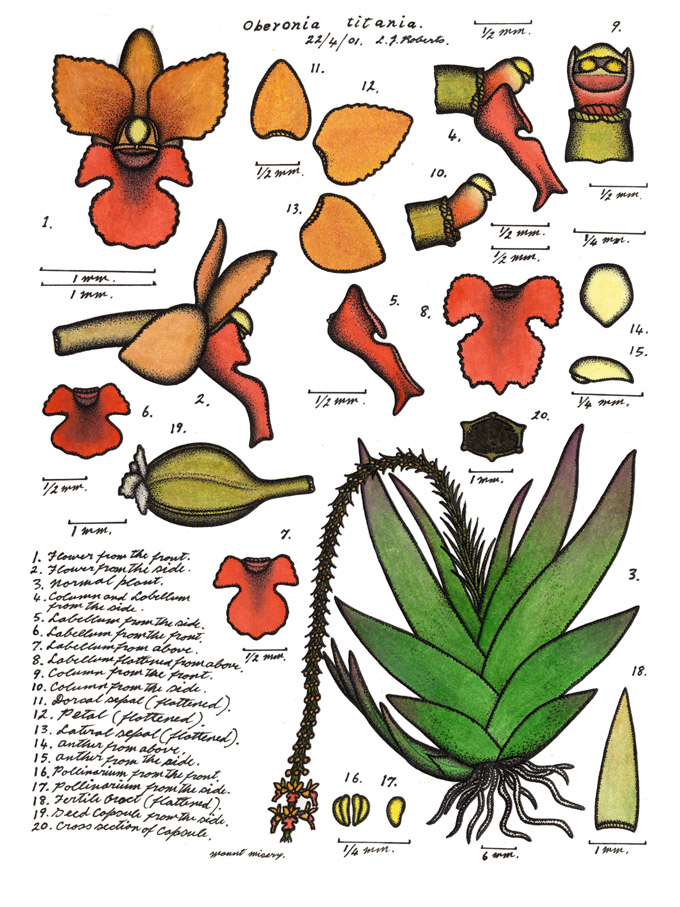
Norfolk Island Oberonia is a clump-forming epiphytic herb. It grows on trees in rainforest environments. It produces between 50 and 350 pinkish to red flowers arranged in whorls of six to eight. Full profile
Compare something else
Page built on 29 November 2026 from the data on the two species pages, where every source is listed.
Cite this page
ScientificNames.org. (2026). Mossman Fairy Orchid vs Norfolk Island Oberonia. Retrieved November 29, 2026, from https://scientificnames.org/compare/mossman-fairy-orchid-vs-norfolk-island-oberonia
“Mossman Fairy Orchid vs Norfolk Island Oberonia.” ScientificNames.org, 2026, scientificnames.org/compare/mossman-fairy-orchid-vs-norfolk-island-oberonia. Accessed 29 Nov. 2026.
ScientificNames.org. “Mossman Fairy Orchid vs Norfolk Island Oberonia.” Accessed November 29, 2026. https://scientificnames.org/compare/mossman-fairy-orchid-vs-norfolk-island-oberonia.
@misc{scientificnames_mossman_fairy_orchid_vs_norfolk_island_oberonia,
  author = {{ScientificNames.org}},
  title = {Mossman Fairy Orchid vs Norfolk Island Oberonia},
  year = {2026},
  url = {https://scientificnames.org/compare/mossman-fairy-orchid-vs-norfolk-island-oberonia},
  note = {Accessed 2026-11-29}
}