Comparison

Oceanspray vs Quince

Oceanspray (Holodiscus discolor) and Quince (Cydonia oblonga) both belong to the subfamily Amygdaloideae and part ways below it. Both are recorded in 5 countries.

Oceanspray

Oceanspray

Holodiscus discolor

Walter Siegmund (talk), CC BY-SA 3.0, via Wikimedia Commons

Quince

Quince

Cydonia oblonga

Unknown author, CC BY-SA 3.0, via Wikimedia Commons

Side by side

OceansprayQuince
Scientific nameHolodiscus discolor (Pursh) Maxim.Cydonia oblonga Mill.
English nameOceansprayQuince
GroupFlowering plantsFlowering plants
ClassMagnoliopsidaMagnoliopsida
OrderRosalesRosales
FamilyRosaceae Rose FamilyRosaceae Rose Family
GenusHolodiscus OceansprayCydonia Quince
Red List categoryNot recordedLeast Concern
Countries on record5 countries88 countries
GBIF occurrence records39,437 records52,611 records

Rows where the two agree are shown in grey.

Where each is found

Both recorded in 5 countries

Only Quince (83)

From Catalogue of Life checklists and GBIF occurrence records. A country missing from a list means no record is held, which is not proof of absence.

Checked facts

OceansprayQuince
Appearance
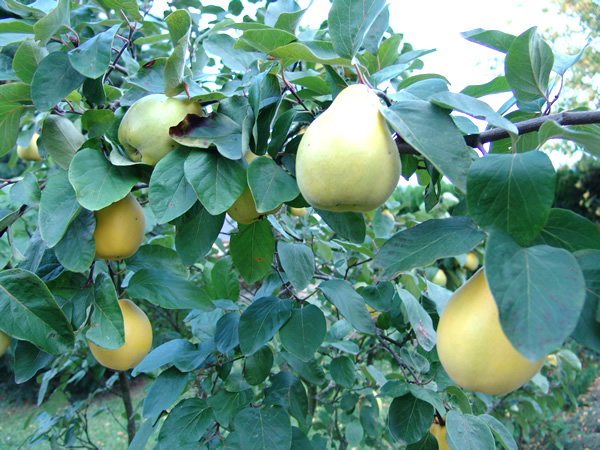
  • The quince is a deciduous shrub or small tree with crowded branches. rhs.org.uk
  • Its leaves are broadly oval, mid-green, and have grey, downy undersides. rhs.org.uk
  • Its solitary flowers are pale pink to white and appear in late spring. rhs.org.uk
  • Its aromatic fruits are golden-yellow and pear-shaped. rhs.org.uk
  • The fruit is a pome with an appearance resembling a pear or golden apple. extension.psu.edu
  • The fruit remains tough and hard even when fully ripe. extension.psu.edu
  • Ripening fruit changes from green through pale green to golden in late fall. extension.psu.edu
  • The fruit flesh contains dispersed gritty stone cells. English Wikipedia
Size
Habitat
  • The species occurs in California mixed evergreen forests. English Wikipedia
  • The species occurs in California oak woodlands. English Wikipedia
  • The species occurs in Coast redwood forests. English Wikipedia
  • The species occurs in lodgepole pine forests. English Wikipedia
  • The species grows in both forest openings and understories beneath various forest canopies. English Wikipedia
  • The species occurs at elevations of approximately 300–1,300 metres in various forest communities. English Wikipedia
  • In open mountain habitats of the Sierra Nevada, the species can occur at elevations up to 3,500 metres. English Wikipedia
  • The species grows in warm-temperate and temperate climates. English Wikipedia
  • The species can grow in most soil types. extension.psu.edu
  • The species tolerates both shaded and sunny growing conditions. English Wikipedia
  • The species can grow in deep, fertile, moist but well-drained soil in a warm, sheltered, sunny location. rhs.org.uk
  • The species requires a cool period with temperatures below 7 °C to flower properly. English Wikipedia
Diet
  • Native bees and butterflies use the species as a pollinator plant. English Wikipedia
  • The species serves as a larval host for Lorquin's admiral, pale tiger swallowtail, and spring azure caterpillars. English Wikipedia
  • The fruit is used as food in cooked preparations including jams, jellies, marmalade, and cakes. pmc.ncbi.nlm.nih.gov
  • The fruit can be eaten raw after sufficient ripening in warmer climates. pmc.ncbi.nlm.nih.gov
  • The fruit can be incorporated into applesauce and apple pie. extension.psu.edu
Reproduction
  • The species produces flowers with five petals, five styles, and at least 20 stamens. pmc.ncbi.nlm.nih.gov
  • The species has flowers with a lower ovary containing numerous ovules. pmc.ncbi.nlm.nih.gov
  • The species can be propagated using cuttings or layering. English Wikipedia
  • The species can also be propagated by seed sown in autumn. rhs.org.uk
Distribution
  • The species is native to western North America. English Wikipedia
  • The species is common throughout the Pacific Northwest. English Wikipedia
  • The species occurs throughout California. English Wikipedia
  • The species occurs in the Rocky Mountains of Colorado, New Mexico, Wyoming, and Idaho. English Wikipedia
  • The species occurs in many plant communities in Utah. English Wikipedia
  • In Arizona, the species occurs in mountain wilderness areas of the Madrean Sky Islands, including the Chiricahua Mountains. English Wikipedia
  • In Nevada, the species occurs in quaking aspen and willow communities and Great Basin sagebrush habitats. English Wikipedia
  • The species occurs in British Columbia, the western and south-central United States, and northern, central, and southwestern Mexico in its nominate variety. English Wikipedia
  • The species is native to the northern forests of Asia Minor and the Caucasus Mountains between Persia and Turkmenistan. pmc.ncbi.nlm.nih.gov
  • Wild populations are reported in Dagestan, Azerbaijan, Turkmenia, and Iran. pmc.ncbi.nlm.nih.gov
Uses
  • Indigenous peoples historically ate the seeds both raw and cooked. English Wikipedia
  • Some Indigenous peoples boiled the leaves with other plant leaves and small game animals. English Wikipedia
  • Many Indigenous tribes used the plant's wood and bark to make tools and furniture. English Wikipedia
  • The wood was used to manufacture digging sticks, spears, arrows, bows, harpoons, and nails. English Wikipedia
  • The Lummi used the flowers as an antidiarrheal remedy and the leaves as a poultice. English Wikipedia
  • The Stl'atl'imx steeped the berries in boiling water to prepare treatments for diarrhea, smallpox, chickenpox, and as a blood tonic. English Wikipedia
  • The Paiute and Shoshoni used the species medicinally for stomachaches and colds. English Wikipedia
  • The K'ómoks and Tla'amin used flowering as an indicator of the optimal time to dig for butter clams and the approaching sockeye salmon run. English Wikipedia
  • The species is grown as an ornamental plant for its attractive pink blossoms. extension.psu.edu
  • The species is used as a rootstock for certain pear cultivars. English Wikipedia
  • The fruit is used to produce alcoholic beverages. English Wikipedia
  • The fruit is used in the Balkans to produce quince eau-de-vie known as rakija. English Wikipedia
  • The fruit is traditionally added to chicken or kibbeh in Levantine cooking. English Wikipedia
  • The leaves have been investigated for their potential use in therapeutic supplements. pmc.ncbi.nlm.nih.gov
  • The leaves contain calcium, magnesium, and iron as their most abundant minerals. pmc.ncbi.nlm.nih.gov
Similar speciesNo checked fact yet
Name originNo checked fact yet
  • The English name quince originated in the fourteenth century from the plural form of the Middle English word quoyn. English Wikipedia
  • The name ultimately derives from the Greek expression kydonion mēlon, meaning Kydonian apple. English Wikipedia
OtherNo checked fact yet

In brief

Oceanspray

Holodiscus discolor occurs in western North America, including California, the Pacific Northwest, parts of the western and south-central United States, and northern, central, and southwestern Mexico. It produces cascading clusters of white, faintly sweet-scented flowers and small, hairy, single-seeded fruits. Full profile

Quince

Quince (Cydonia oblonga Mill.) is a deciduous flowering plant in the Rosaceae family, order Rosales, class Magnoliopsida. It is native to the northern forests of Asia Minor and the Caucasus Mountains between Persia and Turkmenistan. It produces aromatic, golden-yellow, pear-shaped fruits that remain tough and hard even when fully ripe. Full profile

Compare something else

Page built on 28 November 2026 from the data on the two species pages, where every source is listed.

Cite this page

ScientificNames.org. (2026). Oceanspray vs Quince. Retrieved November 28, 2026, from https://scientificnames.org/compare/oceanspray-vs-quince