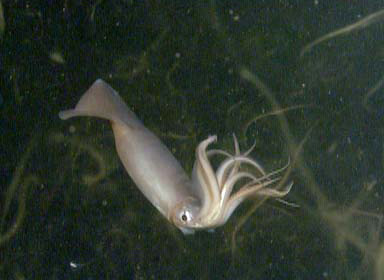
| Appearance | - The species has an elongated silver-colored band along the middle of the ventral mantle. English Wikipedia
- Its photophores are small, irregularly distributed, and restricted to the ventral mantle, head, and tentacles. English Wikipedia
- The species lacks visceral photophores. English Wikipedia
- Its arms lack lateral membranes. English Wikipedia
- Its tentacular club has 4 to 7 toothed suckers near the carpal suckers of the carpal locking apparatus. English Wikipedia
- The ventral sucker series on its arms contains 9 to 27 suckers. English Wikipedia
- The dorsal sucker series on its arms contains 10 to 25 suckers. English Wikipedia
- The protective membranes of the left and right third arms are wider than the arms themselves. English Wikipedia
- Its hectocotylus develops from either the left or right fourth arm. English Wikipedia
| - The species can rapidly change its body coloration using chromatophores. English Wikipedia
- The species can produce rapid red-and-white flashes across its entire body. English Wikipedia
|
|---|
| Size | | |
|---|
| Habitat | - The species inhabits subtropical and temperate oceanic waters. English Wikipedia
- At night, individuals are usually found feeding beneath the surface near cold-water fronts at depths of 0 to 70 m. English Wikipedia
- During daytime, individuals descend to depths of 300 to 700 m. English Wikipedia
- The species has been recorded at depths reaching 1,490 m. English Wikipedia
| - The species inhabits ocean depths ranging from approximately 200 to 700 metres. English Wikipedia
- The species occupies depths exceeding 250 metres during the day and approaches the surface at night. animaldiversity.org
- The species can tolerate low dissolved oxygen concentrations in deep water by reducing its oxygen consumption. animaldiversity.org
- The species can inhabit hypoxic and anoxic ocean waters. pmc.ncbi.nlm.nih.gov
|
|---|
| Diet | - The species feeds on small oceanic fishes, including lanternfishes and saury. English Wikipedia
- The species sometimes consumes smaller individuals of its own species. English Wikipedia
| - The species feeds primarily on small fish, crustaceans, other cephalopods, and copepods. English Wikipedia
- Juveniles consume copepods and pelagic shrimp before shifting toward fish and other cephalopods as they grow. animaldiversity.org
- The species consumes very little anchovy off Peru despite the large biomass of this fish in the region. pmc.ncbi.nlm.nih.gov
- The species sometimes consumes other individuals of its own species. English Wikipedia
|
|---|
| Behaviour | - The species is highly migratory. English Wikipedia
- Individuals move vertically between shallow nighttime feeding waters and deeper daytime waters. English Wikipedia
- The species can propel itself out of the water in a manner comparable to flying fishes. English Wikipedia
- Individuals sometimes land unintentionally on the decks of ships. English Wikipedia
- Its airborne behaviour occurs more frequently during rough weather or when predators are nearby. English Wikipedia
- The species' airborne behaviour is presumed to be an instinctive response to threats. English Wikipedia
| - The species can travel in shoals containing as many as 1,200 individuals. English Wikipedia
- The species can swim at speeds of up to 24 kilometres per hour. English Wikipedia
- The species undertakes daily vertical migrations between deeper daytime waters and shallower nighttime waters. animaldiversity.org
- The species can travel horizontally for up to 100 kilometres over three to four days. animaldiversity.org
- The species has been observed participating in cooperative hunting. English Wikipedia
- The species can use visual signals to interact with other individuals. animaldiversity.org
|
|---|
| Reproduction | - Males generally reach sexual maturity earlier in the season than females. English Wikipedia
- Males transfer spermatophores to females during mating. English Wikipedia
- Females store received spermatophores on the oral surface of their buccal membrane until sexual maturity. English Wikipedia
- Spawning occurs continuously throughout the year in intermittent events rather than during a single spawning season. English Wikipedia
- Females produce approximately 350,000 to 3.6 million eggs, depending on their size. English Wikipedia
- Newly hatched individuals measure approximately 1 mm in length. English Wikipedia
- Hatchlings reach approximately 7 mm in length after one month. English Wikipedia
- Paralarvae migrate northward toward waters bordering subarctic regions during summer and autumn. English Wikipedia
- Maturing individuals return to spawning grounds to mate. English Wikipedia
| - Females produce floating egg masses enclosed in a gelatinous protective layer. animaldiversity.org
- A single egg mass can contain approximately 5,000 to 4.1 million eggs. English Wikipedia
- Large females can produce egg masses measuring three to four metres in diameter. English Wikipedia
- Embryonic development lasts approximately six to nine days before hatching. animaldiversity.org
- Spawning is believed to occur throughout the year, with peaks between October and January in the Southern Hemisphere. animaldiversity.org
- Females may produce between three and twenty egg masses during their reproductive cycle. animaldiversity.org
|
|---|
| Distribution | - The species occurs in subtropical and temperate waters of the Pacific, Atlantic, and Indian Oceans. English Wikipedia
- The species is rarely found in the Mediterranean Sea. English Wikipedia
- From May to July, its pelagic habitat hotspots in the central North Pacific shift from the Kuroshio-Oyashio transition zone toward the subarctic frontal zone. science.gov
- The species' central North Pacific habitat hotspots west of the dateline are associated with dynamic oceanic eddies. science.gov
- Habitat hotspots east of the dateline showed higher persistence from June to July. science.gov
| |
|---|
| Conservation | No checked fact yet | - The Gulf of California fishery collapse associated with warming waters in 2015 had not recovered at the time described in the source. English Wikipedia
|
|---|
| Uses | - The species is commercially harvested for human consumption. English Wikipedia
- The species is one of the major targets of Japanese squid fisheries. science.gov
- Japanese commercial fishing vessels operate in the central North Pacific fishing grounds at 35–45°N around the dateline during summer. science.gov
| - The species is commercially harvested for markets in Europe, Russia, China, Japan, Southeast Asia, and the Americas. English Wikipedia
- The species is consumed in Chile in dishes including chupes and paila marina. English Wikipedia
- The species is used to prepare ceviche in Peru. English Wikipedia
|
|---|
| Similar species | - The orangeback flying squid (Sthenoteuthis pteropus) can be distinguished from this species using the toothed suckers on its tentacular club. English Wikipedia
| No checked fact yet |
|---|
| Other | No checked fact yet | - The species is the most important squid worldwide in commercial fisheries. English Wikipedia
|
|---|