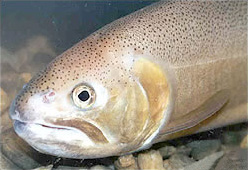
| Appearance | - Gila trout have yellow bodies marked with numerous small dark spots on the upper half. English Wikipedia
- Gila trout are distinguished from Apache trout by numerous small dark spots concentrated on the upper half of their bodies. English Wikipedia
- Adult Gila trout have small dark spots above the lateral line and a larger dark spot on the adipose fin. biokids.umich.edu
- The tips of the dorsal, pelvic, and anal fins are yellow or white. biokids.umich.edu
- Gila trout commonly have a pinkish lateral band that becomes darker in males during spawning season. biokids.umich.edu
- Juvenile parr marks frequently remain visible in adult Gila trout. biokids.umich.edu
- Most mature Gila trout have a yellow cutthroat mark. biokids.umich.edu
| - Sockeye salmon have iridescent silver flanks, a white belly, and a metallic green-blue upper surface while living in the ocean. adfg.alaska.gov
- During spawning migration, sockeye salmon develop brilliant red bodies and greenish heads. adfg.alaska.gov
- Breeding-age male sockeye salmon develop a humped back and hooked jaws containing visible teeth. adfg.alaska.gov
- Juvenile sockeye salmon have dark, oval parr marks on their sides while living in freshwater. adfg.alaska.gov
- Sockeye salmon have 30 to 40 long, serrated gill rakers. English Wikipedia
- Sockeye salmon lack spots on their tails and backs. English Wikipedia
|
|---|
| Size | | - Sockeye salmon measure approximately 18 to 31 inches in length. adfg.alaska.gov
- Sockeye salmon typically weigh between 4 and 15 pounds. adfg.alaska.gov
- The recorded maximum length of sockeye salmon is 31 inches. adfg.alaska.gov
- Landlocked sockeye salmon rarely exceed 14 inches in length. adfg.alaska.gov
|
|---|
| Habitat | - Gila trout inhabit freshwater rivers and perennial streams at elevations between 1,650 and 2,800 m. biokids.umich.edu
- Most Gila trout habitat consists of cold headwater and moderate valley streams that rarely exceed 21°C. biokids.umich.edu
- Gila trout headwater habitats include steep streams with rocky cascades and pools and gradients reaching 12%. biokids.umich.edu
- Gila trout valley habitats typically contain meandering streams with cobble riffles and pools around woody debris and rocks. biokids.umich.edu
- Suitable Gila trout habitat predominantly has gravel substrates measuring 2–9 mm. biokids.umich.edu
- Gila trout occur in small mountain streams and confined pools. English Wikipedia
| - Sockeye salmon inhabit freshwater lakes, streams, and estuaries during spawning and juvenile rearing. adfg.alaska.gov
- Sockeye salmon are generally found at ocean depths of 15 to 33 metres. animaldiversity.org
- Sockeye salmon spawning occurs in rivers, streams, and upwelling areas along lake beaches. adfg.alaska.gov
- Sockeye salmon juveniles commonly rear in freshwater lakes before migrating to the ocean. English Wikipedia
|
|---|
| Diet | - Gila trout feed opportunistically on aquatic insects and small fishes. English Wikipedia
| |
|---|
| Behaviour | No checked fact yet | - Sockeye salmon migrate from freshwater to the ocean and return to freshwater to spawn. adfg.alaska.gov
- Sockeye salmon use their sense of smell to recognize their natal freshwater stream. adfg.alaska.gov
- Sockeye salmon migrate in social groups when returning to freshwater spawning streams. animaldiversity.org
- Sockeye salmon establish social hierarchies, particularly during reproduction. animaldiversity.org
- The largest male sockeye salmon usually occupies the dominant position in the social hierarchy. animaldiversity.org
|
|---|
| Reproduction | - Female Gila trout produce an average of approximately 150 eggs per spawning event. biokids.umich.edu
- The maximum observed egg production by a Gila trout female was 686 eggs. English Wikipedia
- Gila trout eggs incubate in gravel nests called redds. biokids.umich.edu
- Gila trout fry emerge approximately 8–10 weeks after eggs are laid. biokids.umich.edu
- Newly emerged Gila trout fry measure approximately 15–25 mm. biokids.umich.edu
- Female Gila trout reach sexual maturity between two and four years of age. biokids.umich.edu
- Male Gila trout reach sexual maturity between two and three years of age. biokids.umich.edu
- Female Gila trout construct spawning nests by rapidly beating their tails against the substrate. biokids.umich.edu
- Gila trout females cover their fertilized eggs with gravel after spawning. biokids.umich.edu
| - Sockeye salmon females deposit between 2,000 and 5,000 eggs in one or more gravel nests. adfg.alaska.gov
- Female sockeye salmon excavate their spawning nests using their tails. adfg.alaska.gov
- Sockeye salmon eggs hatch during winter. adfg.alaska.gov
- Sockeye salmon eggs remain in gravel nests for approximately 32 to 42 days after fertilization. animaldiversity.org
- Female sockeye salmon produce between 47 and 206 offspring. animaldiversity.org
- Sockeye salmon are semelparous and generally die after spawning. English Wikipedia
- Female sockeye salmon provide parental care by selecting, preparing, and defending their nest sites. English Wikipedia
|
|---|
| Distribution | - Gila trout are native to tributaries of the Gila River in Arizona and New Mexico. English Wikipedia
- Gila trout occur in the upper Gila River watershed in New Mexico and the Francisco River watershed in Arizona. biokids.umich.edu
- Five streams in the Gila National Forest in New Mexico have retained Gila trout populations. English Wikipedia
- The five streams retaining Gila trout populations include Iron, McKenna, Spruce, Main Diamond, and South Diamond creeks. English Wikipedia
| - Sockeye salmon occur along the western coast of North America from northern California to northern Alaska. animaldiversity.org
- Sockeye salmon occur in Asia between Hokkaido, Japan, and the Anadyr River in Siberia. adfg.alaska.gov
- Sockeye salmon populations have been introduced into some parts of Asia and Russia. animaldiversity.org
|
|---|
| Conservation | - Gila trout were federally listed as endangered before being downlisted to threatened in July 2006. English Wikipedia
- Gila trout were listed by the U.S. Fish and Wildlife Service in 1967. English Wikipedia
- Competition and hybridization with introduced rainbow trout threaten Gila trout populations. English Wikipedia
- Habitat loss resulting from reduced water flow and the loss of shade-giving trees is a primary cause of declining Gila trout populations. English Wikipedia
- Gila trout restoration efforts have included removing introduced trout, repairing riparian vegetation, and restocking streams. English Wikipedia
- Gila trout have been introduced into ten new streams through conservation efforts. English Wikipedia
- Most existing Gila trout populations occur on federally managed lands and designated wilderness areas. biokids.umich.edu
| - Two lower-48 United States populations of sockeye salmon are listed under the Endangered Species Act. adfg.alaska.gov
- Habitat loss and direct human-caused mortality have reduced sockeye salmon populations in the lower 48 United States. adfg.alaska.gov
|
|---|
| Uses | No checked fact yet | - Sockeye salmon are commercially harvested for fresh or frozen fillets and canned products. English Wikipedia
- Sockeye salmon are an important subsistence food resource in Alaska. adfg.alaska.gov
- Sockeye salmon are prized by sport anglers for their fighting ability and food quality. adfg.alaska.gov
|
|---|
| Other | | - Landlocked populations of sockeye salmon are commonly called kokanee. adfg.alaska.gov
- Sockeye salmon are the third most abundant species of Pacific salmon. adfg.alaska.gov
|
|---|