Species · Fishes
Sockeye Salmon Oncorhynchus nerka
The scientific name of the Sockeye Salmon is Oncorhynchus nerka. It is a species of fish in the family Salmonidae (trouts), order Salmoniformes. The name dates from 1792.
- Scientific name
- Oncorhynchus nerka (Walbaum, 1792)
- Common name
- Sockeye Salmon
- Genus
- Oncorhynchus
- Family
- Salmonidae (Trouts)
- Order
- Salmoniformes
- Class
- Teleostei
- Red List category
- LC Least Concern
- Environment
- brackish, freshwater, marine
- Recorded in
- 3 countries
- Name status
- accepted in the Catalogue of Life

Overview
Sockeye Salmon occur along the western coast of North America from northern California to northern Alaska and in Asia between Hokkaido, Japan, and the Anadyr River in Siberia. Sockeye Salmon have iridescent silver flanks and metallic green-blue upper surfaces in the ocean, developing brilliant red bodies and greenish heads during spawning migration.
Written 24 November 2026 from the sources listed below. Each statement was checked against the passage it cites; statements that could not be supported were removed.
Similar species
Landlocked populations of Sockeye Salmon are commonly called kokanee.[1]
Appearance
Sockeye Salmon have iridescent silver flanks, a white belly, and a metallic green-blue upper surface while living in the ocean. During spawning migration, they develop brilliant red bodies and greenish heads.[2][3]
Breeding-age males develop a humped back and hooked jaws containing visible teeth. Juveniles living in freshwater have dark, oval parr marks on their sides.[4][5]
Sockeye Salmon have 30 to 40 long, serrated gill rakers and lack spots on their tails and backs.[6][7]
Sockeye Salmon measure approximately 18 to 31 inches in length and typically weigh between 4 and 15 pounds. Their recorded maximum length is 31 inches, while landlocked populations rarely exceed 14 inches.[8][9][10][11]
Habitat
Sockeye Salmon inhabit freshwater lakes, streams, and estuaries during spawning and juvenile rearing. They are generally found at ocean depths of 15 to 33 metres.[12][13]
Spawning occurs in rivers, streams, and upwelling areas along lake beaches. Juveniles commonly rear in freshwater lakes before migrating to the ocean.[14][15]
Diet
Sockeye Salmon primarily consume zooplankton during their ocean life. They also feed on small crustaceans and small fish.[16][17]
In freshwater, Sockeye Salmon consume insects, while juveniles feed on zooplankton and small crustaceans. Individuals living upstream occasionally consume snails.[18][19][20]
Sockeye Salmon stop feeding after entering freshwater for reproduction.[21]
Behaviour
Sockeye Salmon migrate from freshwater to the ocean and return to freshwater to spawn. They use their sense of smell to recognize their natal freshwater stream.[22][23]
Sockeye Salmon migrate in social groups when returning to freshwater spawning streams. They establish social hierarchies, particularly during reproduction, with the largest male usually occupying the dominant position.[24][25][26]
Reproduction and life cycle
Female Sockeye Salmon deposit between 2,000 and 5,000 eggs in one or more gravel nests. They excavate their spawning nests using their tails.[27][28]
Sockeye Salmon eggs remain in gravel nests for approximately 32 to 42 days after fertilization and hatch during winter. Females produce between 47 and 206 offspring.[29][30][31]
Female Sockeye Salmon provide parental care by selecting, preparing, and defending their nest sites. Sockeye Salmon are semelparous and generally die after spawning.[32][33]
Conservation
Two lower-48 United States populations of Sockeye Salmon are listed under the Endangered Species Act. Habitat loss and direct human-caused mortality have reduced Sockeye Salmon populations in the lower 48 United States.[34][35]
Uses
Sockeye Salmon are commercially harvested for fresh or frozen fillets and canned products. They are an important subsistence food resource in Alaska.[36][37]
Sockeye Salmon are prized by sport anglers for their fighting ability and food quality. They are the third most abundant species of Pacific salmon.[38][39]
Classification of the Sockeye Salmon
| Kingdom | Animalia |
|---|---|
| Phylum | Chordata |
| Subphylum | Vertebrata |
| Infraphylum | Gnathostomata |
| Parvphylum | Osteichthyes |
| Gigaclass | Actinopterygii |
| Superclass | Actinopteri |
| Class | Teleostei (Teleost) |
| Order | Salmoniformes |
| Family | Salmonidae (Trouts) |
| Subfamily | Salmoninae |
| Genus | Oncorhynchus (Pacific Salmon) |
| Species | Oncorhynchus nerka (Walbaum, 1792) |
Where the Sockeye Salmon is found
Checklists and occurrence records place Oncorhynchus nerka in 3 countries. GBIF holds 183,519 georeferenced records of it.
Countries
Regions and cities with the most records
- British Columbia, Canada 96,291
- Richmond, Canada 24,235
- Vancouver, Canada 23,347
- North Vancouver, Canada 17,931
- New Westminster, Canada 17,111
- Burnaby, Canada 16,999
- Delta, Canada 16,660
- Surrey, Canada 15,610
- Fleetwood, Canada 12,766
- Coquitlam, Canada 12,745
- Port Coquitlam, Canada 12,706
- Abbotsford, Canada 11,834
- West Vancouver, Canada 11,087
- Chilliwack, Canada 6,160
- Maple Ridge, Canada 5,869
- Langley, Canada 5,782
- Alaska, United States 1,765
- Idaho, United States 1,632
- Montana, United States 553
- Washington, United States 376
- Oregon, United States 275
- Wyoming, United States 253
- California, United States 235
- Kamloops, Canada 191
- Bellevue, United States 161
- Kelowna, Canada 158
- Utah, United States 156
- Colorado, United States 136
- Seattle, United States 126
- Coeur d'Alene, United States 116
- Kirkland, United States 114
- Yukon, Canada 92
- Shoreline, United States 91
- Kamchatka, Russia 87
- City of Sammamish, United States 86
- Sammamish, United States 86
6 more countries have a few records outside this range
These countries hold a few records of Oncorhynchus nerka but lie outside the range the checklists give for it. Such records are often zoo or garden specimens, museum material or vagrants, so the species is not counted as occurring there.
A number beside a place is its count of GBIF occurrence records. A place without a number comes from a checklist alone. Records show where a species has been observed or collected, which can include escapes and vagrants.
Common names
English
- Sockeye Salmon
- Kokanee Salmon
- Sockey Salmon
- Blueback Salmon
- Kokanee
- Red Salmon
Names in 22 other languages
- Asturian
- salmón bermeyu
- Catalan
- Salmó vermell
- Chinese
- 紅鉤吻鮭, 紅鮭, 红大马哈鱼
- Czech
- losos nerka
- Dutch
- rode zalm
- Finnish
- punalohi
- French
- kokani, saumon rouge, saumon sockeye
- Georgian
- ნერკა
- German
- Blaurückenlachs, Rotlachs
- Hungarian
- Vörös lazac
- Italian
- Salmone rosso
- Japanese
- Benizake, ヒメマス, ベニザケ, ベニザケ/ヒメマス
- Korean
- 홍연어
- Norwegian Bokmål
- rødlaks
- Norwegian Nynorsk
- raudlaks
- Portuguese
- Salmão-vermelho
- Russian
- Nerka, Нерка, красная
- Slovenian
- rdeči losos
- Spanish
- Salmón Rojo, salmon rojo
- Swedish
- indianlax
- Vietnamese
- Cá hồi đỏ
- esu
- sayak
Synonyms
7 other scientific names have been used for this species and are now treated as synonyms of Oncorhynchus nerka.
- Hypsifario kennerlyi (Suckley, 1861)
- Oncorhynchus adonis Jordan & McGregor in Jordan & Hubbs, 1925
- Oncorhynchus nerka kennerlyi (Suckley, 1861)
- Oncorhynchus nerka nerka (Walbaum, 1792)
- Salmo kennerlyi Suckley, 1861
- Salmo nerka Walbaum, 1792
- Salmo paucidens Richardson, 1836
Subspecies and varieties
- Oncorhynchus nerka infra subspecies
- Oncorhynchus nerka ovetsch subspecies
Related species
-
 Rainbow TroutOncorhynchus mykiss
-
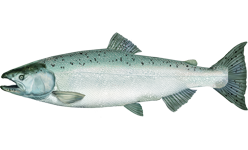 Chinook SalmonOncorhynchus tshawytscha
-
 Coho SalmonOncorhynchus kisutch
-
 Chum SalmonOncorhynchus keta
-
 Pink SalmonOncorhynchus gorbuscha
-
 Cutthroat TroutOncorhynchus clarkii
-
 Golden TroutOncorhynchus aguabonita
-
 Cherry SalmonOncorhynchus masou
Compare
Questions and answers
What is the scientific name of the Sockeye Salmon?
The scientific name of the Sockeye Salmon is Oncorhynchus nerka. Written with its author, the full name is Oncorhynchus nerka (Walbaum, 1792).
Which family does the Sockeye Salmon belong to?
Oncorhynchus nerka belongs to the family Salmonidae, in the order Salmoniformes and the class Teleostei.
Where is the Sockeye Salmon found?
Checklists and occurrence records place Oncorhynchus nerka in 3 countries: Canada, United States and Russia.
What is the conservation status of the Sockeye Salmon?
The IUCN Red List category recorded for Oncorhynchus nerka is Least Concern (LC).
What other names does the Sockeye Salmon have?
Oncorhynchus nerka is also known in English as Kokanee Salmon, Sockey Salmon, Blueback Salmon, Kokanee and Red Salmon.
What is the diet of sockeye salmon?
Sockeye Salmon primarily consume zooplankton during their ocean life. They also feed on small crustaceans and small fish. In freshwater, they consume insects and occasionally snails when living upstream; juveniles feed on zooplankton and small crustaceans.[16][18][19][17][20]
What type of habitat do salmon live in?
Sockeye Salmon inhabit freshwater lakes, streams, and estuaries during spawning and juvenile rearing. They are generally found at ocean depths of 15 to 33 metres. Spawning occurs in rivers, streams, and upwelling areas along lake beaches.[12][13][14]
Where does sockeye salmon live?
Sockeye Salmon occur along the western coast of North America from northern California to northern Alaska and in Asia between Hokkaido, Japan, and the Anadyr River in Siberia. Populations have also been introduced into some parts of Asia and Russia.[40][41][42]
Do sockeye salmon have teeth?
Breeding-age male Sockeye Salmon develop hooked jaws containing visible teeth.[4]
Sources
Passages the profile rests on
- Landlocked populations of sockeye salmon are commonly called kokanee. Source passage: “kokanee (landlocked form in lower 48 states and Canada)” — adfg.alaska.gov
- Sockeye salmon have iridescent silver flanks, a white belly, and a metallic green-blue upper surface while living in the ocean. Source passage: “Sea-going sockeye salmon have iridescent silver flanks, a white belly, and a metallic green-blue top” — adfg.alaska.gov
- During spawning migration, sockeye salmon develop brilliant red bodies and greenish heads. Source passage: “their bodies turn brilliant red and their heads take on a greenish color” — adfg.alaska.gov
- Breeding-age male sockeye salmon develop a humped back and hooked jaws containing visible teeth. Source passage: “Breeding-age males develop a humped back and hooked jaws filled with tiny, visible teeth.” — adfg.alaska.gov
- Juvenile sockeye salmon have dark, oval parr marks on their sides while living in freshwater. Source passage: “Juveniles, while in fresh water, have dark, oval parr marks on their sides.” — adfg.alaska.gov
- Sockeye salmon have 30 to 40 long, serrated gill rakers. Source passage: “their long, serrated gill rakers that range from 30 to 40 in number” — English Wikipedia
- Sockeye salmon lack spots on their tails and backs. Source passage: “their lack of a spot on their tail or back.” — English Wikipedia
- Sockeye salmon measure approximately 18 to 31 inches in length. Source passage: “measuring 18 to 31inches in length” — adfg.alaska.gov
- Sockeye salmon typically weigh between 4 and 15 pounds. Source passage: “weighing 4-15 pounds.” — adfg.alaska.gov
- The recorded maximum length of sockeye salmon is 31 inches. Source passage: “Length = 24 inches (Record: 31 inches)” — adfg.alaska.gov
- Landlocked sockeye salmon rarely exceed 14 inches in length. Source passage: “Landlocked sockeye salmon rarely grow to more than 14 inched in length” — adfg.alaska.gov
- Sockeye salmon inhabit freshwater lakes, streams, and estuaries during spawning and juvenile rearing. Source passage: “Fresh water lakes, streams and estuaries provide important habitat for spawning and rearing sockeye salmon.” — adfg.alaska.gov
- Sockeye salmon are generally found at ocean depths of 15 to 33 metres. Source passage: “They are generally found at depths of 15 to 33 m.” — animaldiversity.org
- Sockeye salmon spawning occurs in rivers, streams, and upwelling areas along lake beaches. Source passage: “Spawning itself usually occurs in rivers, streams, and upwelling areas along lake beaches.” — adfg.alaska.gov
- Sockeye salmon juveniles commonly rear in freshwater lakes before migrating to the ocean. Source passage: “the fry typically rear in lakes before migrating to the ocean.” — English Wikipedia
- Sockeye salmon primarily consume zooplankton during their ocean life. Source passage: “While in the ocean, sockeye salmon primarily consume zooplankton.” — animaldiversity.org
- Sockeye salmon also feed on small crustaceans and small fish. Source passage: “Diet Zooplankton,small crustaceans, small fish” — adfg.alaska.gov
- Sockeye salmon consume insects in freshwater environments. Source passage: “In freshwater environments, they are known to eat insects” — animaldiversity.org
- Sockeye salmon occasionally consume snails when living upstream. Source passage: “and, when upstream, occasionally snails.” — animaldiversity.org
- Juvenile sockeye salmon feed on zooplankton and small crustaceans in freshwater. Source passage: “juveniles usually spend one to three years in fresh water, feeding on zooplankton and small crustaceans” — adfg.alaska.gov
- Sockeye salmon stop feeding after entering freshwater for reproduction. Source passage: “Feeding ends once they enter into freshwater” — English Wikipedia
- Sockeye salmon migrate from freshwater to the ocean and return to freshwater to spawn. Source passage: “Like all species of Pacific salmon, sockeye salmon are anadromous, living in the ocean but entering fresh water to spawn.” — adfg.alaska.gov
- Sockeye salmon use their sense of smell to recognize their natal freshwater stream. Source passage: “Salmon use their sense of smell (“olfaction”) to recognize their home stream.” — adfg.alaska.gov
- Sockeye salmon migrate in social groups when returning to freshwater spawning streams. Source passage: “they swim in runs when migrating to freshwater streams to spawn.” — animaldiversity.org
- Sockeye salmon establish social hierarchies, particularly during reproduction. Source passage: “They also establish social hierarchies, usually at times of reproduction.” — animaldiversity.org
- The largest male sockeye salmon usually occupies the dominant position in the social hierarchy. Source passage: “Typically the largest male is most dominant.” — animaldiversity.org
- Sockeye salmon females deposit between 2,000 and 5,000 eggs in one or more gravel nests. Source passage: “2,000 – 5,000 eggs are deposited in one or more “redds”” — adfg.alaska.gov
- Female sockeye salmon excavate their spawning nests using their tails. Source passage: “which the female digs with her tail over several days time.” — adfg.alaska.gov
- Sockeye salmon eggs hatch during winter. Source passage: “Eggs hatch during the winter” — adfg.alaska.gov
- Sockeye salmon eggs remain in gravel nests for approximately 32 to 42 days after fertilization. Source passage: “After fertilization, eggs stay in the gravel nest for 32 to 42 days.” — animaldiversity.org
- Female sockeye salmon produce between 47 and 206 offspring. Source passage: “Females produce 47 to as many as 206 offspring.” — animaldiversity.org
- Sockeye salmon are semelparous and generally die after spawning. Source passage: “Sockeye salmon are semelparous, dying after they spawn.” — English Wikipedia
- Female sockeye salmon provide parental care by selecting, preparing, and defending their nest sites. Source passage: “They select, prepare, and defend a nest site until they die or are displaced.” — English Wikipedia
- Two lower-48 United States populations of sockeye salmon are listed under the Endangered Species Act. Source passage: “two lower-48 populations of sockeye salmon have been listed under the Endangered Species Act.” — adfg.alaska.gov
- Habitat loss and direct human-caused mortality have reduced sockeye salmon populations in the lower 48 United States. Source passage: “Human induced habitat loss and direct mortality has depressed populations in the lower 48 states.” — adfg.alaska.gov
- Sockeye salmon are commercially harvested for fresh or frozen fillets and canned products. Source passage: “for fresh or frozen fillet sales and canning.” — English Wikipedia
- Sockeye salmon are an important subsistence food resource in Alaska. Source passage: “Subsistence users harvest sockeye salmon in many areas of the state.” — adfg.alaska.gov
- Sockeye salmon are prized by sport anglers for their fighting ability and food quality. Source passage: “Sockeye are highly prized by sport anglers for their tenacious fighting ability as well as food quality.” — adfg.alaska.gov
- Sockeye salmon are the third most abundant species of Pacific salmon. Source passage: “3rd most abundant species of Pacific salmon.” — adfg.alaska.gov
- Sockeye salmon occur along the western coast of North America from northern California to northern Alaska. Source passage: “They can be located as far north as northern Alaska and as far south as northern California.” — animaldiversity.org
- Sockeye salmon occur in Asia between Hokkaido, Japan, and the Anadyr River in Siberia. Source passage: “Asia – Hokkaido, Japan to Anadyr River, Siberia” — adfg.alaska.gov
- Sockeye salmon populations have been introduced into some parts of Asia and Russia. Source passage: “Populations of this species have also been introduced in some areas of Asia and Russia.” — animaldiversity.org
Data
- Catalogue of Life, 2026-10-16 XR cc by
- Global Biodiversity Information Facility CC BY 4.0
- Wikidata CC0
- GeoNames CC BY 4.0
- Wikimedia Commons per image; credit shown with each image
- Within the Catalogue of Life, this name comes from World Register of Marine Species cc by
References
- Walbaum, J. J. 1792. Petri artedi Sueci genera piscium. in quibus systema totum ichthyologiae proponitur cum classibus, ordinibus, generum characteribus, specierum differentiis, observationibus plurimis. Redactis speciebus 242 ad genera 52. Ichthyologiae. A.F. Rose, Grypeswaldiae [= Greifswald]. No. Pars iii: 1-723, pls. 1-3. where the name was published
This species in other databases
- Catalogue of Life 49JFH
- Wikidata Q44064
- iNaturalist 69922
- WoRMS urn:lsid:marinespecies.org:taxname:254569
- ITIS 161979
Page built on 24 November 2026. See how the catalog is made and all sources and licences.
Cite this page
ScientificNames.org. (2026). Oncorhynchus nerka (Sockeye Salmon). Retrieved November 24, 2026, from https://scientificnames.org/species/oncorhynchus-nerka
“Oncorhynchus nerka (Sockeye Salmon).” ScientificNames.org, 2026, scientificnames.org/species/oncorhynchus-nerka. Accessed 24 Nov. 2026.
ScientificNames.org. “Oncorhynchus nerka (Sockeye Salmon).” Accessed November 24, 2026. https://scientificnames.org/species/oncorhynchus-nerka.
@misc{scientificnames_oncorhynchus_nerka_sockeye_salmon,
  author = {{ScientificNames.org}},
  title = {Oncorhynchus nerka (Sockeye Salmon)},
  year = {2026},
  url = {https://scientificnames.org/species/oncorhynchus-nerka},
  note = {Accessed 2026-11-24}
}