Comparison

Orchard Swallowtail vs Black Swallowtail

Orchard Swallowtail (Papilio aegeus) and Black Swallowtail (Papilio polyxenes) both belong to the genus Papilio (swallowtails) and part ways below it.
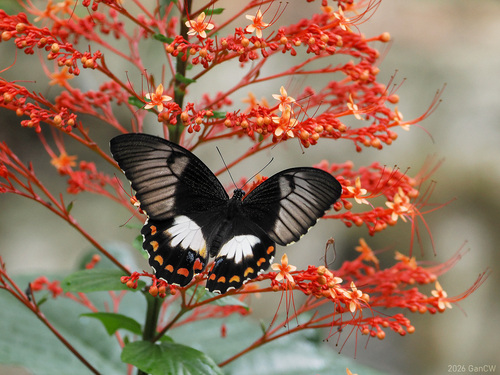
Orchard Swallowtail

Orchard Swallowtail

Papilio aegeus

(c) Cheongweei Gan, some rights reserved (CC BY), uploaded by Cheongweei Gan, CC BY 4.0, via iNaturalist

Black Swallowtail

Black Swallowtail

Papilio polyxenes

D. Gordon E. Robertson, CC BY-SA 3.0, via Wikimedia Commons

Side by side

Orchard SwallowtailBlack Swallowtail
Scientific namePapilio aegeus Donovan, 1805Papilio polyxenes Fabricius, 1775
English nameOrchard SwallowtailBlack Swallowtail
GroupInsectsInsects
ClassInsecta InsectInsecta Insect
OrderLepidopteraLepidoptera
FamilyPapilionidae Swallowtail ButterflyPapilionidae Swallowtail Butterfly
GenusPapilio SwallowtailsPapilio Swallowtails
Named in18051775
Red List categoryNot recordedLeast Concern
Countries on record6 countries12 countries
GBIF occurrence records15,454 records127,056 records

Rows where the two agree are shown in grey.

Where each is found

Only Orchard Swallowtail (6)

Only Black Swallowtail (12)

From Catalogue of Life checklists and GBIF occurrence records. A country missing from a list means no record is held, which is not proof of absence.

Checked facts

Orchard SwallowtailBlack Swallowtail
Appearance
  • Both sexes have black forewings marked with a white stripe, with females displaying more white. English Wikipedia
  • The hindwings are black with a white band across the middle. English Wikipedia
  • Female hindwings have marginal chains of red-to-orange and blue crescent markings. English Wikipedia
  • The underside of the wings has markings similar to those on the upper surface. English Wikipedia
  • Unlike many other swallowtails, this species lacks the distinctive tails on its hindwings. English Wikipedia
  • The pupa can be grey, green or brown, depending on the colour of the stem to which it is attached. English Wikipedia
  • Early larval instars are brown and have three white patches. English Wikipedia
  • Later larval instars are green with irregular white, yellow or brown diagonal markings. English Wikipedia
  • Adult butterflies have black upper wing surfaces marked with two rows of yellow spots. English Wikipedia
  • Females have a more prominent blue area between the rows of yellow spots than males. English Wikipedia
  • Females generally have smaller and lighter yellow wing spots than males. hort.extension.wisc.edu
  • Both sexes have a red eyespot with a black center near the inner hind margin of the hindwings. English Wikipedia
  • The underside of the forewings has two rows of pale yellow spots, while the hindwings have orange spots separated by blue areas. English Wikipedia
  • Both sexes possess a narrow tail-like lobe on the hindwings. hort.extension.wisc.edu
  • The chrysalis can be greenish with yellow markings or mottled brown. hort.extension.wisc.edu
Size
  • Female individuals have a wingspan of approximately 140 millimetres. English Wikipedia
  • Male individuals have a wingspan of approximately 120 millimetres. English Wikipedia
Habitat
  • The species is commonly encountered in Brisbane where citrus trees provide food for its larvae. English Wikipedia
  • The species inhabits open environments including fields, meadows, parks, wetlands, prairies, and sunny backyards. hort.extension.wisc.edu
  • The species occurs in open habitats including gardens, lowlands, marshes, and deserts. animaldiversity.org
  • The species prefers tropical or temperate habitats. English Wikipedia
Diet
  • The larvae feed on citrus leaves. English Wikipedia
  • Larvae naturally use plants belonging to the genera Boronia, Citrus, Clausena, Dinosperma, Eriostemon, Flindersia, Geijera, Halfordia, Leionema, Micromelum, Philotheca, Zanthoxylum and Zieria as food plants. English Wikipedia
  • Larvae have also been recorded feeding on introduced plants belonging to Choisya, Citrus, Murraya, Poncirus and Zanthoxylum. English Wikipedia
  • Caterpillars accept leaves of parsley and Cryptocarya glauscens. English Wikipedia
Behaviour
  • Larvae generally feed during daylight hours and rest on the upper surfaces of leaves at night. English Wikipedia
  • Resting larvae resemble fresh bird droppings. English Wikipedia
  • When disturbed, caterpillars extend a bright red osmeterium from behind the head to deter predators. English Wikipedia
  • The caterpillar's osmeterium releases a citrus-like smell when extended. English Wikipedia
  • Male butterflies defend territories used for locating mates and conducting courtship. English Wikipedia
  • Male butterflies aggressively chase other males that approach their territories. English Wikipedia
  • Male butterflies alternate between perching on hilltops and patrolling flat areas while searching for females. animaldiversity.org
  • Adults spend approximately 67% of their day perching and 25% patrolling. animaldiversity.org
  • The species regulates its thoracic temperature through changes in abdomen position, wing position, sun orientation, and perching behavior. English Wikipedia
Reproduction
  • Females lay creamy white, smooth, spherical eggs individually on the upper surfaces of host-plant leaves and shoots. English Wikipedia
  • The eggs have an approximate diameter of 0.5 millimetres. English Wikipedia
  • Eggs generally hatch approximately one week after being laid. English Wikipedia
  • The primary host plants used for egg laying belong to the Rutaceae family and include native and introduced citrus plants. English Wikipedia
  • After approximately four weeks, larvae may reach 60 millimetres in length and become ready to pupate. English Wikipedia
  • The pupa attaches to a host-plant stem using a cremaster. English Wikipedia
  • A thin silk girdle keeps the head end of the chrysalis uppermost during pupation. English Wikipedia
  • Adult butterflies emerge from the chrysalis approximately one to six months later, depending on the season. English Wikipedia
Distribution
Conservation
  • The larvae are sometimes regarded as pests because they feed on citrus leaves in suburban gardens. English Wikipedia
UsesNo checked fact yet
Other
  • Males of the subspecies Papilio aegeus aegeus have a red spot on the upper side of each hindwing, which is absent in males of Papilio aegeus ormenus. English Wikipedia
No checked fact yet

In brief

Orchard Swallowtail

The species occurs in eastern Australia and Papua New Guinea. Full profile

Black Swallowtail

Papilio polyxenes occurs from southern Canada through North America to South America and in the West Indies. Adult butterflies have black upper wing surfaces marked with two rows of yellow spots and a red eyespot with a black center near the inner hind margin of each hindwing. Full profile

Compare something else

Page built on 28 November 2026 from the data on the two species pages, where every source is listed.

Cite this page

ScientificNames.org. (2026). Orchard Swallowtail vs Black Swallowtail. Retrieved November 28, 2026, from https://scientificnames.org/compare/orchard-swallowtail-vs-black-swallowtail