Species · Insects
Orchard Swallowtail Papilio aegeus
The scientific name of the Orchard Swallowtail is Papilio aegeus. It is a species of insect in the family Papilionidae (swallowtail butterfly), order Lepidoptera. The name dates from 1805.
- Scientific name
- Papilio aegeus Donovan, 1805
- Common name
- Orchard Swallowtail
- Genus
- Papilio
- Family
- Papilionidae (Swallowtail Butterfly)
- Order
- Lepidoptera
- Class
- Insecta
- Recorded in
- 6 countries
- Name status
- accepted in the Catalogue of Life
Overview
The species occurs in eastern Australia and Papua New Guinea.
Written 26 November 2026 from the sources listed below. Each statement was checked against the passage it cites; statements that could not be supported were removed.
Appearance
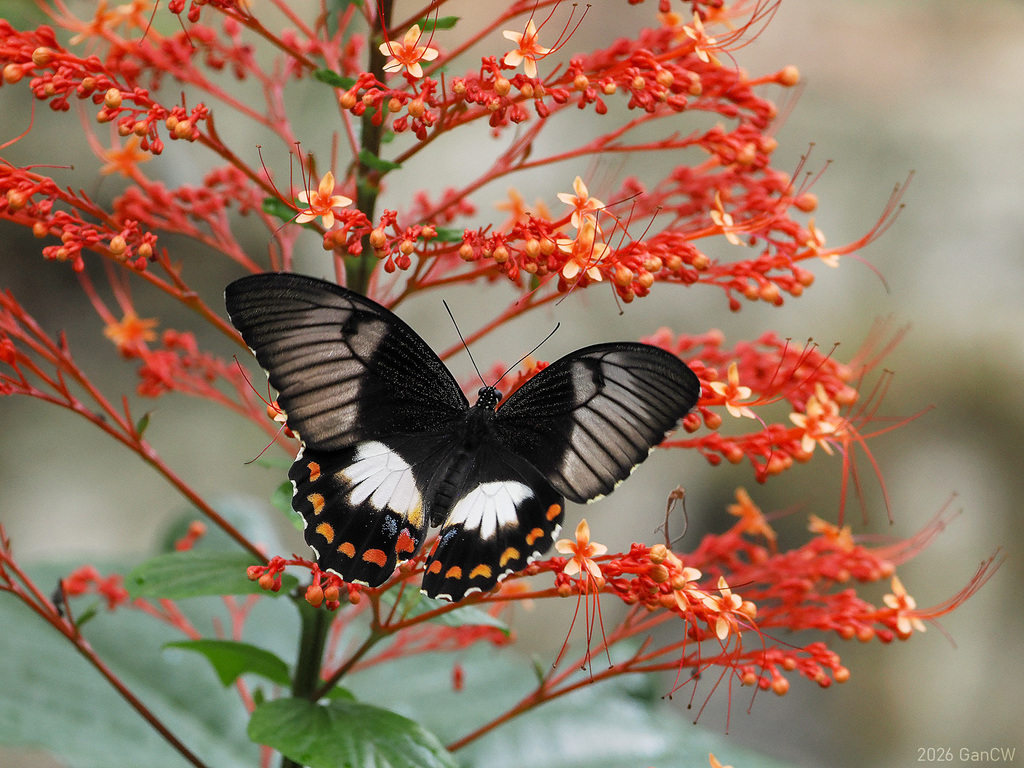
Both sexes have black forewings marked with a white stripe, with females displaying more white. The hindwings are black with a white band across the middle.[1][2]
Female hindwings have marginal chains of red-to-orange and blue crescent markings. The underside of the wings has markings similar to those on the upper surface.[3][4]
Unlike many other swallowtails, the Orchard Swallowtail lacks the distinctive tails on its hindwings.[5]
Female individuals have a wingspan of approximately 140 millimetres, while male individuals have a wingspan of approximately 120 millimetres.[6][7]
Early larval instars are brown and have three white patches. Later larval instars are green with irregular white, yellow or brown diagonal markings.[8][9]
The pupa can be grey, green or brown, depending on the colour of the stem to which it is attached.[10]
Males of the subspecies Papilio aegeus aegeus have a red spot on the upper side of each hindwing, which is absent in males of Papilio aegeus ormenus.[11]
Habitat
The species is commonly encountered in Brisbane, where citrus trees provide food for its larvae.[12]
Diet
The larvae feed on citrus leaves. Their natural food plants belong to the genera Boronia, Citrus, Clausena, Dinosperma, Eriostemon, Flindersia, Geijera, Halfordia, Leionema, Micromelum, Philotheca, Zanthoxylum and Zieria.[13][14]
Larvae have also been recorded feeding on introduced plants belonging to Choisya, Citrus, Murraya, Poncirus and Zanthoxylum. Caterpillars accept leaves of parsley and Cryptocarya glauscens.[15][16]
Behaviour
Larvae generally feed during daylight hours and rest on the upper surfaces of leaves at night. Resting larvae resemble fresh bird droppings.[17][18]
When disturbed, caterpillars extend a bright red osmeterium from behind the head to deter predators. The extended osmeterium releases a citrus-like smell.[19][20]
Reproduction and life cycle
Females lay creamy white, smooth, spherical eggs individually on the upper surfaces of host-plant leaves and shoots. The eggs have an approximate diameter of 0.5 millimetres and generally hatch approximately one week after being laid.[21][22][23]
The primary host plants used for egg laying belong to the Rutaceae family and include native and introduced citrus plants.[24]
After approximately four weeks, larvae may reach 60 millimetres in length and become ready to pupate.[25]
The pupa attaches to a host-plant stem using a cremaster. A thin silk girdle keeps the head end of the chrysalis uppermost during pupation.[26][27]
Adult butterflies emerge from the chrysalis approximately one to six months later, depending on the season.[28]
Conservation
The larvae are sometimes regarded as pests because they feed on citrus leaves in suburban gardens.[29]
Classification of the Orchard Swallowtail
| Kingdom | Animalia |
|---|---|
| Phylum | Arthropoda |
| Subphylum | Hexapoda |
| Class | Insecta (Insect) |
| Order | Lepidoptera |
| Superfamily | Papilionoidea |
| Family | Papilionidae (Swallowtail Butterfly) |
| Genus | Papilio (Swallowtails) |
| Species | Papilio aegeus Donovan, 1805 |
Where the Orchard Swallowtail is found
Checklists and occurrence records place Papilio aegeus in 6 countries. GBIF holds 15,454 georeferenced records of it.
Countries
Regions and cities with the most records
- Queensland, Australia 7,521
- New South Wales, Australia 4,463
- Brisbane, Australia 1,819
- Logan City, Australia 997
- Sydney, Australia 941
- Capalaba, Australia 936
- Parramatta, Australia 721
- Papua, Indonesia 708
- Canberra, Australia 658
- Australian Capital Territory, Australia 648
- Hornsby, Australia 608
- Tuggeranong, Australia 472
- Narangba, Australia 464
- Sunshine Coast, Australia 301
- Toowoomba, Australia 275
- Liverpool, Australia 265
- Victoria, Australia 264
- Gold Coast, Australia 244
- Cairns, Australia 240
- Maluku, Indonesia 238
- Townsville, Australia 185
- Caloundra, Australia 183
- Wollongong, Australia 166
- Western Australia, Australia 165
- Bundaberg, Australia 158
- Abepura, Indonesia 142
- Central Coast, Australia 130
- Sentani, Indonesia 126
- Coffs Harbour, Australia 125
- Tual, Indonesia 124
- Jayapura, Indonesia 109
- Newcastle, Australia 104
- Albany, Australia 88
- Armidale, Australia 85
- Morobe Province, Papua New Guinea 73
- Hervey Bay, Australia 69
A number beside a place is its count of GBIF occurrence records. A place without a number comes from a checklist alone. Records show where a species has been observed or collected, which can include escapes and vagrants.
Common names
English
- Orchard Swallowtail
- Large Citrus Butterfly
- Orchard Butterfly
- Orchard Swallowtail Butterfly
Names in 5 other languages
- Chinese
- 果園鳳蝶
- French
- Voilier des vergers
- Japanese
- メスアカモンキアゲハ
- Russian
- Парусник эгей
- Spanish
- Papilio de los Vergeles
Synonyms
6 other scientific names have been used for this species and are now treated as synonyms of Papilio aegeus.
- Papilio aegeus aegates Fruhstorfer, 1903
- Papilio aegeus bismarckianus Rothschild, 1895
- Papilio aegeus keianus Rothschild, 1896
- Papilio aegeus oritinus Fruhstorfer, 1903
- Papilio aegeus ormenulus Fruhstorfer, 1902
- Papilio othello f. obscurata Joicey & Noakes, 1915
Related species
-
 Old World SwallowtailPapilio machaon
- Eastern Tiger SwallowtailPapilio glaucus
-
 Black SwallowtailPapilio polyxenes
- Common MormonPapilio polytes
-
 Eastern Giant SwallowtailPapilio cresphontes
-
 Lime ButterflyPapilio demoleus
-
 Spicebush SwallowtailPapilio troilus
-
 Ulysses ButterflyPapilio ulysses
Compare
Questions and answers
What is the scientific name of the Orchard Swallowtail?
The scientific name of the Orchard Swallowtail is Papilio aegeus. Written with its author, the full name is Papilio aegeus Donovan, 1805.
Which family does the Orchard Swallowtail belong to?
Papilio aegeus belongs to the family Papilionidae, in the order Lepidoptera and the class Insecta.
Where is the Orchard Swallowtail found?
Checklists and occurrence records place Papilio aegeus in 6 countries: Australia, Indonesia, Papua New Guinea, Solomon Islands, India and Malaysia.
What other names does the Orchard Swallowtail have?
Papilio aegeus is also known in English as Large Citrus Butterfly, Orchard Butterfly and Orchard Swallowtail Butterfly.
How can you tell the difference between a male and female orchard swallowtail butterfly?
Females display more white on their forewings and have marginal chains of red-to-orange and blue crescent markings on their hindwings. Female individuals have a wingspan of approximately 140 millimetres, compared with approximately 120 millimetres in males.[1][3][6][7]
Sources
Passages the profile rests on
- Both sexes have black forewings marked with a white stripe, with females displaying more white. Source passage: “Both male and female have black forewings with a white stripe, though there is more white overall on the female forewing.” — English Wikipedia
- The hindwings are black with a white band across the middle. Source passage: “The hindwing is again black, and there is a white swath through the middle.” — English Wikipedia
- Female hindwings have marginal chains of red-to-orange and blue crescent markings. Source passage: “the female has chains of red to orange and blue crescents toward the edge.” — English Wikipedia
- The underside of the wings has markings similar to those on the upper surface. Source passage: “The markings on the underside are similar to those on top.” — English Wikipedia
- Unlike many other swallowtails, this species lacks the distinctive tails on its hindwings. Source passage: “this characteristic is entirely absent.” — English Wikipedia
- Female individuals have a wingspan of approximately 140 millimetres. Source passage: “The wingspan is about 140 millimetres (5.5 in) in females” — English Wikipedia
- Male individuals have a wingspan of approximately 120 millimetres. Source passage: “and 120 millimetres (4.7 in) in males” — English Wikipedia
- Early larval instars are brown and have three white patches. Source passage: “The early instars are brown with three white patches” — English Wikipedia
- Later larval instars are green with irregular white, yellow or brown diagonal markings. Source passage: “The later instars are green with irregular white, yellow or brown markings that run diagonally” — English Wikipedia
- The pupa can be grey, green or brown, depending on the colour of the stem to which it is attached. Source passage: “The pupa is coloured in cryptic grey, green or brown, depending on the colour of the stem it is attached to.” — English Wikipedia
- Males of the subspecies Papilio aegeus aegeus have a red spot on the upper side of each hindwing, which is absent in males of Papilio aegeus ormenus. Source passage: “P. a. aegeus males have a red spot on the above side of each hindwing, which is absent in the males of P. a. ormenus.” — English Wikipedia
- The species is commonly encountered in Brisbane where citrus trees provide food for its larvae. Source passage: “the largest butterfly commonly found in Brisbane where there are many citrus trees, on which the larvae feed.” — English Wikipedia
- The larvae feed on citrus leaves. Source passage: “their feeding on citrus leaves in suburban gardens.” — English Wikipedia
- Larvae naturally use plants belonging to the genera Boronia, Citrus, Clausena, Dinosperma, Eriostemon, Flindersia, Geijera, Halfordia, Leionema, Micromelum, Philotheca, Zanthoxylum and Zieria as food plants. Source passage: “Boronia, Citrus, Clausena, Dinosperma, Eriostemon, Flindersia, Geijera, Halfordia, Leionema, Micromelum, Philotheca, Zanthoxylum and Zieria” — English Wikipedia
- Larvae have also been recorded feeding on introduced plants belonging to Choisya, Citrus, Murraya, Poncirus and Zanthoxylum. Source passage: “Choisya, Citrus, Murraya, Poncirus and Zanthoxylum” — English Wikipedia
- Caterpillars accept leaves of parsley and Cryptocarya glauscens. Source passage: “Caterpillars also accept leaves from Parsley and Cryptocarya glauscens” — English Wikipedia
- Larvae generally feed during daylight hours and rest on the upper surfaces of leaves at night. Source passage: “Feeding usually takes place during the day and resting on the upperside of leaves during the night” — English Wikipedia
- Resting larvae resemble fresh bird droppings. Source passage: “resembling fresh bird droppings.” — English Wikipedia
- When disturbed, caterpillars extend a bright red osmeterium from behind the head to deter predators. Source passage: “when disturbed, the caterpillar erects its bright red osmeterium from behind the head” — English Wikipedia
- The caterpillar's osmeterium releases a citrus-like smell when extended. Source passage: “releasing the smell of citrus, to drive predators away.” — English Wikipedia
- Females lay creamy white, smooth, spherical eggs individually on the upper surfaces of host-plant leaves and shoots. Source passage: “The female lays creamy white, smooth, spherical eggs with an approximate diameter of 0.5 millimetres individually on the upper surface of the leaves and shoots of host plants” — English Wikipedia
- The eggs have an approximate diameter of 0.5 millimetres. Source passage: “with an approximate diameter of 0.5 millimetres” — English Wikipedia
- Eggs generally hatch approximately one week after being laid. Source passage: “The eggs will hatch about one week later.” — English Wikipedia
- The primary host plants used for egg laying belong to the Rutaceae family and include native and introduced citrus plants. Source passage: “primarily tropical to subtropical members of the family Rutaceae, which includes introduced and native citrus.” — English Wikipedia
- After approximately four weeks, larvae may reach 60 millimetres in length and become ready to pupate. Source passage: “After about four weeks, the larva may have reached a length of 60 millimetres (2.4 in) and be ready to pupate.” — English Wikipedia
- The pupa attaches to a host-plant stem using a cremaster. Source passage: “The chrysalis is fastened to a stem of the host plant by means of a cremaster.” — English Wikipedia
- A thin silk girdle keeps the head end of the chrysalis uppermost during pupation. Source passage: “A thin girdle of silk keeps the head end of the chrysalis uppermost during pupation.” — English Wikipedia
- Adult butterflies emerge from the chrysalis approximately one to six months later, depending on the season. Source passage: “Depending on the season, an imago will emerge from the chrysalis, approximately one to six months later.” — English Wikipedia
- The larvae are sometimes regarded as pests because they feed on citrus leaves in suburban gardens. Source passage: “The larvae of this species are sometimes considered a pest, due to their feeding on citrus leaves in suburban gardens.” — English Wikipedia
Data
- Catalogue of Life, 2026-10-16 XR cc by
- Global Biodiversity Information Facility CC BY 4.0
- Wikidata CC0
- GeoNames CC BY 4.0
- iNaturalist per image; credit shown with each image
- Within the Catalogue of Life, this name comes from Global Butterfly Information System cc by
This species in other databases
Page built on 26 November 2026. See how the catalog is made and all sources and licences.
Cite this page
ScientificNames.org. (2026). Papilio aegeus (Orchard Swallowtail). Retrieved November 26, 2026, from https://scientificnames.org/species/papilio-aegeus
“Papilio aegeus (Orchard Swallowtail).” ScientificNames.org, 2026, scientificnames.org/species/papilio-aegeus. Accessed 26 Nov. 2026.
ScientificNames.org. “Papilio aegeus (Orchard Swallowtail).” Accessed November 26, 2026. https://scientificnames.org/species/papilio-aegeus.
@misc{scientificnames_papilio_aegeus_orchard_swallowtail,
  author = {{ScientificNames.org}},
  title = {Papilio aegeus (Orchard Swallowtail)},
  year = {2026},
  url = {https://scientificnames.org/species/papilio-aegeus},
  note = {Accessed 2026-11-26}
}